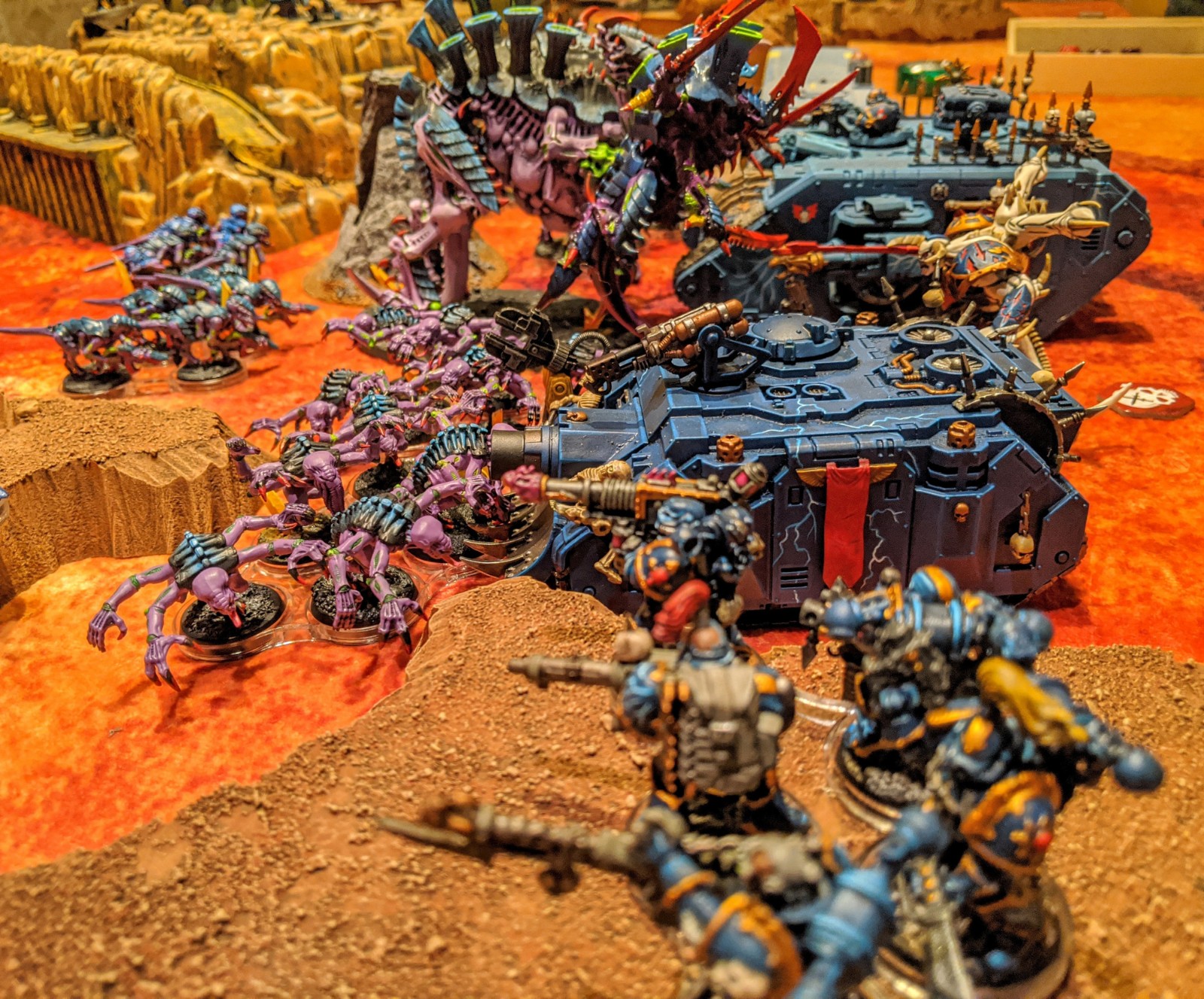
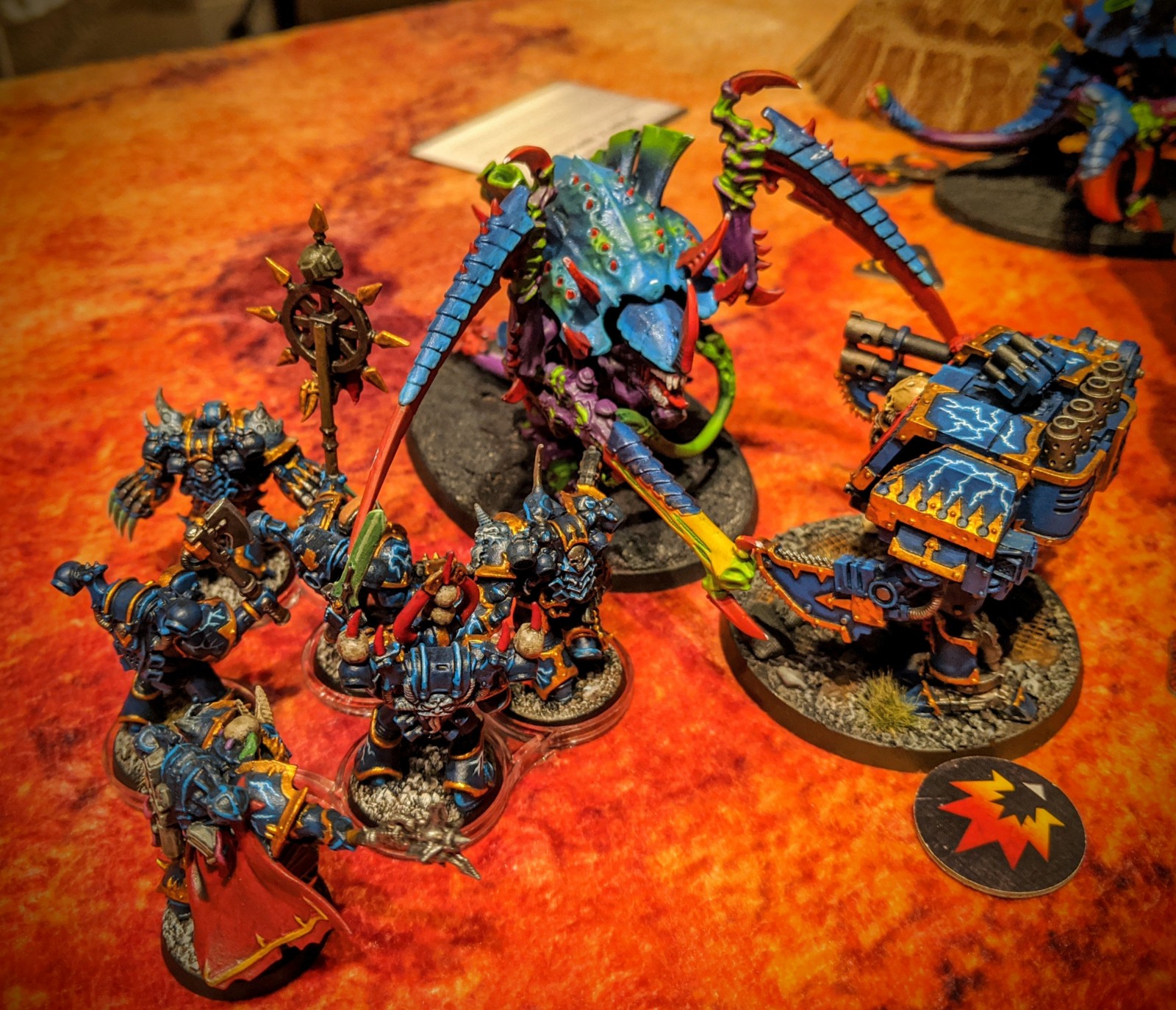
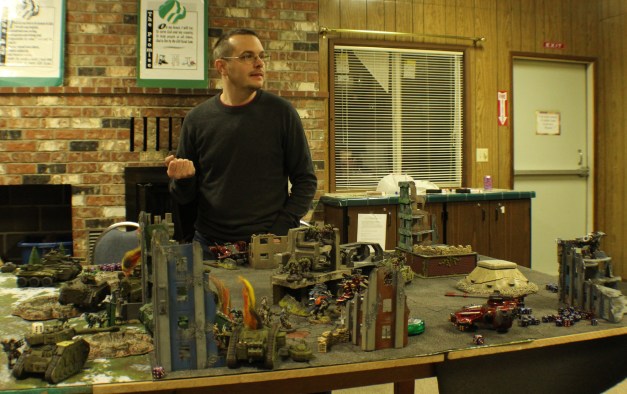
Paul and I got together earlier this month for a trial game of Warhammer 40,000: Apocalypse. We had been interested in trying out this ruleset ahead of our actual Apocalypse game that is coming up this month. In previous years, we’d just played using the regular 40k rules. The new Apocalypse rules have gotten quite a bit of good buzz, and Paul had dipped a toe in with a learning game of his own earlier this year.
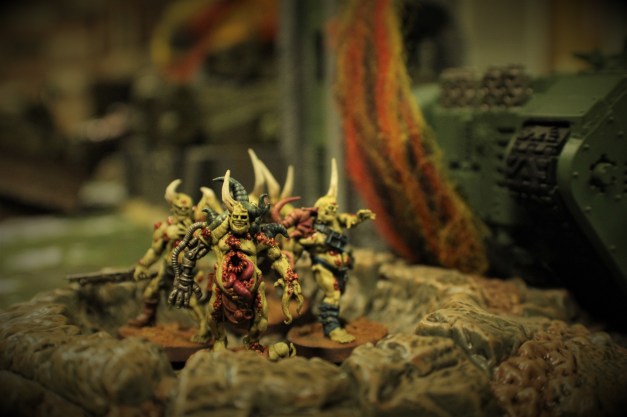
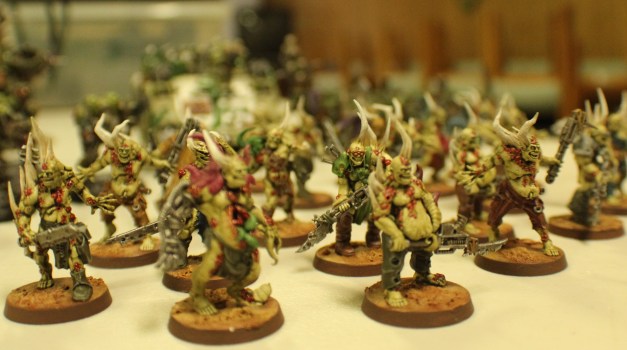
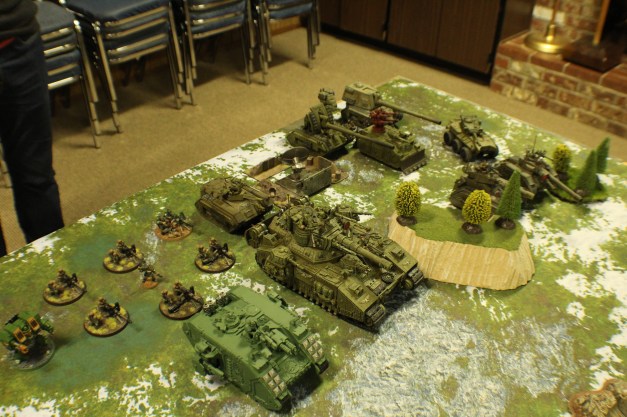
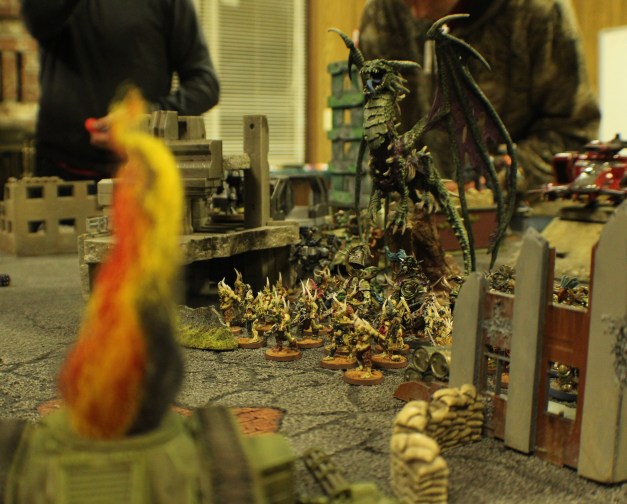
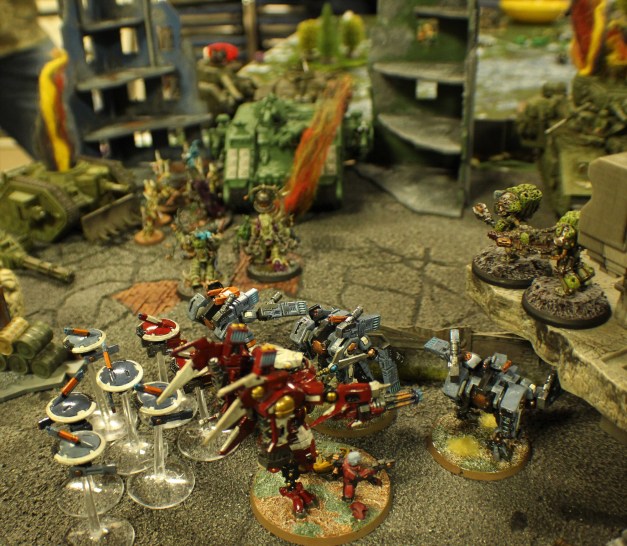
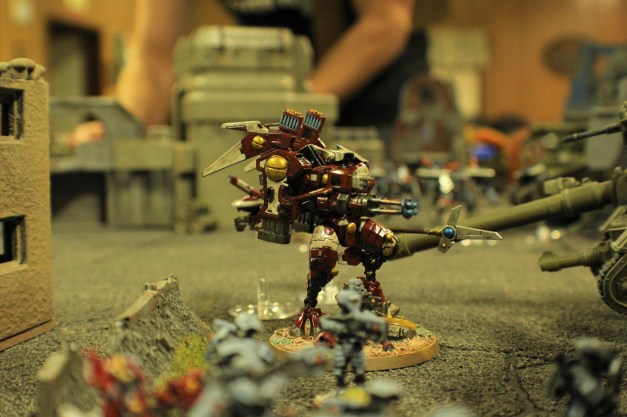
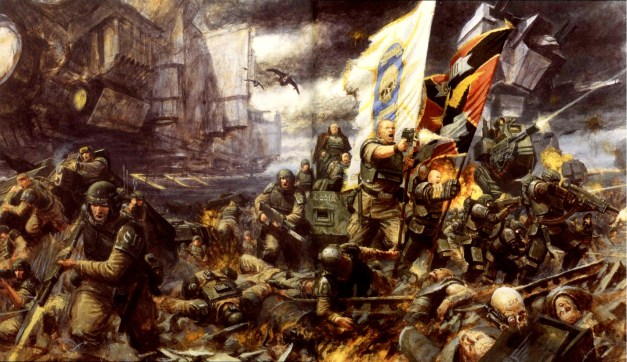
The game was 60 Power Level per side — tiny for Apocalypse, but we kept it intentionally small so we could work through the rules. Paul ran his Tyranids and I captained my Night Lords in a savage clash on one of the moons of Cantho in the Erigaea Sub-Sector. Read on for a bit of lore from Paul that accurately encapsulated our battle.
The Last Thoughts of Zad Gryznic
We had nothing, but they came. Searching for the Emperor knows what. Redlands is a mining town, built of scraps and digging deeper. The mountains of earth and metal and forever-poly cover the planet. . . some sort of waste dumping ground for people or xenos during the Long Night. Or something like that. Who the fork knows. What I do know is that the lifters come every week and we load them with scrap we dig out of the mountains. Gotta be something worth the promethium.
Gotta be something else that brought the Night Lords.
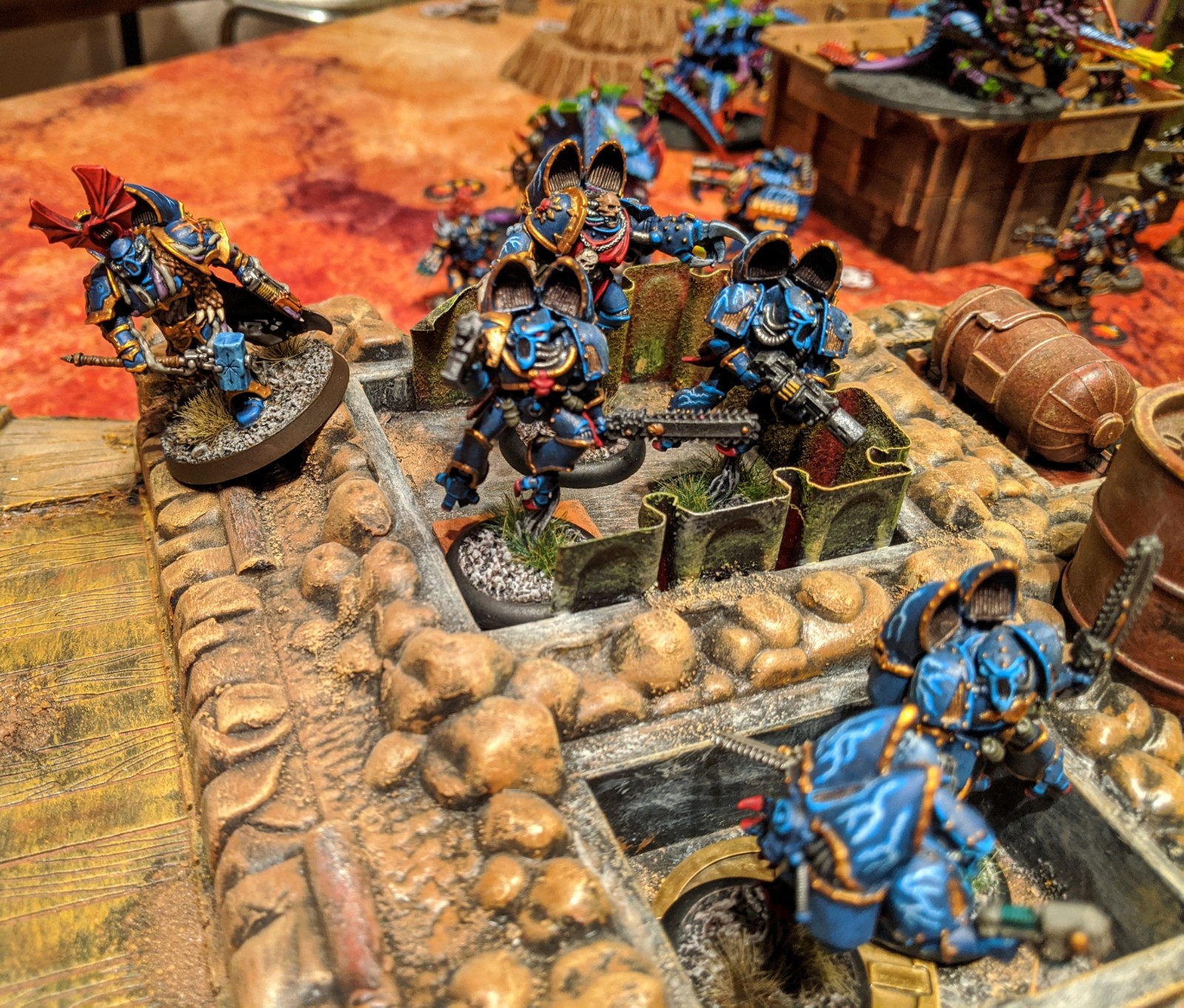
They rounded up the townsfolk and flayed them all, one by one. I buried myself so I didn’t have to hear the screams. Didn’t work. I tell myself that they asked questions before flensing my friends alive. But deep down, I think the Lords did it for fun. Or whatever passes for fun for bastards like that. And when they were done, they loosed their machines on the scrap outbound for the next Lifter. Yeah, they were looking for something. I just gotta make it to tonight, I thought. They’ll find what they’re looking for and leave. It’ll get better.
It got worse.
Freaking Tyranid bioforms blot out the greasy sun and turn the sky mud brown and then green. Soon pods are landing and birthing these monsters and the Night Lords are firing in the air even as their slaves keep digging. One Lord is whipping his slave with his left hand while firing his weapon at a descending pod.
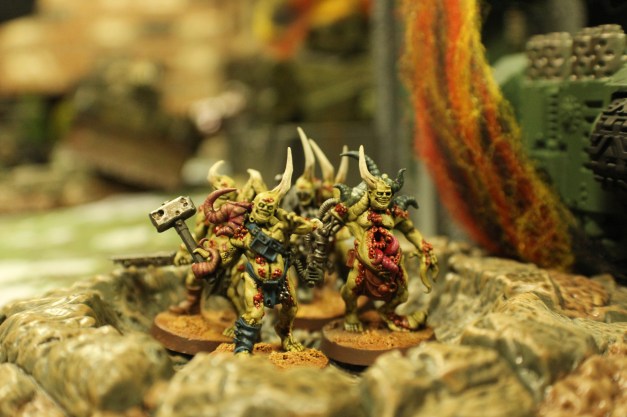
There’s so much noise, and I can taste poison on the air. It’s coming from the Tyranids. They’ve established a beachhead. A giant mother bug whose belly continuously shreds and bleeds as eggs and terrors rip their way out. She roars and staggers forward, leaving a trail of slime and chitin behind. Soon her children cover the town and are racing towards the Night Lords, frantically whipping their slaves.
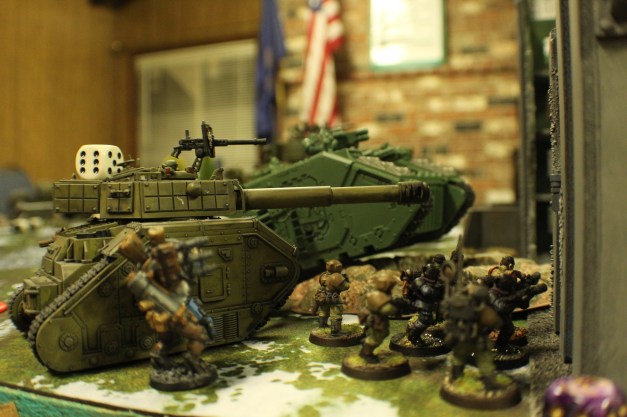
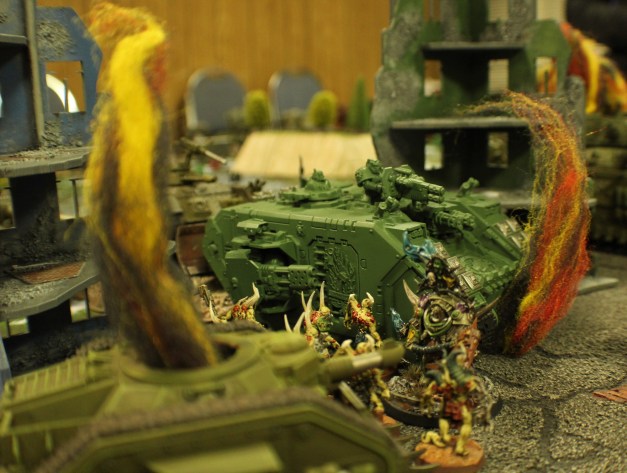
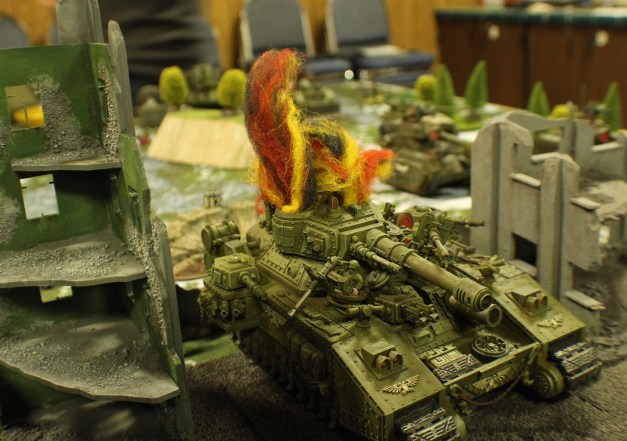
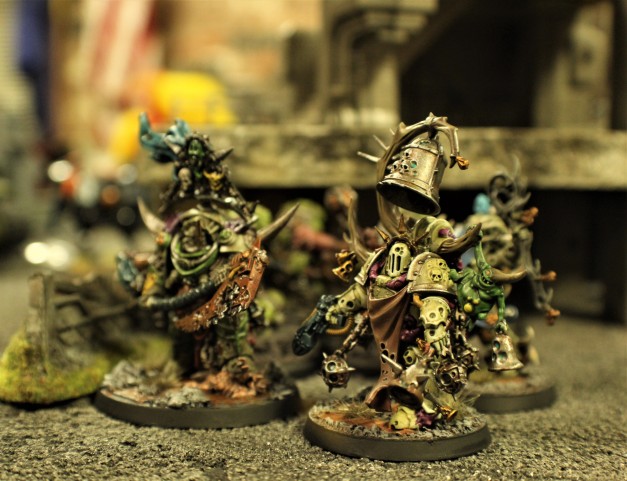
But the Lords have their own monsters. A Prince of Night. I can’t look at him without images of Chaos addling my brain. But he has his minions about him too, and the horrors walking as machines. And the tanks adorned with human flesh and skulls. The smoke pouring from its smokestacks is the color of dried blood. Bolters crack and some of the Lords launch themselves into the air, their weapons blazing.

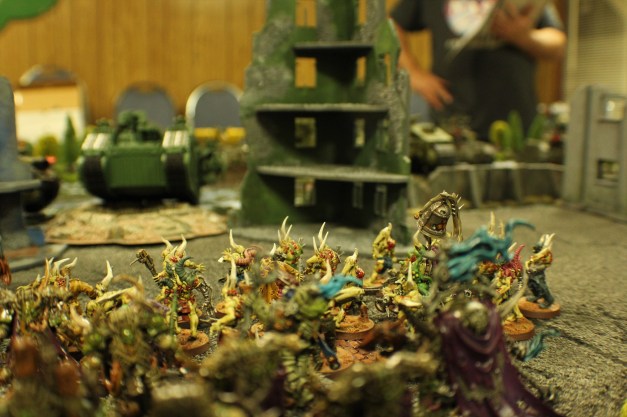
And then the Tyranids charge. So fast. So forking fast. You think you have time to breathe, to look at how the Lords will respond, but the bugs have covered the field in a blink. The ancient cracked behemoth is leading a herd of elephantine tanks with teeth. And they leap onto building, bringing them down on top of Night Lords. No, one of the Lords, another Captain is battling the One Eyed. A Sorcerer is chanting a ritual. I cannot bear to listen. . . the horns of the Carnifex trumpet their rage. I can taste blood and poison — the poison in the air has made my eyes bleed. Bloody tears in my mouth. It’s nearly over. The Carnifex have destroyed the Lords near the tower, and only the Sorcerer remains. He’s looking at the other half of the battlefield.
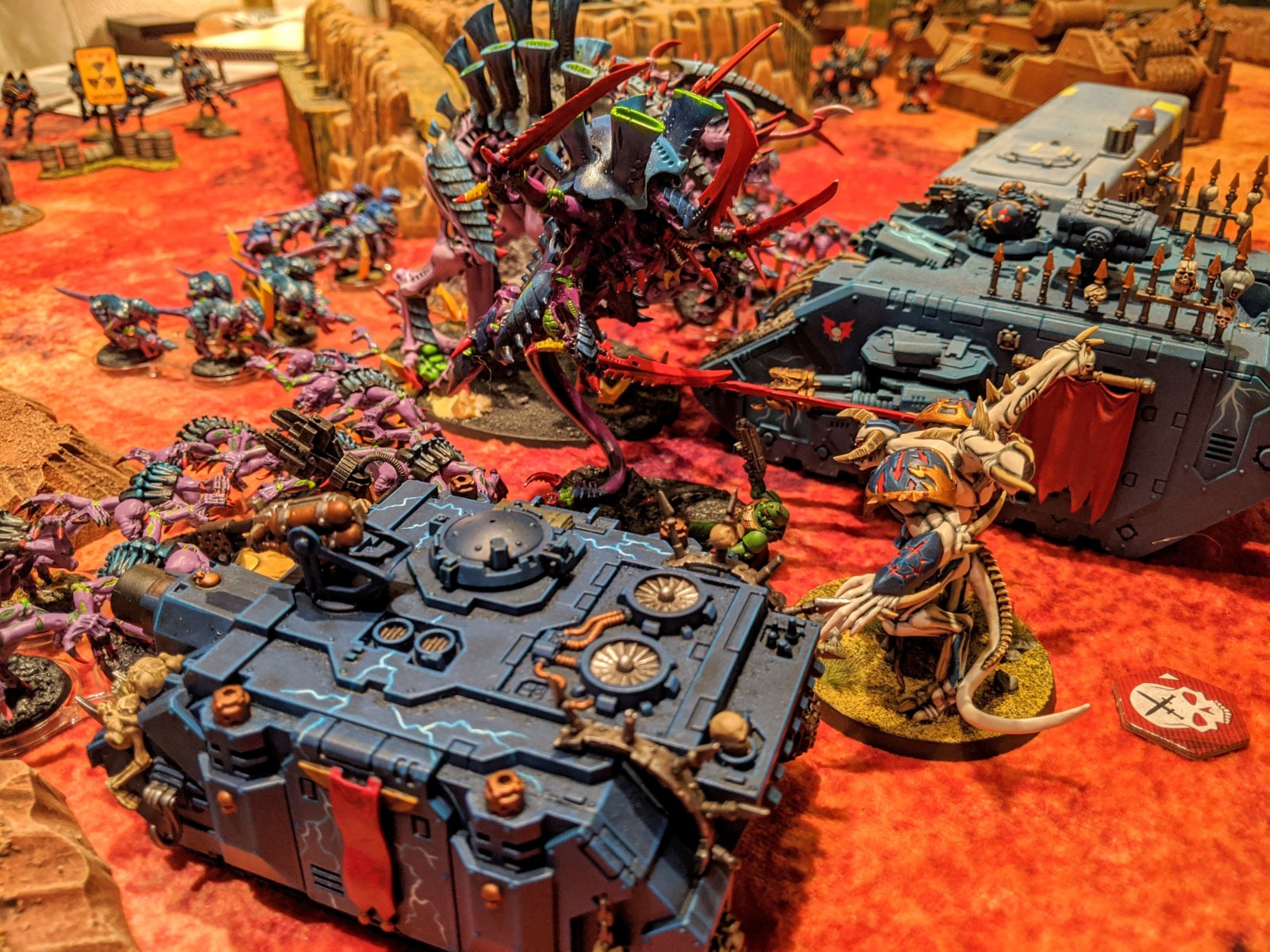
A raging shriek of torn metal and dying Tyranids fills every sense. A whirlwind of bone swords is hacking into a Tank, while demons and Captains bring down the Mother. Raptors fly through air green with poison, raining their bolters down on a battlefield meters deep in blood and chitin. Body parts and metal fly into the air, catching fire or melting with acid, only to rain down on the battlefield before flying up again.
It’s too much for the Night Lords, but they do not seem displeased. I see a slave raise something from the trashheap he’s working. He goes down, cut in twain, but his Lord holds it in his fist, even as his brethren fall about him. The metal airships are coming for the remaining Night Lords, winged steel eagles trailing catch ropes knotted with femurs and feet. The Night Lords evacuate. They have paid an enormous price for a piece of metal lain buried for 20 millennia. I curse them and wish the Tyranids good aim as they pour bio fire into the retreating aircraft.

I have no time to smile. More pods of Tyranids are raining down, the earth shaking. The scrap heap in which I’m hiding shifts and my legs are pinned under metal. I can’t reach my weapon. I need to end my life quickly and painlessly. But it’s out of reach. A monster hears my frantic breathing. He’s coming. My eyes give up their integrity to the poison in the air and I can feel the warmth of them pour down my face. Trapped and blind I wait. Now? Now? Now?
Well there you have it! The Night Lords were driven off, but not before they took plenty of Tyranid trophies, plus a relic of unspeakable power that will probably turn up in our grand finale next weekend.
Warhammer 40,000: Apocalypse was a surprisingly satisfying game. I had expected more complexity layered on top of something close to the existing 40k ruleset, but what I found instead was a well written “mass battle” game that sacrified granularity in the name of fast gameplay and big units. The game gives a decent sense of strategic command and control; you really feel like you’re in command of a battalion or company sized detachment. Details such as wargear and individual models’ equipment was abstracted to the point where most infantry squads had rather generic combat stats — melee attacks for Raptors, and a few ranged options for battle tanks. Infantry units are mounted on movement trays for easy movement (and removal, as they typically die like ants). I found this refreshing, as it meant I didn’t have to track the performance of individual models.
Instead, we could focus on the overall ebb and flow of the game. Where did I need to commit my reserves? Could I hold the flank and counter-charge with the survivors? (The answer to this last question was a resounding NO, as Paul’s Tyranids used their fearsome speed to overwhelm the Night Lords before they could strike a decisive blow.)
The game’s command card system adds another layer of strategy, too. I have grown wary wargames that try to add a deckbuilding component, as I find the mashup aesthetically uncomfortable most of the time. It works in Apocalypse, though, because they’re not core to the game’s mechanics. You can play an entire game of Apocalypse without using a single card, and not suffer too badly as a result. The cards add a fun strategic element, but they’re not essential, which is a nice touch.
We use Power Level for our games of 40k, and we used it for this Apocalypse game, too. I found the Power Levels of our armies to be roughly approximate in both 40k and Apocalypse — that is, 60 Power Level bought roughly the same units, in the same quantities, in Warhammer 40k as it did in Apocalypse. The difference was that Apocalypse speeds up gameplay to the point where a 60 Power Level game barely took us 2 hours to play out. Again, that’s a feature, not a bug.
By the end of the game (which Paul generously described as a tactical retreat by the Night Lords in the face of an overwhelming Tyranid assault), I could easily see how we could accomplish a large game (200+ Power Level per side) without much hassle. Tune in later this month to see how it all turns out in our annual Apoc-Luck game! We’ll have food, a day of gaming, plus our club’s first-ever Secret Santa gift exchange!

 If you’ve not caught up on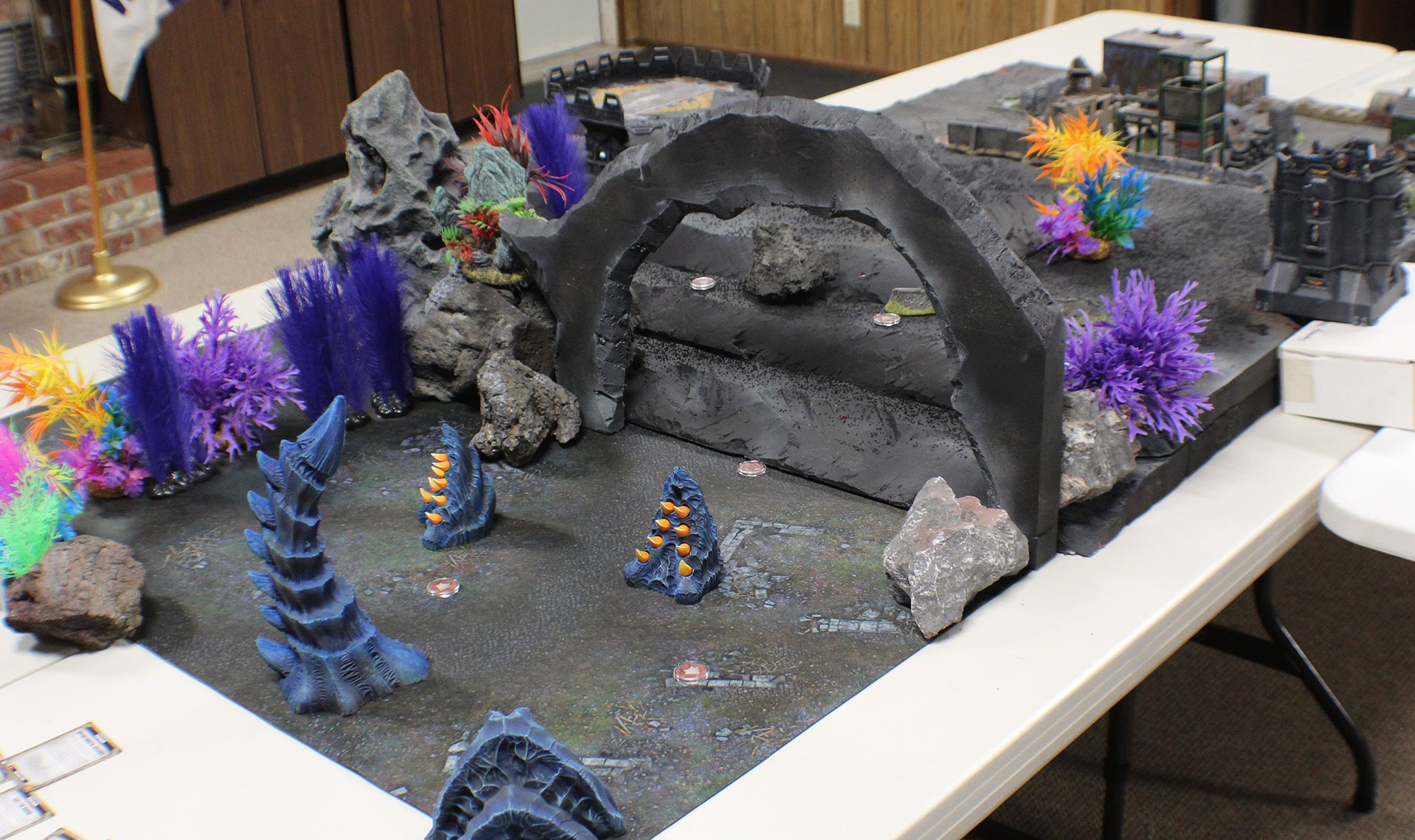

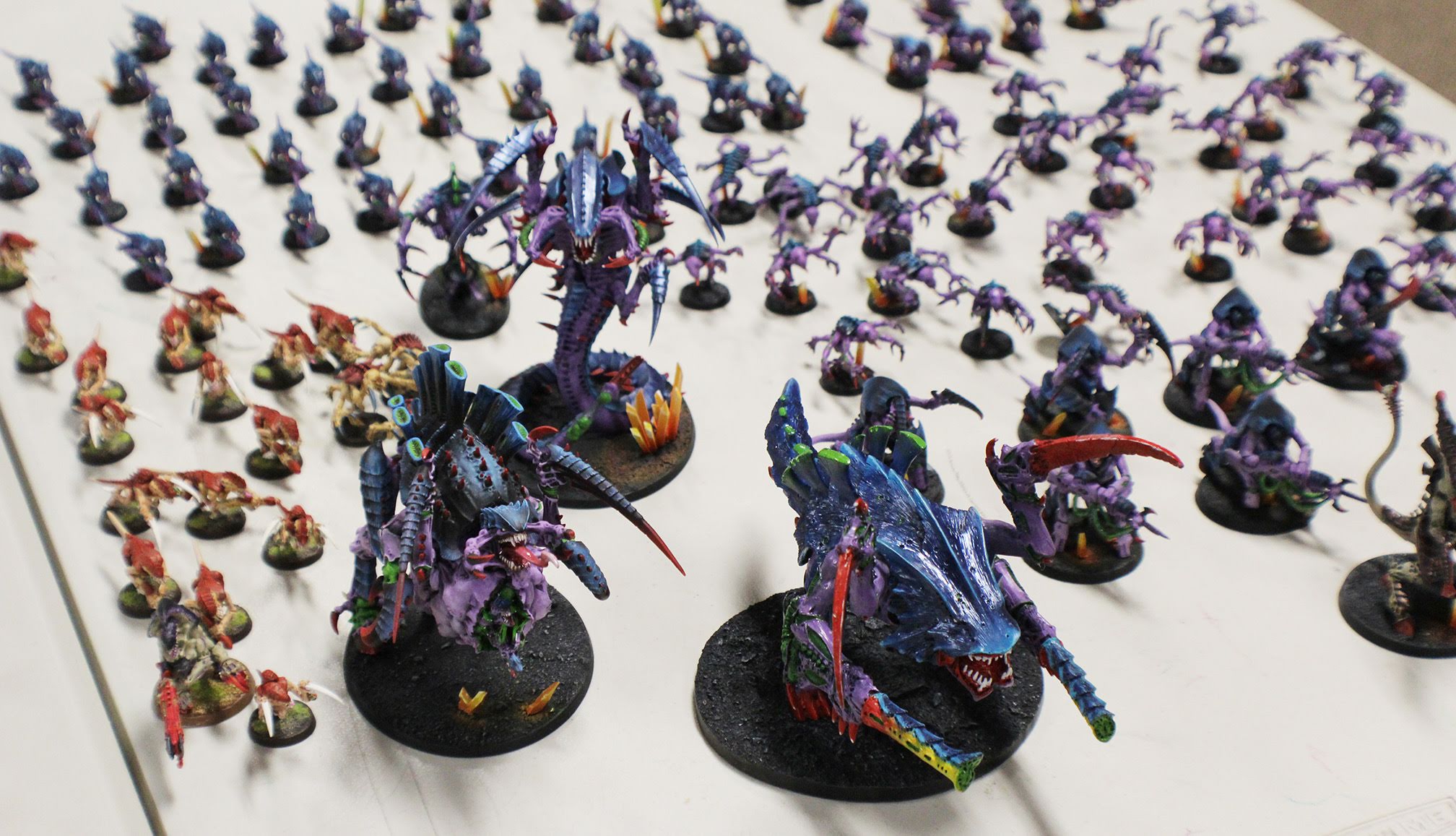
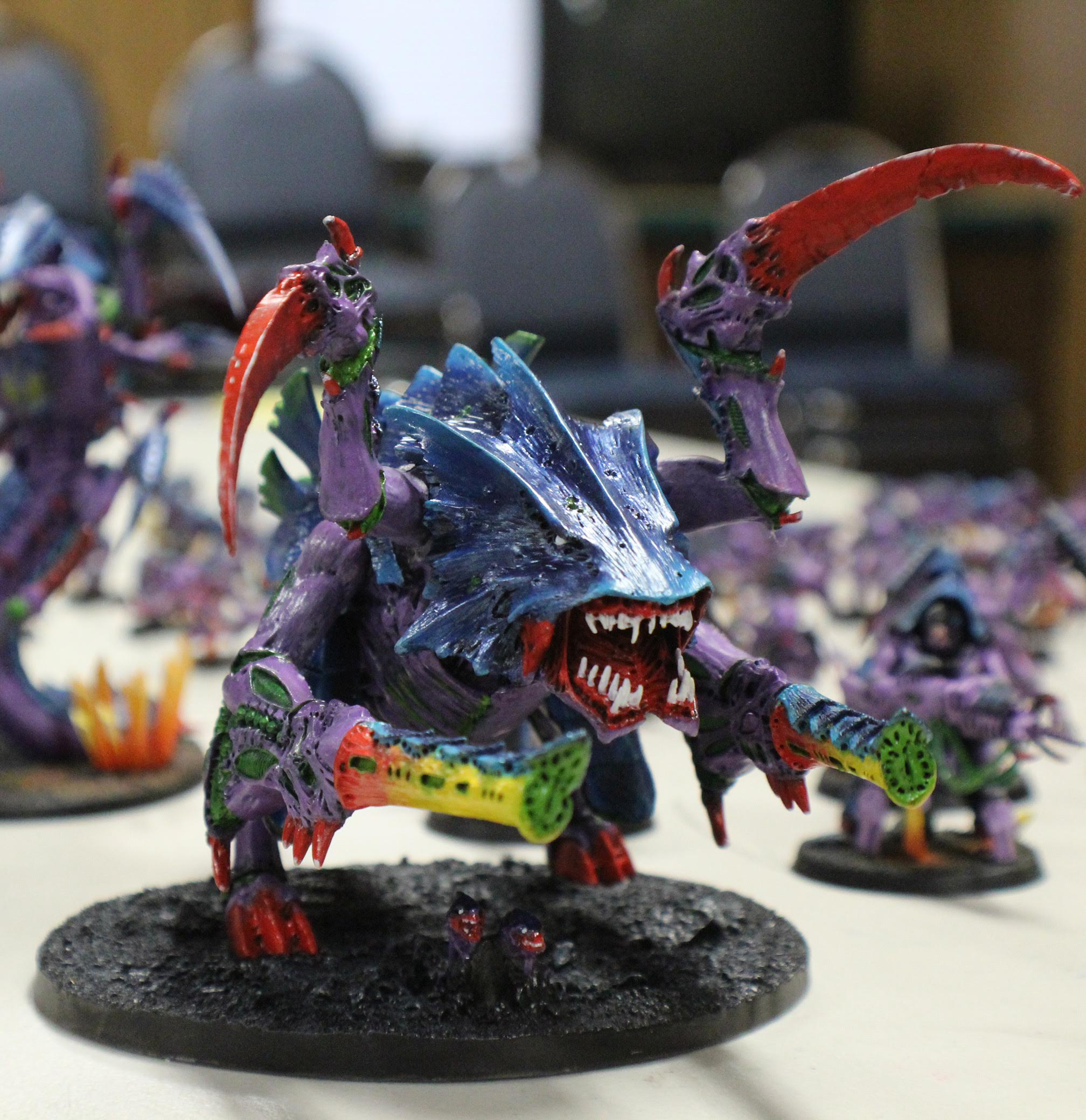
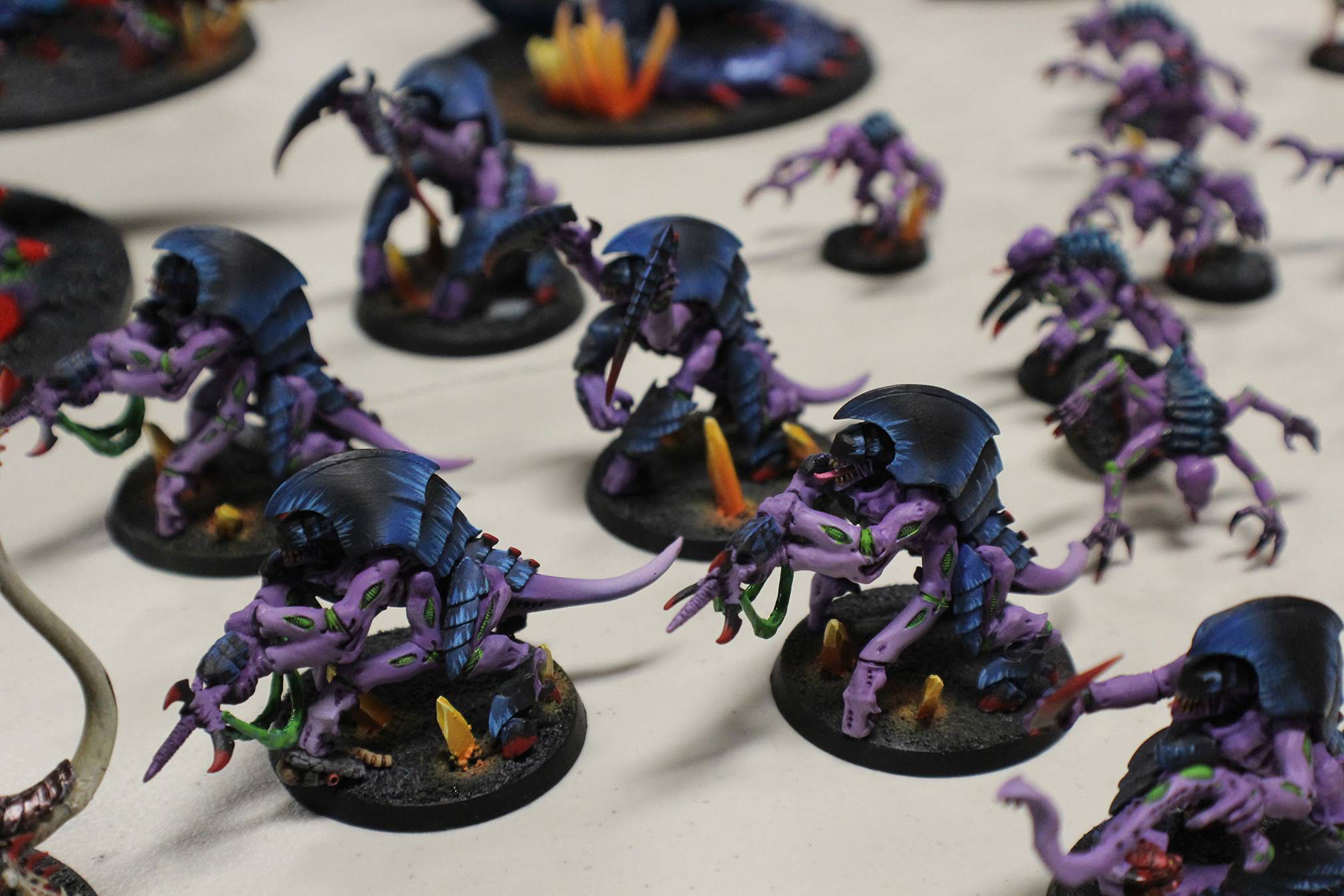
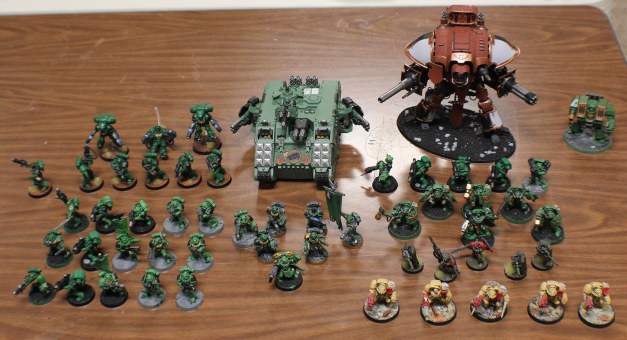
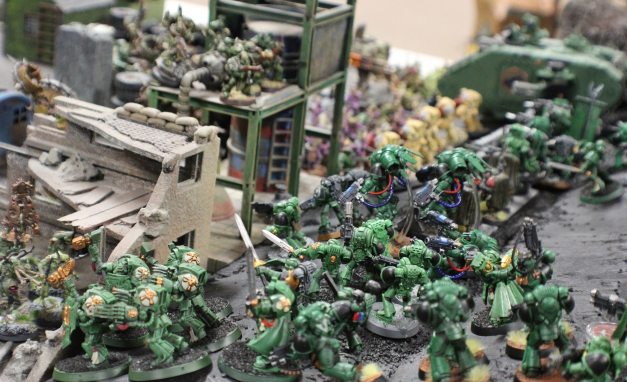
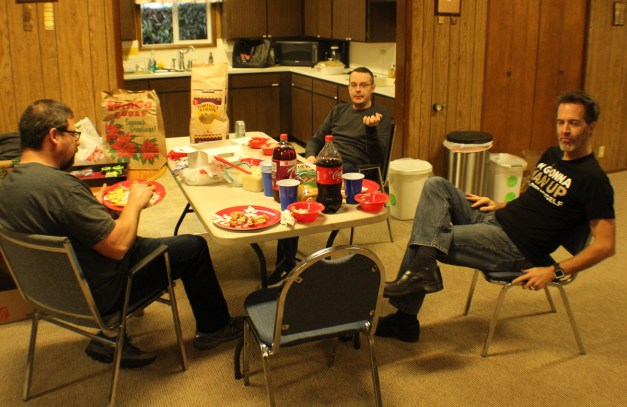
 With that settled, we began unpacking our armies and munching on some of the snacks scattered around the room. Here’s a look at the “armies on parade” at the outset of the game.

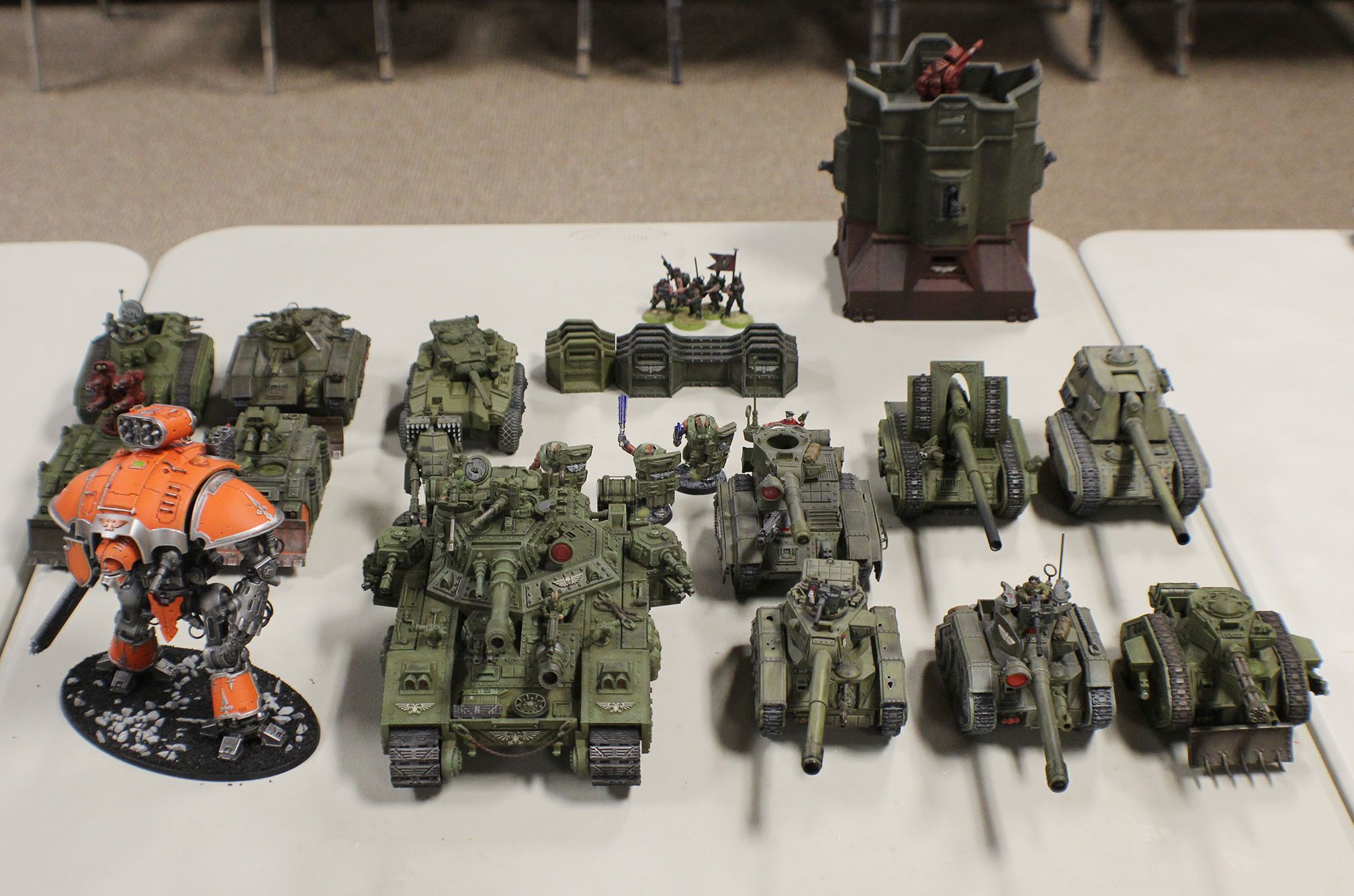



 And likewise, on turn 1 the massed infantry and armor of the Imperial Guard were facing a purple horde of Tyranids charging out of the cave entrance directly into their ranks!

 This really added to the playability of our game … armies didn’t have to waste hours of time crossing empty fields to engage. The meatgrinder got underway almost immediately!
Each side of the battlefield featured 3 minor objectives and 1 major objective. Each was scored at the end of each turn. We used a whiteboard to keep a running tally of the score as each faction racked up the points. Having lots of objectives that scored often created a very dynamic battlefield where individual maneuvers and key command decisions carried a lot of weight.
Just like last year, we used a timer to keep our turns short and sweet. Turn 1 was limited to 30 minutes each. Each subsequent turn was limited to 20 minutes! We learned to pre-plan our moves, play fast, and prioritize unit selection to make sure we got the most out of our time “on the clock.” With such brief turns, everybody was bound to forget or overlook something. It just added to the overall chaos of the battle!
This really added to the playability of our game … armies didn’t have to waste hours of time crossing empty fields to engage. The meatgrinder got underway almost immediately!
Each side of the battlefield featured 3 minor objectives and 1 major objective. Each was scored at the end of each turn. We used a whiteboard to keep a running tally of the score as each faction racked up the points. Having lots of objectives that scored often created a very dynamic battlefield where individual maneuvers and key command decisions carried a lot of weight.
Just like last year, we used a timer to keep our turns short and sweet. Turn 1 was limited to 30 minutes each. Each subsequent turn was limited to 20 minutes! We learned to pre-plan our moves, play fast, and prioritize unit selection to make sure we got the most out of our time “on the clock.” With such brief turns, everybody was bound to forget or overlook something. It just added to the overall chaos of the battle!
 With such a massive battle, I wasn’t able to capture the turn-by-turn action, but I got the overall narrative flow. As such, I’ll divide up this report into “early turns” and “later turns” for both sides of the battle.
 Facing the defenders of the Imperium was the boiling horde of xenos from Hive Fleet Tiamat. Paul put two units of 15 Genestealers all along the front line to soak up wounds. But behind them were the monsters — two Carnifexes, a Tervigon birthing Termagaunts, and a massive Barbed Hierodule with twin barbed strangler guns and massive scything talons. What force could stand against such inhuman savagery?!
 The Imperials took the initiative in the first round, firing salvo after salvo from their emplaced tanks and guns into the swarm of Genestealers. The massive onslaught had predictable results, wiping out entire squads and leaving a hole in the Tyranid front line.
However, these losses were inconsequential to the Hive Mind. Paul’s genestealers fell back, then he moved up his big monsters and fired their gruesome bioweapons directly into the Chimeras that were guarding the central objective. The Chimeras withstood the long range venom cannons of the Tyranid warriors, but withered under the crackling energy of the Hierodule’s guns.
The Imperials took the initiative in the first round, firing salvo after salvo from their emplaced tanks and guns into the swarm of Genestealers. The massive onslaught had predictable results, wiping out entire squads and leaving a hole in the Tyranid front line.
However, these losses were inconsequential to the Hive Mind. Paul’s genestealers fell back, then he moved up his big monsters and fired their gruesome bioweapons directly into the Chimeras that were guarding the central objective. The Chimeras withstood the long range venom cannons of the Tyranid warriors, but withered under the crackling energy of the Hierodule’s guns.
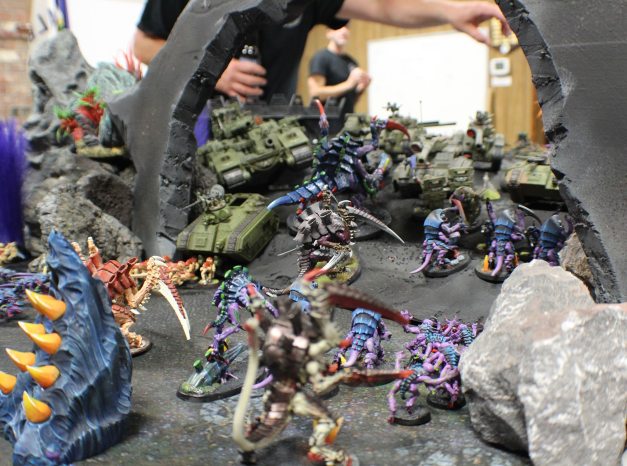 With a hole now blasted in the Guard’s flank, Paul sent his Tyranids charging in. The remaining Chimeras were cut down by the Carnifexes (Carnifices?) and at the bottom of the round the Tyranids had successfully exited the caverns and were beginning to rampage into the Imperials’ landing zone.
 As the xenos approached, the Guard held firm. Jim’s Knight and Baneblade focused their attention on the Carnifex holding the center objective and their combined fire brought it down, chittering its rage as it fell apart. The two remaining frontline Chimeras continued a grinding melee against the Termagaunts and the remaining Genestealers. But there were simply too many bioforms for the vehicles to overcome. For every Tyranid crushed under tire tread and track, two more emerged from the caverns to throw themselves against the tanks.
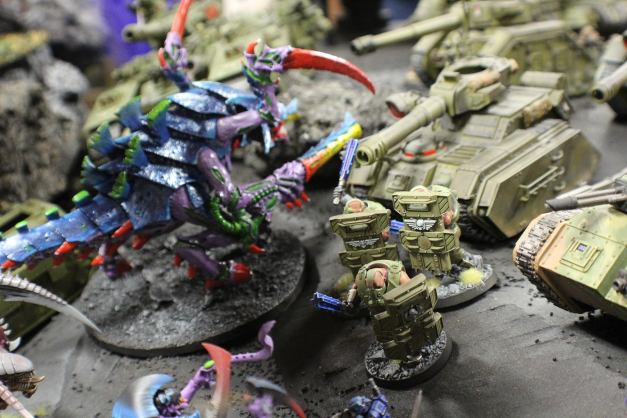 When the Tyranids counterattacked, the next wave of vehicles exploded under the crackling energy of the biofire. Jim’s Knight fell apart, kneecapped and billowing smoke. A Leman Russ melted into the earth and a third Chimera was sliced open. Jim desperately hoped for one of his vehicles to explode and take down Tyranids with a death-blast of fire, but roll after roll gave him no relief. All the vehicles went down in defeat with no explosion. So, too, the mighty Knight.
 At this point, I began a series of rather spectacular dice rolls related to the Death Guard’s Disgustingly Resilient keyword trait. Time and time again in this game, Disgustingly Resilient would save my bacon in the face of almost certain annihilation.
And so the Maggot Magnates mobilized, trudging forward in the face of deadly fire from the Astartes. On the front lines, Typhus hefted his manreaper scythe and urged on the hordes of poxwalkers. Spewing smoke and trailing a stream of foul ichor, a Helbrute stomped to the head of the pack and paused to unleash the full force of its lascannons into an Astartes Land Raider that was mere meters away, such was the devastating proximity of the two armies.
At this point, I began a series of rather spectacular dice rolls related to the Death Guard’s Disgustingly Resilient keyword trait. Time and time again in this game, Disgustingly Resilient would save my bacon in the face of almost certain annihilation.
And so the Maggot Magnates mobilized, trudging forward in the face of deadly fire from the Astartes. On the front lines, Typhus hefted his manreaper scythe and urged on the hordes of poxwalkers. Spewing smoke and trailing a stream of foul ichor, a Helbrute stomped to the head of the pack and paused to unleash the full force of its lascannons into an Astartes Land Raider that was mere meters away, such was the devastating proximity of the two armies.

 Even as I advanced, I tried to mess with Alex’s backfield as much as I could. He had several concentric lines of Salamanders behind defensive formations; these I targeted with my flying daemon prince and with my hovering bloat-drone.
After a couple turns of combat, we agreed that Alex’s Salamanders were incredibly resilient! They benefited from re-rolls and special rules that made it possible to resurrect slain characters! Plus, Alex had lots and lots of guns pointed at my Death Guard, which is basically where you want to be in a game like this.
Even as I advanced, I tried to mess with Alex’s backfield as much as I could. He had several concentric lines of Salamanders behind defensive formations; these I targeted with my flying daemon prince and with my hovering bloat-drone.
After a couple turns of combat, we agreed that Alex’s Salamanders were incredibly resilient! They benefited from re-rolls and special rules that made it possible to resurrect slain characters! Plus, Alex had lots and lots of guns pointed at my Death Guard, which is basically where you want to be in a game like this.

 Elsewhere, my bloat-drone armed with a fleshmower plowed into a squad of terminators, beginning an epic melee that would last for most of the game (though the bloat-drone fleshmower would fall early on in the clash).
 As the first two turns drew to a close, it became clear that, in my haste to advance out of Outpost Omicron and crush the Salamanders, I had left my three backfield objectives dangerously unprotected. Oops! It was just sheer luck that Alex hadn’t been able to capitalize on my goof. The next two turns would show just how important these objectives would become…
 There was much chuckling from Jim and Bif, as they had both discussed — and summarily discarded — the possibility of Paul bringing a Bio-Titan. Hah, the joke’s on them!
Paul wasted no time in putting his shiny new toy to work. The Heirophant instantly became Public Enemy #1 as it pulped squads of Guardsmen and ripped into the Baneblade.
There was much chuckling from Jim and Bif, as they had both discussed — and summarily discarded — the possibility of Paul bringing a Bio-Titan. Hah, the joke’s on them!
Paul wasted no time in putting his shiny new toy to work. The Heirophant instantly became Public Enemy #1 as it pulped squads of Guardsmen and ripped into the Baneblade.
 Of course, Paul was a benevolent GM for this campaign finale. He wasn’t just going to spring a surprise like that on the Imperial players without giving them something in return. That “something” was a heavy lifter blasting down from orbit to deliver another Knight to face off against the gargantuan titan rising from the earth. Huzzah!
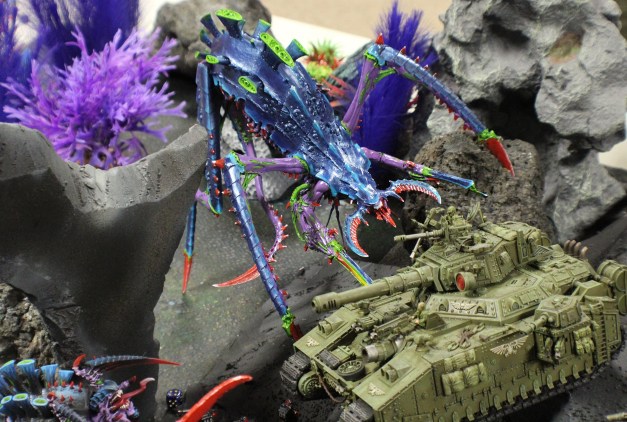
I don’t have a picture of the moment the knight arrived, so how about another pic of the Heirophant looming over a battlefield full of soon-to-be scrap metal?
Of course, Paul was a benevolent GM for this campaign finale. He wasn’t just going to spring a surprise like that on the Imperial players without giving them something in return. That “something” was a heavy lifter blasting down from orbit to deliver another Knight to face off against the gargantuan titan rising from the earth. Huzzah!
I don’t have a picture of the moment the knight arrived, so how about another pic of the Heirophant looming over a battlefield full of soon-to-be scrap metal?
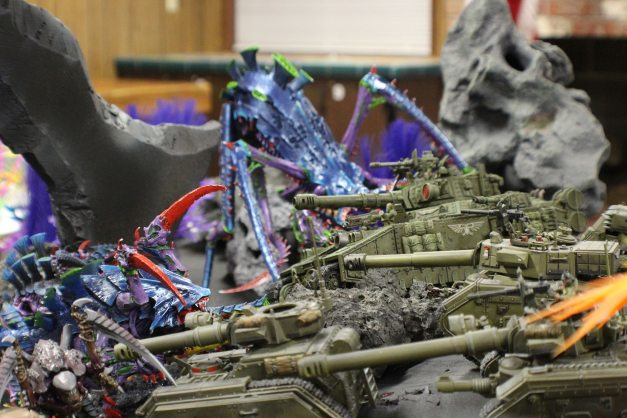 The arrival of the Bio-Titan seemed to signal a turning point in the battle versus the Tyranids. Jim’s Baneblade and Knight lashed their combined firepower at the Heirophant, while his last Guardsmen and Sentinels held the final positions at the summit of the landing field. However, the Bio-Titan seems to just shrug off their fire and in one turn hollowed out both the Baneblade and Knight. Jim returned fire on the next turn killing the two Carnifex’s and the birthing machine Tervigon. From their furious death cries, the earth rose up and a burrowing Trygon took their place on the slopes leading up to the landing pad.
 At this point, the battle on the west front had decisively turned in the Tyranids favor. The remaining guardsmen and their vehicles staged a retreat, falling back to their landing zone and turning their guns to the east in support of the Salamanders trying to stem the push from the Death Guard…
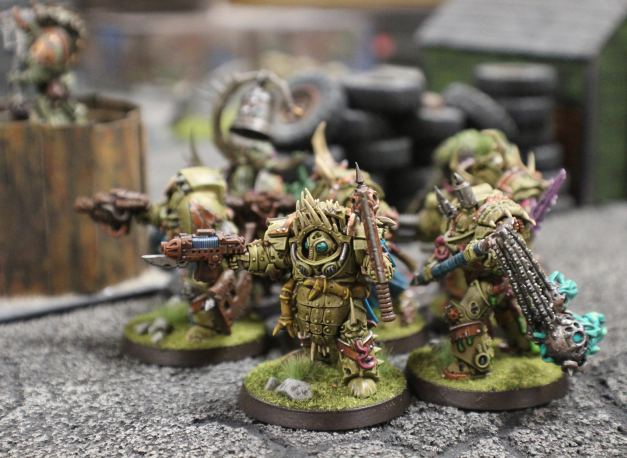
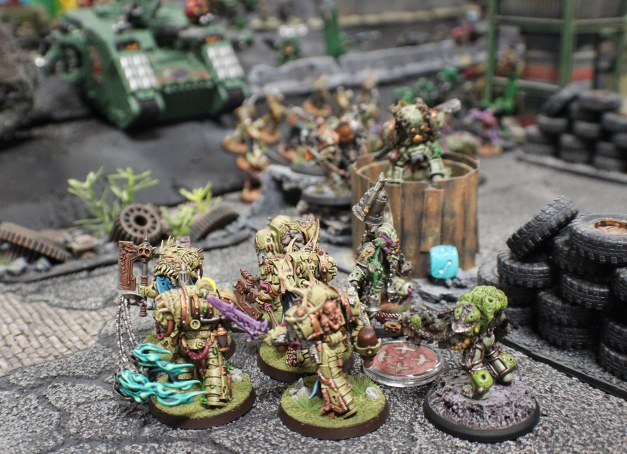 These guys were the newest miniatures I had completed for my Death Guard army, and we made many jokes about how their fate was sealed — like all newly painted minis, they would certainly be killed before they had a chance to do anything of note on the battlefield. It is known.
But! The gods had a sense of humor this day, and it came to pass that my Blightlords were able to play a pivotal role in the final endgame.
In one extraordinarily brutal round of combat, they brought the Land Raider to the brink of destruction. It was summarily destroyed by a piece of flaming debris that crashed down from orbit. (We were using the “Orbital Debris” twist from the Open War deck to model the massive naval battle raging overhead, and I got a lucky dice roll in the final turn of the game to finish off the Land Raider. Great stuff!)
These guys were the newest miniatures I had completed for my Death Guard army, and we made many jokes about how their fate was sealed — like all newly painted minis, they would certainly be killed before they had a chance to do anything of note on the battlefield. It is known.
But! The gods had a sense of humor this day, and it came to pass that my Blightlords were able to play a pivotal role in the final endgame.
In one extraordinarily brutal round of combat, they brought the Land Raider to the brink of destruction. It was summarily destroyed by a piece of flaming debris that crashed down from orbit. (We were using the “Orbital Debris” twist from the Open War deck to model the massive naval battle raging overhead, and I got a lucky dice roll in the final turn of the game to finish off the Land Raider. Great stuff!)
 After that, they swept up the hill and into an Imperial Guard heavy weapon squad, killing as they went. Blood, pus, and ichor flowed like water as the Hideous Bloom marched onward. At the end of the game, one Blightlord remained alive to contest a crucial minor objective. Defiant to the last.
 But the battle would be decided elsewhere, by none other than the Herald of the Plague God himself. Typhus, who had been leading more or less from the back for the entirety of the game, finally strode forth on the final turn to slaughter the remnants of a squad of Terminators and (with the help of some Poxwalkers) seize the major objective.
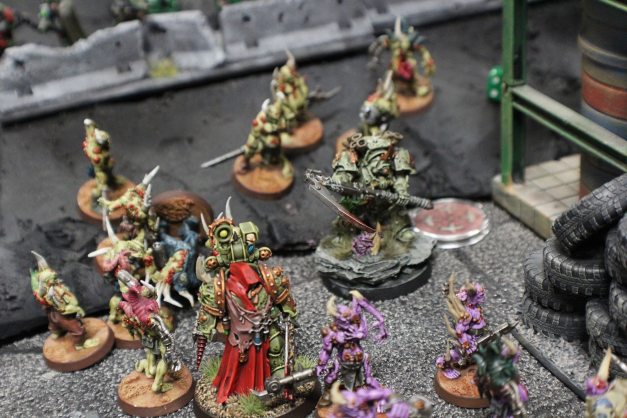 We all agreed that it was incredibly fitting that a final, pivotal play of the game came down to Typhus. It’s always nice when your awesome named characters get to steer the narrative outcome. Anyway, that sealed the deal for the battle in Outpost Omicron. And with the Heirophant Bio-Titan rampaging virtually unchecked on the other side of the table, it seemed that doom had come for the forces of the Imperium.
In one of final actions of the game, the Bio-Titan directed its full firepower at the Alex’s Knight standing in the middle of Outpost Omicron. Paul rolled dice for what felt like 10 straight minutes as the beast unleashed stupendous punishment on the gallant Knight. Incredibly, the Knight made its saves — withstanding the firepower that had killed everything else in its path!
But it was a pyrrhic victory, as the Imperial lines were collapsing and utter annihilation was imminent. With that, the game came to an end.
We all agreed that it was incredibly fitting that a final, pivotal play of the game came down to Typhus. It’s always nice when your awesome named characters get to steer the narrative outcome. Anyway, that sealed the deal for the battle in Outpost Omicron. And with the Heirophant Bio-Titan rampaging virtually unchecked on the other side of the table, it seemed that doom had come for the forces of the Imperium.
In one of final actions of the game, the Bio-Titan directed its full firepower at the Alex’s Knight standing in the middle of Outpost Omicron. Paul rolled dice for what felt like 10 straight minutes as the beast unleashed stupendous punishment on the gallant Knight. Incredibly, the Knight made its saves — withstanding the firepower that had killed everything else in its path!
But it was a pyrrhic victory, as the Imperial lines were collapsing and utter annihilation was imminent. With that, the game came to an end.
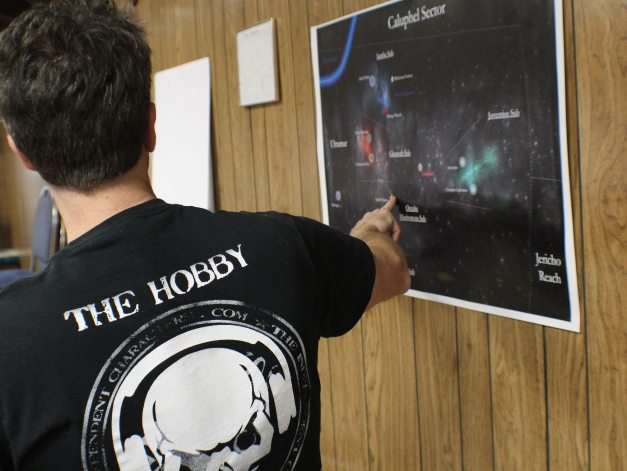
 In addition, the Total Victory outcome meant that Hive Fleet Tiamat crashed headlong into the Caluphel Sector, sending three tendrils of its army snaking through the various sub-sectors that we had mapped out earlier. The three tendrils represented the Tyranids’ overwhelming momentum coming off the victory on Caluphel Prime, and they also spelled certain doom for the beleaguered Imperial defenders elsewhere in the sector. Here’s a look at the map showing the Tyranids’ gains.
 Amid the chaos and confusion, another terrifying creature made itself known. From the bio-pools of Caluphel’s caverns, the deadly Hive Queen of Tiamat rose up and then transcended to the Fleet above, annihilating hundreds of unfortunate Guardsmen in the psychic scream that accompanied her birth.
This marked the arrival of Paul’s Hive Queen, a new model he had commissioned by Colin Ward to lead his Tyranid army. Here she is in all her sensual glory.
Amid the chaos and confusion, another terrifying creature made itself known. From the bio-pools of Caluphel’s caverns, the deadly Hive Queen of Tiamat rose up and then transcended to the Fleet above, annihilating hundreds of unfortunate Guardsmen in the psychic scream that accompanied her birth.
This marked the arrival of Paul’s Hive Queen, a new model he had commissioned by Colin Ward to lead his Tyranid army. Here she is in all her sensual glory.
 But wait! There’s more. Paul had drawn up an entire postgame show for us to commemorate the Caluphel Awakenings campaign. Each of us got a special award for our contributions to the campaign, and Paul surprised us by unveiling a custom plaque for the campaign winner. As you can see, it’s got blank spots so it can be used repeatedly for future campaigns. The idea is that each year’s winner gets to hold onto the plaque until the next campaign, kind of like a Warhammer 40k Stanley Cup.
 Now is the part where I tell you that this year’s campaign winner was actually yours truly! All of the monthly contributions — painting, writing lore, making maps — had points attached to them, and I managed to sneak out a win for the overall five-month campaign.
So the plaque goes home with me!
Now is the part where I tell you that this year’s campaign winner was actually yours truly! All of the monthly contributions — painting, writing lore, making maps — had points attached to them, and I managed to sneak out a win for the overall five-month campaign.
So the plaque goes home with me!
 Actually, it’s already on display in my workshop. Doubtless I’ll have some stiff competition next year — these guys will be coming for my title!
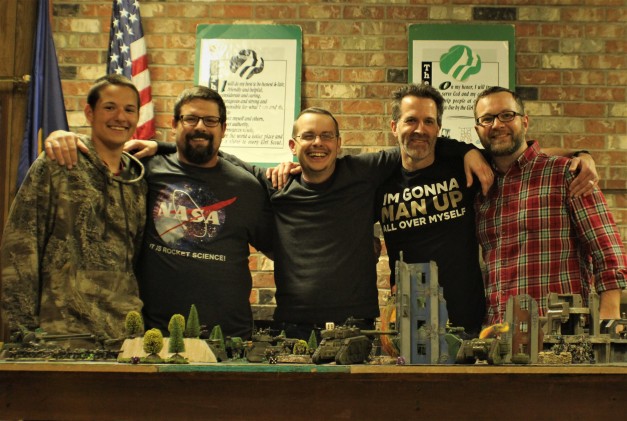
 Thus ends another incredible satisfying Warhammer 40k campaign. This one really pushed our small game group to new heights of painting, modeling, and narrative gaming. Paul masterminded this thing from start to finish, and we all gave him a hearty round of applause at the end. Follow along on Comrade’s Wargames to see where we’ll go from here!












 Comrade's Wargames