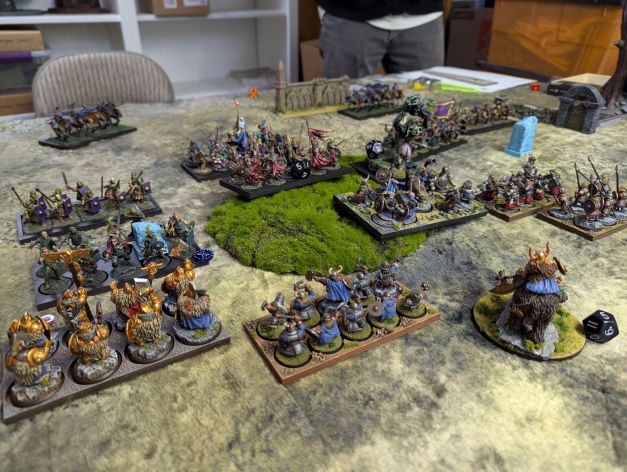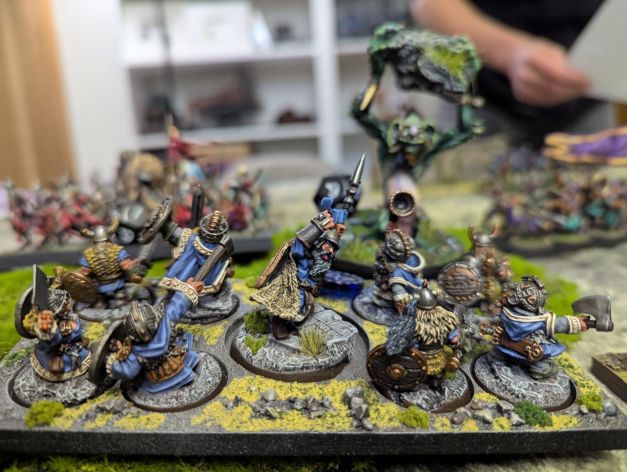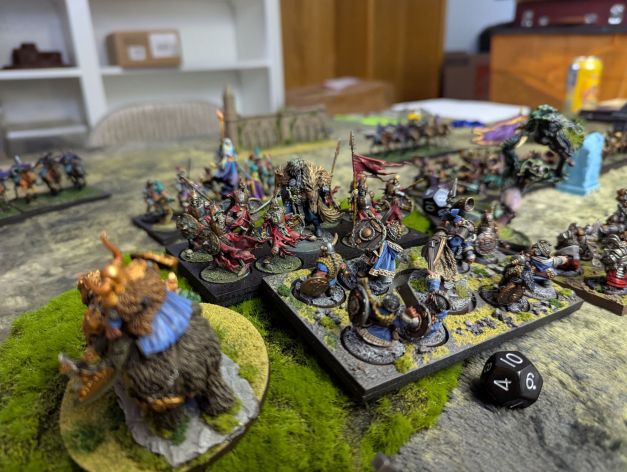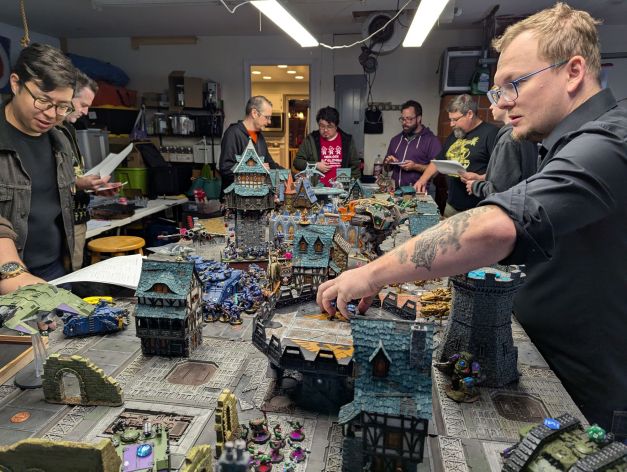
Comrade's Wargames

Painting toy soldiers in Oregon

  • Home
  • Narrative Campaigns
    • The Cauldron: A Grimdark Sci-Fi Campaign
    • The Chronicles of Üthdyn: A Fantasy Tabletop Campaign Setting
    • Nightwatch: Beyond the Borderlands
    • Frostgrave: Mystery of the Night-Haunted City
  • About Comrade’s Wargames

Hobgoblin: More Thoughts and Musings

Posted by Comrade on November 10, 2025
Posted in: Posts. Tagged: 28mm, apocalypse, arm, army, club, fantasy, game night, hobgoblin, narrative. Leave a comment

We’ve settled on Hobgoblin as the game of choice for our annual holiday mega-battle (affectionally known as Apoc-Luck, since we each bring a dish and break for dinner midway through the evening).

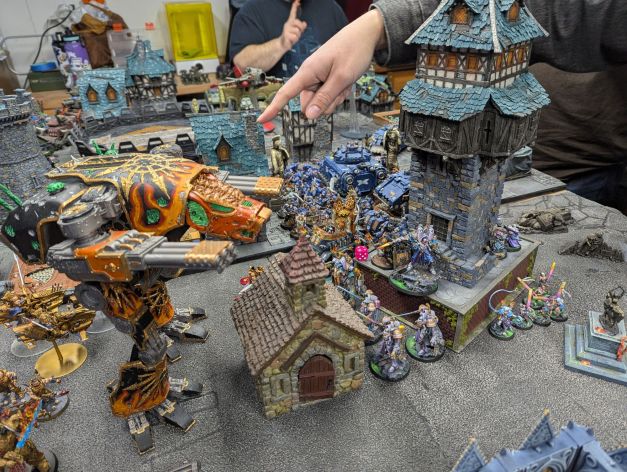
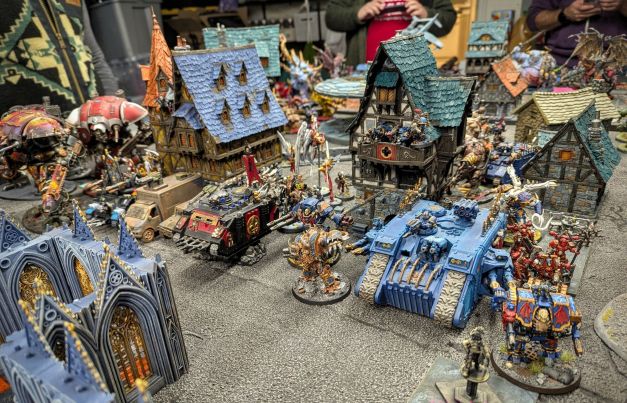
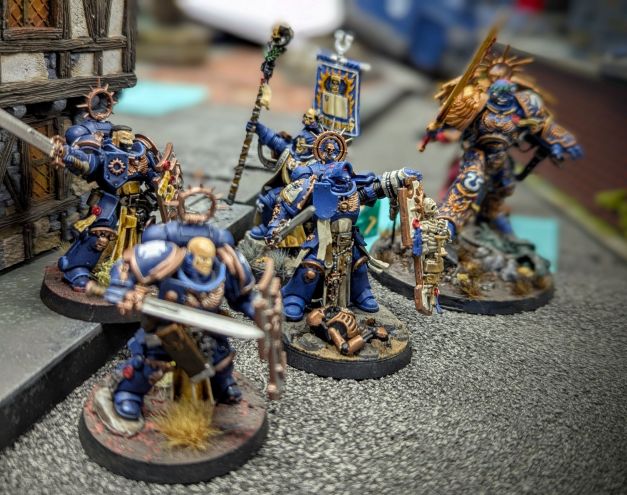
These games are typically structured around simple scenarios, with instructions to each player that can be summed up as “bring all your painted models and we’ll shoehorn everything into a game.” Game balance goes out the window in favor of a grand spectacle of beautifully painted armies clashing on the field of battle surrounded by gorgeous terrain and scenery. Here’s a pic from last year’s Apoc-Luck game which sums up the aesthetic we’re aiming for.

I’ve done a few writeups here of our previous Apoc-Luck game days; check ’em out at the links below.

  • Apoc-Luck 2024 (Grimdark Future)
  • Apoc-Luck 2022 (Age of Fantasy)
  • Apoc-Luck 2017 (8th edition Warhammer 40k)

We’re planning a learning game of Hobgoblin later this month so other guys in the club can get up to speed on it. Personally, I think it’s an inspired choice for a mega-battle. Hobgoblin was developed specifically to accommodate this sort of play style: huge armies clashing, plenty of high drama without a lot of fussing and fiddling with modifiers and stats.

The lore of Hobgoblin is surprisingly well developed as well, which is a refreshing option after many years playing Grimdark Future and Age of Fantasy (both serviceable rulesets, of course, but bereft of lore until rather recently in their development).

So I wanted to record some thoughts and musings about Hobgoblin here, to inspire me and possibly serve other players out there who are dipping a toe in the game.

Hobgoblin is a game of matchups

In Hobgoblin, everyone builds their armies from the same core list of a dozen or so units, flavored with a short list of fun keyword abilities. Units have various to-hit target numbers based on what they’re going up against. Again, that’s shared knowledge … both your opponent and you both know that Monstrous Infantry are going to absolutely chew up ranged units or cavalry if they can get off a charge.

As you can see in this photo below from a game earlier this summer, John’s cave troll (a Beast, in the parlance of Hobgoblin) got in amongst my dwarven front line infantry and absolutely wrecked face with his big ol’ rock. John got the matchup he wanted, and I suffered as a result.

Doom Comes to Us All

In Hobgoblin, units don’t take casualties — they accumulate doom tokens, which slowly (or quickly, if you’re me) build up until the unit breaks and flees in terror. There are a few ways to remove doom tokens, but those techniques are really more about managing doom — delaying the inevitable — than they are about actually healing a unit up to its starting “hit points.”

Because of that, it’s important to understand that units will die in Hobgoblin. You can count on that, and you need to position your remaining units to take advantage of that certainty. Second rank units (reinforcements, coming up behind wavering units) are very important. They can plug gaps in the line and charge a weakened unit. You can’t move through friendly or enemy units, of course. So until the front line units die, you need to carefully marshal your second rank reinforcements to ensure they’re fresh and ready to charge in when the time comes.

Magic and Cursed Artefects Are Fun and Wildly Unbalanced

If the basic units you’ll use to build your Hobgoblin army seem bog standard, the same cannot be said of the magic system. Magic in Hobgoblin is dark, terrifying, and flavorful in a way that I’ve never encountered in a game before. The schools of magic, called “Abyssal Allegiances” in Hobgoblin, are straight out of a Lovecraftian tome. They’re utterly unique, and each Allegiance offers spells that affect the game in weird and different ways.

Same with Cursed Artefacts — in a standard game, you and your opponent each select one or roll randomly. It gets assigned to one unit (usually your general) and typically gives a distinct, narrowly applicable set of abilities to your unit or army. For example, you can have both players move twice in a turn, or steal a magic point from the opposing player, or remove doom from a friendly unit.

Abyssal Allegiances are extraordinarily fun; I love the flavor behind them, and the chance to swing for the fences with a particularly potent ability. They also have the potential to whiff badly as the game plays out. You may find that you unit positioning, combined with terrain placement or unexpected casualties, means your spells don’t do much for the majority of the game. For that reason, I have a hard time evaluating their effectiveness, and I’d definitely say they’re generally unbalanced against each other. Some Abyssal Allegiances just feel outright better in most circumstances. Of course, that makes a player like me much more likely to try to force the issue and make a “weaker” Allegiance work.

So all in all, I’m excited to dig into Hobgoblin this month, and to build a gigantic list for next month’s Apoc-Luck game. Stay tuned for more!

Grimdark Future: The Scouring of Hundvolst

Posted by Comrade on October 13, 2025
Posted in: Posts. Tagged: 28mm, 40k, apoc luck, apocalypse, club, game night, grimdark, miniatures, narrative, sci-fi, warhammer. 2 Comments

I’m slowly working through my backlog of photos and content that I’ve been meaning to post over the last year or two.

One such info dump is our annual 40k Apocalypse game, which took place in December 2024. We used Grimdark Future for our ruleset of choice, since it was quick and easy to pick up and play; it has served our group well over the years.

For the game, Paul and I set up a narrative scenario featuring the siege of Hundvolt, an Imperial feudal world that had unfortunately drawn the attention of the evil factions operating near Warzone Endymion. Here’s the capsule blurb we came up with:

The feudal world of Hundvolst has suffered mightily under the yoke of the Imperial tithe. For
decades, village elders have watched as their sons and daughters were conscripted and
shipped off planet.
Now, the war has come to Hundvolst. Invading forces led by Heretic Astartes and foul xenos
scum have laid waste to the planet even as Imperial defenders mount a dogged defense. Mighty
armies churn the verdant soil of Hundvolst, reducing the planet’s forested hills and idyllic
villages into charred rubble.
The invasion is reaching its apotheosis. Imperial Navy ships, operating under a directive from
the Ordo Malleus, have taken up station above the benighted planet. In mere hours, they will
deliver the Exterminatus unto the cursed planet, scouring the surface of all life and rendering it
inert and lifeless – such is the Emperor’s divine wrath.
As the sun sets on Hundvolst, ragged Imperial units fall back to their evacuation sites. Several
plucky force commanders stage a daring raid to liberate the knucklebone of St. Theodosia the
Spiteful, seeking to spirit the saint’s relic away from the doomed planet and keep it from the vile
clutches of xenos and heretic alike.

The scenario was intended to give us a reason to set up a weird mash-up of a feudal low-tech Imperial world being fought over by monstrous sci-fi war machines and armies. We wanted an excuse to set up a battlefield with our immense shared collection of gorgeous Tabletop World resin fantasy buildings, for one thing. We combined those with Daniel’s Sector Imperialis tiles to create a pleasing aesthetic.

The game itself was absolutely massive, with each player bringing about ~5,000 points of their respective factions. It was a glorious stew of beautiful models, vehicles, monsters, and war machines. All fully painted, as is our standard approach here at Comrade’s Wargames.

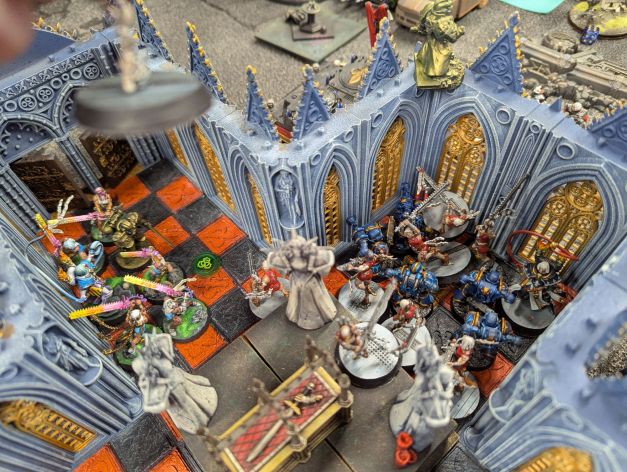
The cathedral in the building above housed the main objective — the knucklebone of St. Theodosia the Spiteful. The factions were competing to see who could seize the knucklebone before the virus bombs of the Exterminatus arrived to turn the surface of Hundvolst into a primordial soup of biological matter.

Here’s a peek at the action inside the cathedral. It was a bloodbath as the forces of Chaos tried repeatedly to gain control of the sanctuary, only to be pushed back by the combined guns of the Imperial Guard and Adeptus Sororitas!

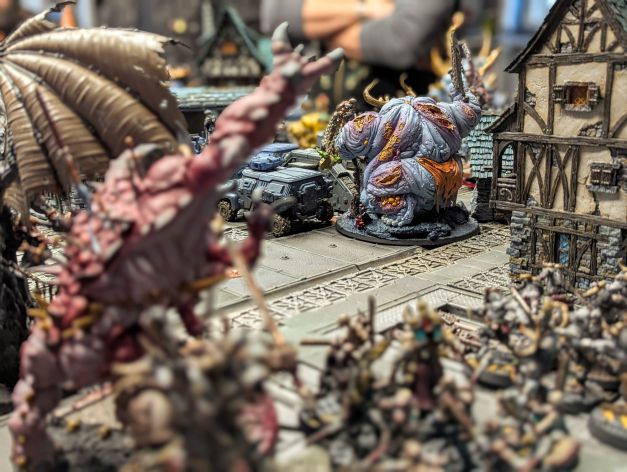
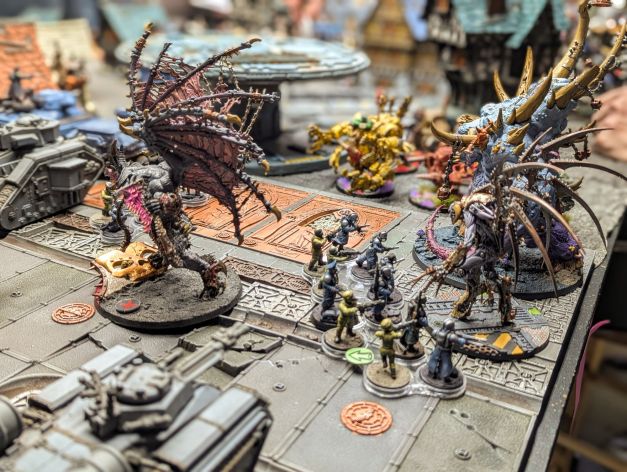
To be honest, I’m a year removed from the blow-by-blow action of the game, so it’s all a little hazy. I know we had some hot daemon-on-tank action, as seen below, followed by a gallant last stand by a gas mask-wearing commissar.

The streets nearer to the cathedral were choked with tanks as the heavy armor maneuvered for position. Troops scampered from cover to cover as the steel behemoths traded shots. The stone and thatch buildings provided tempting positions for heavy weapon squads, too.

The defenders of the Imperium — Astartes, Sororitas, Custodes, and Astra Militarum — mounted a brave defense, selling themselves dearly even as the clock ticked down toward the planet’s doom.

As the night wore on, the defenders rallied again and again in the face of the unending onslaught. But the forces of Chaos would not be denied their prize. Slowly, through gritted teeth and white knuckles, the defenders were pressed back and the attackers surged forward.

The battle reached its culmination as the forces of Chaos seized the knucklebone and began an extraction from the cathedral. Alas, this extraction turned into a rout as the combined forces of the Sisters of Battle and Imperial Guard fell upon the vile Heretic Astartes.

In a surprise no one saw coming, the defenders of the Imperium seized the holy relic, and an extraction squad managed to make it to a waiting Valkyrie gunship which lifted off mere moments before virus bombs rained down on the planet’s surface.

The image above shows the rearguard defending the landing site until the Valkyrie could escape. And then — a curtain was drawn back on the poor feudal world of Hundvolst, and no further missive is recorded herein about the fate of the world. Perhaps in a thousand years, Imperial surveyors might return and divine some clue about the ultimate fate of those trapped on the surface when the virus bombs fell. Or perhaps not.

Conclusion

As in years past, Grimdark Future gave us a great game that kept everyone engaged and rolling dice until the bitter end. We brought food and drink and enjoyed a meal together about midway through the game, as is our tradition with these end-of-the-year Apocalypse sized games.

And seeing as how I’m writing this in October, it’s a good reminder that we have just a few months before the next Apocalypse game. I’ll try to come up with a suitably epic scenario and tabletop setup, so stay tuned!

Shadow War: Armageddon Battle Report & Review

Posted by Comrade on October 10, 2025
Posted in: Posts. Tagged: miniatures, sci-fi, 28mm, skirmish, 40k, warhammer, game night, grimdark. 3 Comments

We have a penchant for old-school gaming here at Comrade’s Wargames, so it shouldn’t surprise anyone that I’ve been eager to try out Shadow War: Armageddon ever since I came across some blog posts and Youtube videos about how it’s been rediscovered lately as a diamond in the rough.

Now, don’t get me wrong — Shadow War isn’t an old game, per se. It was released in 2017, just before the debut of the revamped 8th edition of Warhammer 40,000. But it’s imbued with a certain old-school sensibility that appeals to me greatly. How, you might ask?

  • It’s essentially a re-skin of the venerable and popular Necromunda skirmish ruleset, which itself is derived from 2nd edition Warhammer 40k.
  • In my opinion, 2nd edition 40k is a lousy ruleset for army-scale games, but it’s ideal for skirmish level games, where each players controls about a dozen (or fewer) figures. The super granular statline for a typical figure makes sense when you’re only controlling a handful of dudes.
  • It’s one of the last (if not possibly the last) of GW’s one-book-is-all-you-need titles. The main book contained everything: core rules, army lists, advanced rules, campaign systems, etc. There were no extra books to buy, at all, ever. (Now you can see why GW has no interest in this type of approach.)
  • The core rulebook contains a dozen army lists covering most 40k armies, making it trivial to get players of all stripes interested in trying out the game.

Lately, as the increasing cost of models and rapid pace of rulebooks and supplements has increased the barrier for entry to the Warhammer hobby, players like me have been rediscovering older rulesets like Shadow War: Armageddon. To further illustrate the Venn diagram for you: I’m an avid enjoyer of One Page Rules, so I’ve never really been a participant in the current GW treadmill approach to game editions and rules supplements.

Anyway, enough of that preamble! You came to hear about the game, right?

John, Jim, and I got together last weekend to try out Shadow War: Armageddon. The core book doesn’t explicitly include rules for multiplayer games, but we are seasoned veterans of the wargaming hobby, so it was simple to adapt one of the rulebook scenarios to incorporate three players, all competing to accomplish little mini-missions on the tabletop.

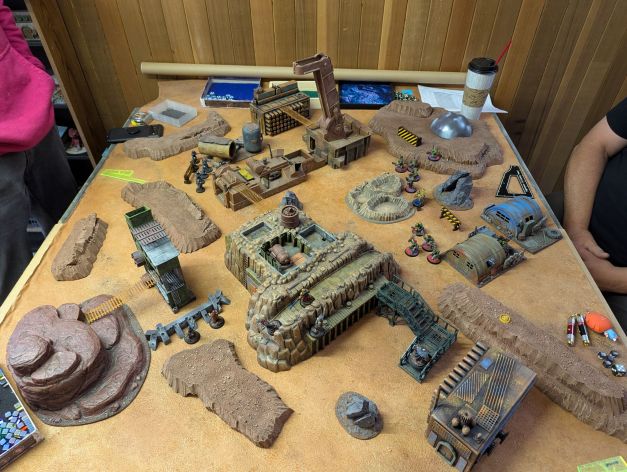
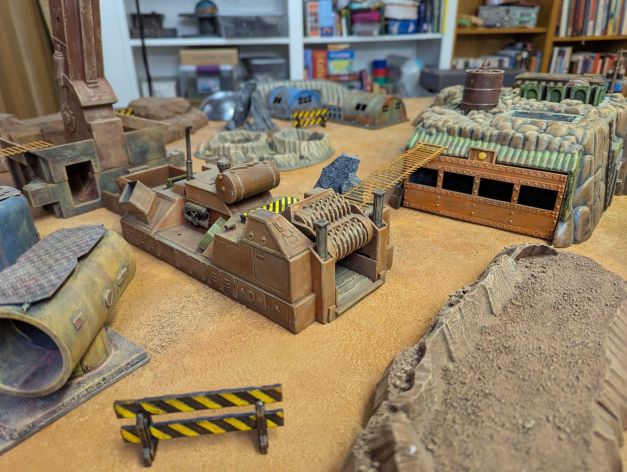
I set up a dusty, windswept desert battlefield replete with craggy rock formations and rusted industrial equipment. Here’s a look at the setup.

We played on a 4×4 battlefield, as advised in the rulebook. Weapon ranges are fairly short, and we concluded after the game that a 3×3 battlefield could easily have sufficed, even for our three-player game.

John fielded his grubby little Imperial Guardsmen, and Jim brought a stupendous number of Orks – 11 figures in total, I think. Contrast that with my Inquisitorial warband, which numbered 6 models. Yikes! Here’s a look at our factions as we started the game.

Prior to deployment, each player received a randomly determined mission objective.

John’s Guardsmen were trying to get across the board and exit from an opposing player’s deployment area.

Jim’s Orks were trying to blow up a tank of promethium (the 40k equivalent of natural gas + gasoline + napalm, all mixed together and used for a variety of purposes).

My Inquisitor was trying to isolate and assassinate the Ork warboss.

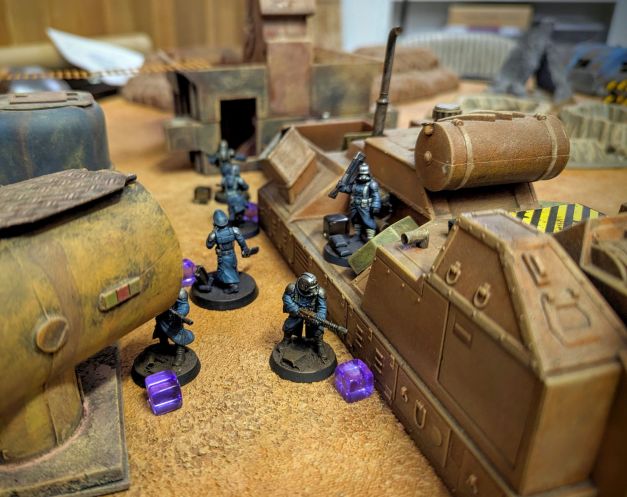
The game started with John’s Guardsmen moving purposefully through a narrow defile on the left flank of the industrial facility. They used the overwatch rule from Shadow War: Armageddon to great effect to cover their approach.

Waiting to meet them were Jim’s Orks, of course! He couldn’t just let those Guardsmen jog across the field unopposed.

The upcoming clash in this dusty back alley was one for the books. Stay tuned!
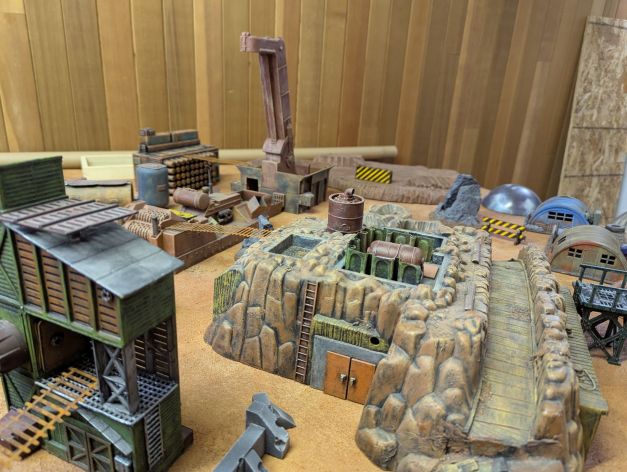
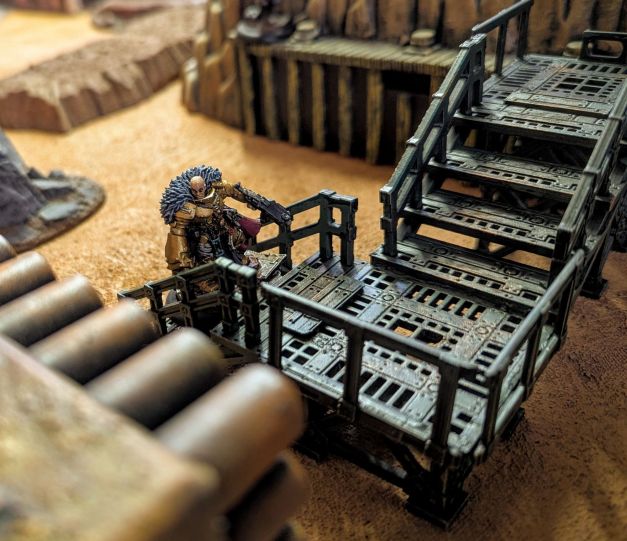
Meanwhile, Inquisitor Coteaz sent his warband up onto the central terrain feature — a craggy bunker defended by a trench and topped with (you guessed it) some promethium tanks.

From this perch, they could watch both of the opposing warbands as they jockeyed for position in the outskirts of the facility. I knew the Orks had to come my way to accomplish their mission, but I also didn’t want Jim to have to face John’s Guardsmen alone! So, in a burst of tactical genius, I split up my forces. You’ll see later how this played out for me.

But first — back to that alley. The Guardsmen were creeping along, covering their advance with overwatch, when suddenly a mob of Orks burst forth and charged them in true orky fashion!

It was an absolute bloodbath for the Orks. We learned a lot about the casualty system in Shadow War: Armageddon. You aren’t outright dead when you take a wound, but most of the time you’re in very bad shape, with just a slim hope for recovery on the battlefield.

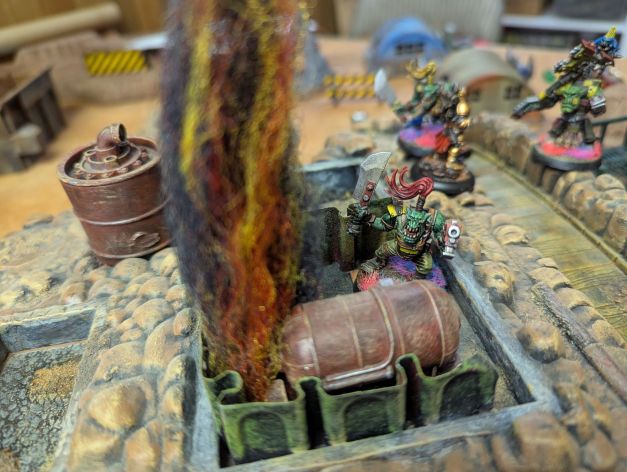
Over by the promethium tanks, a brawl was developing as Jim charged his Orks up to assault the trench line. I had two models available to defend — Interrogator Lysander Frost and Virgil the Huntsman, who was armed (fortuitously) with a flamethrower.

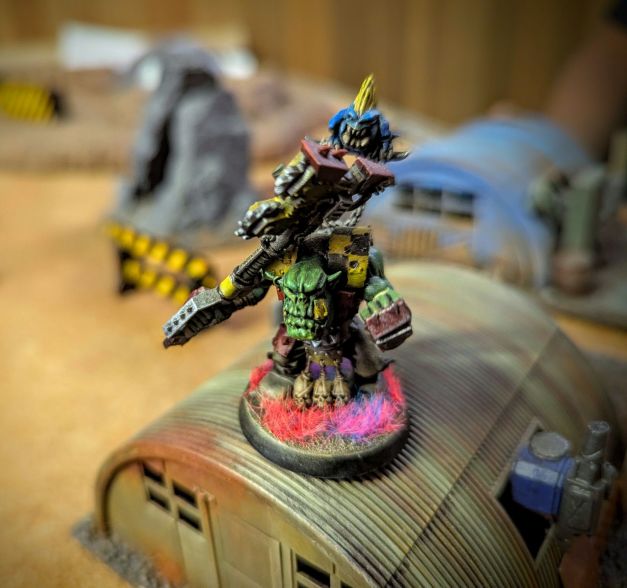
As this bloodthirsty scrum was developing, Jim’s warboss bravely stepped out of hiding and entered the fray. He started by throwing grenades, then decided to wade into combat and try to draw off some Inquisitorial acolytes.

As it happened, the warboss ended up within charge range of Inquisitor Coteaz! This was literally my game objective — slay the opposing leader! I couldn’t let a chance like this pass by.

Throwing caution to the wind, Inquisitor Coteaz raced into combat against the warboss. For a turn or two, it was a fair fight… we traded blows but no one seemed to gain the upper hand. Once some more Ork boyz joined the fray, things went sideways quickly for the Lord Inquisitor.

Here’s his final stand, just before he was cut down in single combat.

Luckily, his broken body was spirited away by Interrogator Lysander, to be healed and restored to the Emperor’s service.

In doing so, Lysander’s attention was taken away from the Ork boyz scrambling up the hill toward the promethium tank. Oops!

All it took was a tiny little distraction to seal the deal for Jim’s Orks. This silly Ork warrior blew up the promethium tank in a fiery explosion, ensuring victory for the greenskins even as the Imperial factions retreated to lick their wounds.

Feedback from the guys for Shadow War: Armageddon was generally positive. “It definitely scratched an itch,” was how Jim put it after the game. SW:A had all the accoutrements that would normally turn me off from a GW game: super granular stats for figures, weird corner case rules like ammo rolls and crawling 2″ per turn when wounded, inexplicable wargear missing from the army lists.

But I’ll be honest with you — it works. The whole package plays smoothly and is imbued with a healthy dose of nostalgia. The clunky parts are a glorious love letter to earlier editions of Warhammer 40k. And it’s such a small scale game that you just don’t mind flipping through the rulebook to uncover mundane rules for grenade deviation or melee attacks on pinned models.

For me, the most appealing factor is the “one rulebook is all you need” approach. The rulebook is out of print, but PDFs can be found without a lot of effort. And that’s it — no further buy-in is needed. The rulebook contains army lists for nearly every 40k faction you might want.

So we’ll be playing this one again, for sure. In fact, we’re already discussing a campaign to see how our little warbands can level up and improve their position. Stay tuned for more!

The Expedition Soldiers On

Posted by Comrade on September 30, 2025
Posted in: Posts. Tagged: 28mm, army, dwarves, fantasy, miniatures, painting. 5 Comments

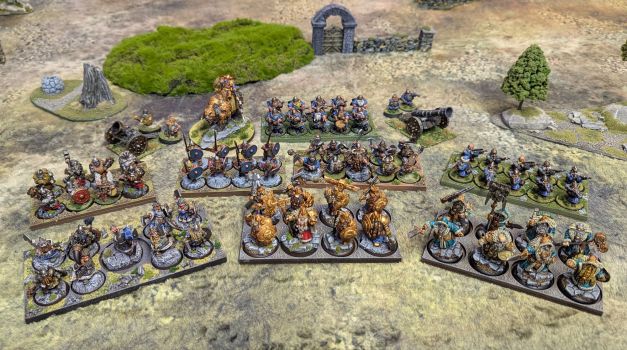
I’ve spent some time lately returning to my fantasy dwarf heartbreaker army — The Expedition to Hearthspire. This army has been in existence, either in concept or on the actual tabletop, since the late 2000s, when I scraped together a handful of dwarves to play A Song of Blades & Heroes with my old game club back in Chicago.

Since then, my collection of dwarves has increased consistently. Models became units. Units became a small army, then a larger army. Now I’ve got a fairly vast collection of painted dwarves, ready to undertake the quest for the ancient city of Hearthspire. Here’s the latest family photo, taken last month when I mustered the whole group for a game of Hobgoblin with John.

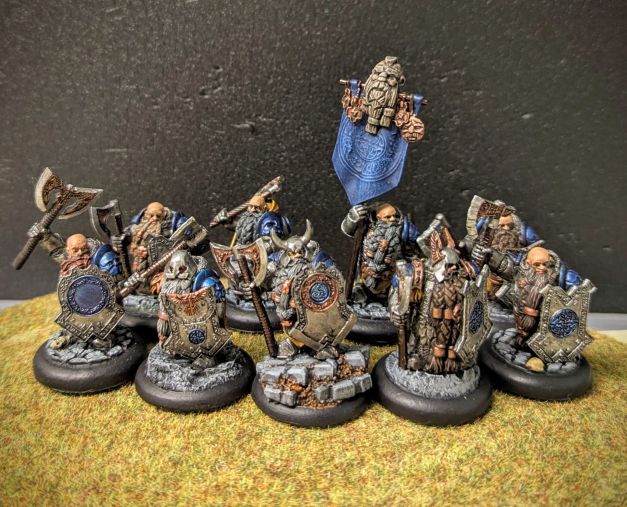
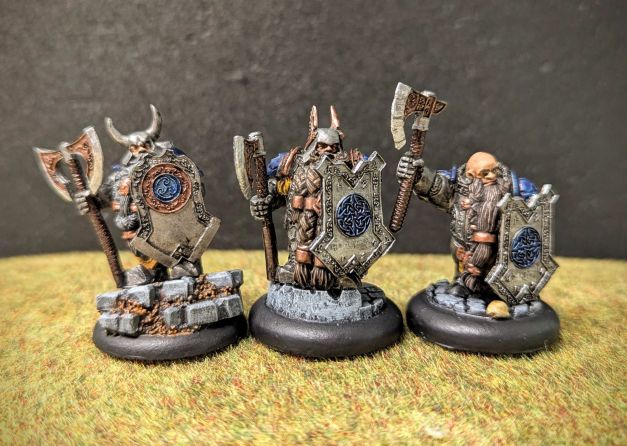
After that game, I felt inspired to paint up some reinforcements to further bolster the dwarven throng. Hobgoblin is an old school rank-and-flank type of game that encourages large armies. So I assessed the current state of my dwarf army and identified the distinct need for some elite, heavily armored dwarven infantry to anchor the center of my battle line.

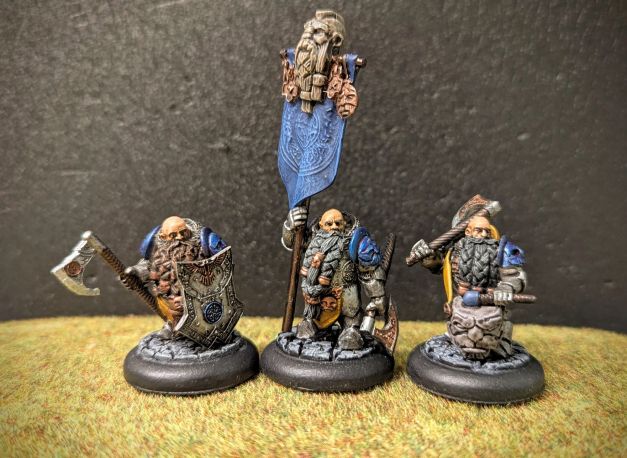
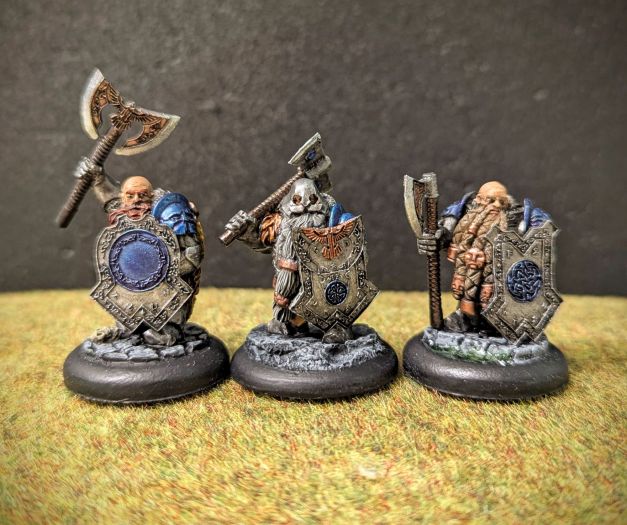
I found what I was looking for in a big box full of various units and figures from Scibor Monstrous Miniatures – one of my all-time favorite makers of chunky, characterful dwarf models. (Yes, it’s true, I have so many Scibor kits in my dragon hoard that they have their own dedicated box.)

These guys were a lot of fun to paint up. I’m not always fond of bare heads (something about my lack of precision and patience when painting faces) but these guys weren’t too difficult.

I painted these guys up over the summer, and they’ve yet to see the battlefield. I’m sure they’ll eventually take to the field in a game of Hobgoblin – I played a session earlier this year with John and got my butt kicked. (And I convinced myself the reason I lost is because I didn’t have a sufficient critical mass of armored dwarvess. Problem solved!!)

Stay tuned for more content in general from Comrade’s Wargames. After a long drought, I’m easing back into the saddle to share more quality hobby content with my tens of readers.

THE DOOMED Battle Report and Review

Posted by Comrade on October 10, 2023
Posted in: Posts. Tagged: 28mm, 40k, club, game night, grimdark, narrative, post-apoc, sci-fi, warband. 8 Comments

Last month a new game landed like a hand grenade right in the midst of Comrade’s Wargames – THE DOOMED, the new apocalyptic sci-fi skirmish game from Osprey Publishing, written by Chris McDowall.

My group had been eagerly awaiting the release of this game. The premise sounds delicious – warbands of grimdark sci-fi soldiers battle across a benighted planet overrun with nameless horrors. The setting is not defined in great detail, but it seems clear that THE DOOMED is aimed at baroque sci-fi, the sort which features demons, inquisitors, cyborgs, cultists, and motley bands of hardened soldiers. Sound familiar? It certainly tracks with what we’re all about here at Comrade’s Wargames.

We got in a game toward the beginning of October, so I’ll intersperse some photos and impressions of our game throughout this post. Here’s the setup for our game: an abandoned laboratory.

THE DOOMED (sorry, caps lock just seems to pop on whenever I type the name of this game) is a skirmish-sized game meant to be played on a smallish table filled with terrain. The maximum size of any warband is eight models – no more than that. There are 4 flavorful warband lists to build your forces. In addition to two opposing warbands, every game features a Horror – a chaotic monster of some sort, usually with a few weaker minions nearby. Each Horror has its own set of special rules that govern its behavior on the battlefield and the behavior of its minions. Along with the Horror, each scenario also specifies some nexuses, which are basically “weak points” on the battlefield that must be defeated before the main Horror can die. Imagine egg sacs, or power stones, or prey carcasses … as long as those exist, the Horror is effectively “shields up” and largely invulnerable. The nexuses must be dispatched in order to defeat the big boss.

As you can imagine, this was an absolutely delightful game concept. Player-vs-player, with the added twist of a rampaging spoiler faction that operates under its own set of rules. To be clear, THE DOOMED is not intended to be a competitive game. Instead, it is designed to represent savage combat between warbands where the greatest threat is probably not the opposing player … it is the Horror that stalks the tunnels, slaying without prejudice or preference. The game is designed to promote collaborative gameplay alongside traditional matchups. Will you join forces for a turn or two to punish the big bad, and then go back to gleefully slaughtering the opposing warband? Who will break the gentlemen’s agreement first?

Our game got underway with some cautious exploration by both warbands. Inquisitor Ash, commander of John’s contingent of feudal sci-fi guardsmen, led her warriors to examine the first laboratory.

Meanwhile, my Dark Mechanicum warband led by Ozmas Hyperfane, the Sanctified Ferromancer of the Sixth Liturgy, filtered into the abandoned science facility by another route, which unfortunately brought them into close proximity to THE DEVOURER (i.e. the Horror that we selected for this scenario). The Devourer activated and promptly began pursuing my Dark Mechanicum warband.

One of the most innovative aspects of THE DOOMED is that there are no movement rates or weapon ranges. You basically nominate a model, describe where you want to move, and then roll a dice vs. your figure’s Quality to see if you are successful. If you succeed, you move directly to that point. If you fail, your opponent places your model anywhere along the route you described. Yikes! Ranged combat operates similarly … everything is understood to be in range, so the only real limits are line of sight and intervening terrain and cover.

I’ve played games like this before, and they really require – nay, demand – an incredibly dense terrain setup. Thankfully, that happens to align with our interests here at Comrade’s Wargames, and we are blessed with a wealth of beautiful handmade terrain to adorn our battlefields. Just something to be aware of it as you’re reading through THE DOOMED rulebook.

Even as the Devourer closed in and its devilish minions spawned at random points throughout the battlefield, my warband tried to remain focused on the objective, which was to occupy and seize two of the three laboratories. The labs themselves had a variety of nasty rules in effect to make them into truly deadly combat zones.

As the halls rang with the sound of desperate combat, somehow Ozmas Hyperfane barged his way into one of the labs and encountered a puddle of viscera which represented one of the Devourer’s nexuses. Aha! Its weak points were revealed!

Before Ozmas could stomp the goo puddle, he had to dispatch John’s feudal guardsman. Thus our first player-vs-player combat was joined!

THE DOOMED has a fairly simple combat resolution system, so it was easy to get up to speed. Weapons have straightforward profiles emphasizing the number of dice rolled to attack or the number of dice rolled to deal damage, along with a special rule or two. The rules system in general seems to play second fiddle to the voluminous sections devoted to the various Horrors, their lairs, their henchmen, and their in-game capabilities. Truly, this is a scenario-based game, and the star of every scenario is The Horror.

The Devourer quickly picked up the scent and smashed his way into the laboratory to confront Ozmas Hyperfane. The confrontation was decidedly one-sided – the poor cyborg was smashed into pulp and wreckage by the enraged beast. Oops … there goes my leader! How could I possibly carry on without this key piece of my warband?

Meanwhile, Inquisitor Ash and her cohort of goons was doing a good job of clearing and securing the other labs. Demonic dogs (spawn of the Devourer) continuously menaced her and her warriors as they struggled to gain the upper hand. More critically, they were responsible for destroying the final two nexus points, thus making the Devourer vulnerable to lethal attacks.

And about that Devourer … to put it mildly, he decimated my warband, slaying them almost to a man. Temporarily out of targets, the big guy stepped out of the laboratory – and into range of my cyborg railgunner, who proceeded to pop him at range with a series of spectacular dice rolls, followed by whiffed defense rolls by the Devourer, which snuffed out the big guy and ended our first game of THE DOOMED.

This was a tremendously satisfying game that brought together several of my favorite tabletop gaming concepts: skirmish sized games with warbands comprised of unique models, AI-driven NPC factions, and objective-based scenario play. John’s terrain was lovely, and his newly painted Devourer model (plus those demonic dogs) was a real treat to get onto the battlefield. The game itself is definitely designed to encourage some fun kitbashing and DIY terrain creation. The massive list of unique Horrors in the rulebook, combined with an equally comprehensive array of scenarios, ensures that we’ll play this one again soon … and that no game will be precisely the same.

Posts navigation

← Older Entries
  • Recent Posts

    • Hobgoblin: More Thoughts and Musings
    • Grimdark Future: The Scouring of Hundvolst
    • Shadow War: Armageddon Battle Report & Review
    • The Expedition Soldiers On
    • THE DOOMED Battle Report and Review
  • Follow Comrade's Wargames on WordPress.com
  • Tags

    28mm 40k army battle report caluphel campaign chaos club death guard dragon rampant dwarves fantasy game night grimdark hobby miniatures narrative nurgle painting post-apoc project saga sci-fi skaven skirmish terrain warbands wargames warhammer workshop
  • Archives

    • November 2025 (1)
    • October 2025 (2)
    • September 2025 (1)
    • October 2023 (2)
    • September 2023 (1)
    • August 2023 (2)
    • July 2023 (3)
    • June 2023 (3)
    • May 2023 (4)
    • April 2023 (2)
    • March 2023 (5)
    • February 2023 (2)
    • January 2023 (2)
    • December 2022 (1)
    • November 2022 (1)
    • October 2022 (4)
    • August 2022 (2)
    • July 2022 (1)
    • June 2022 (2)
    • May 2022 (5)
    • March 2022 (1)
    • February 2022 (1)
    • January 2022 (3)
    • December 2021 (1)
    • November 2021 (2)
    • October 2021 (1)
    • September 2021 (2)
    • July 2021 (1)
    • June 2021 (1)
    • May 2021 (2)
    • March 2021 (3)
    • February 2021 (1)
    • January 2021 (3)
    • December 2020 (1)
    • October 2020 (1)
    • September 2020 (2)
    • August 2020 (1)
    • July 2020 (1)
    • June 2020 (1)
    • May 2020 (1)
    • April 2020 (1)
    • March 2020 (1)
    • February 2020 (2)
    • January 2020 (3)
    • December 2019 (5)
    • November 2019 (1)
    • October 2019 (1)
    • September 2019 (2)
    • August 2019 (2)
    • July 2019 (4)
    • June 2019 (3)
    • May 2019 (3)
    • April 2019 (1)
    • March 2019 (1)
    • February 2019 (2)
    • December 2018 (3)
    • November 2018 (3)
    • October 2018 (5)
    • September 2018 (5)
    • August 2018 (5)
    • July 2018 (5)
    • June 2018 (2)
    • May 2018 (1)
    • April 2018 (3)
    • March 2018 (1)
    • February 2018 (1)
    • January 2018 (1)
    • December 2017 (1)
    • November 2017 (5)
    • October 2017 (1)
    • September 2017 (2)
    • August 2017 (4)
    • July 2017 (4)
    • June 2017 (3)
    • May 2017 (4)
    • April 2017 (3)
    • March 2017 (7)
    • February 2017 (6)
    • January 2017 (2)
    • December 2016 (5)
    • November 2016 (2)
    • October 2016 (3)
    • September 2016 (4)
    • August 2016 (5)
    • July 2016 (6)
    • June 2016 (8)
    • May 2016 (2)
Create a website or blog at WordPress.com
Comrade's Wargames
Create a website or blog at WordPress.com
  • Subscribe Subscribed
    • Comrade's Wargames
    • Join 154 other subscribers
    • Already have a WordPress.com account? Log in now.
    • Comrade's Wargames
    • Subscribe Subscribed
    • Sign up
    • Log in
    • Report this content
    • View site in Reader
    • Manage subscriptions
    • Collapse this bar
 

Loading Comments...