Last month, my game group’s little Discord server lit up with chatter about Black Death City, the new Mordheim-inspired fantasy heartbreaker from Sam Pearson (author of the original Warcry rules, among other GW titles).
A few of us had been following the rumor mill around Black Death City since Sam started sharing hints and nuggets on his YouTube channel last year. We’re huge fans of warband-sized fantasy skirmish games, particularly games with a miniatures-agnostic approach and lots of customization. Our portfolio of games played over the years includes Frostgrave, Open Combat, Relic Blade, A Song of Blades & Heroes, and most recently, Sword Weirdos.
So you can see how a fantasy skirmish game inspired by the granddaddy of ’em all (Mordheim) would be right up our alley.
Things started moving quickly once Sam released the alpha playtest version of Black Death City. The latest version of this edition is available on his game website. It includes the core rules, four unique and highly playable warbands, and a handful of assorted scenarios.
Gentle readers, even I was shocked at how quickly my game group mobilized after we got our hands on these rules. Within three days of snagging the PDF, we had scheduled a Black Death City game day in John’s garage game room. Incredibly, we were able to set up three (3!) separate game tables for six total players, each group playing a different scenario on beautiful battlefields of nicely painted terrain.
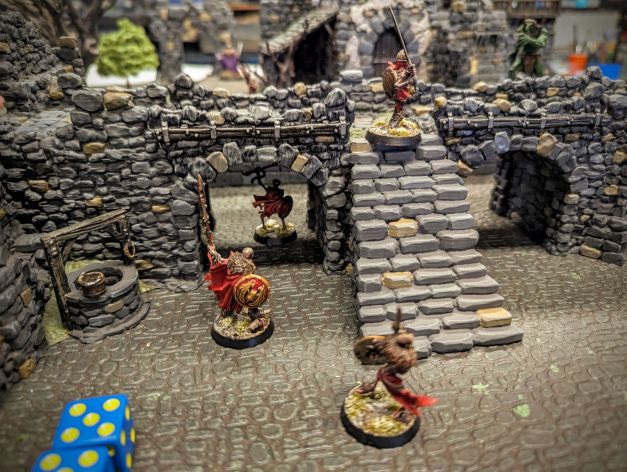
I took quite a few photos of my own game and didn’t record the other two games in great detail. I believe we had all four warbands from the main rulebook represented. My own game was Verminkin (ratmen, my vintage all-metal Skaven army) vs. John’s Guild Mercenaries (scroungy humans, a scurrilous lot at best).
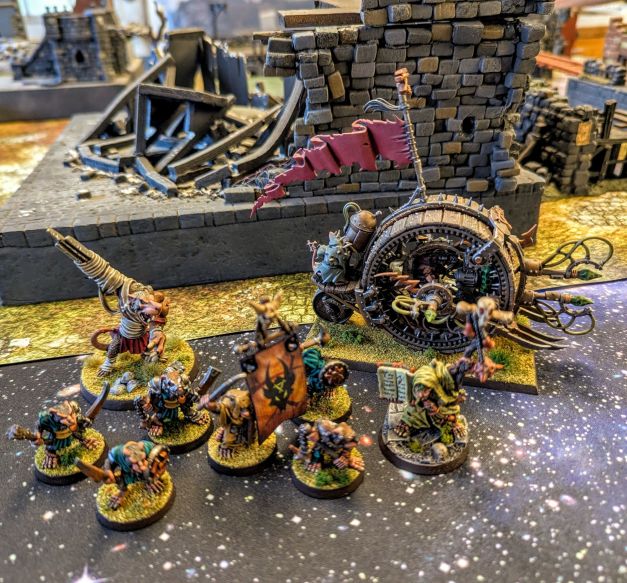
For our scenario, we selected “The Find,” which begins as a standard loot-the-hoard scenario with a mound of treasure in the center of the table and an understrength troop of guards nearby. Each scenario in Black Death City includes some optional twists that you can roll randomly to inject a little spice into your game. In our case, our random twist said that John’s warband could not break and flee the battlefield — for better or for worse, they would stand and fight!
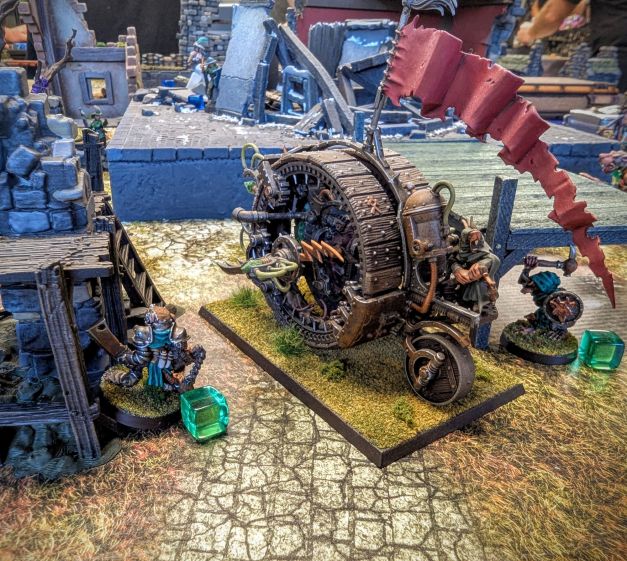
This suited my Verminkin just fine. My standard henchmen were a bit faster than John’s soldiers, and my rat mutant and “rolling contraption” (Doomwheel) also had increased mobility, so we found ourselves closing the distance rapidly.
The game uses alternating unit activations, which is a modern game design principle I love, because it ensures that both players are engaged throughout the turn.
Black Death City aims to keep core mechanics simple, while adding complexity and decision points both before and after the core dice rolls. For example, there are just a handful of modifiers for a typical attack roll, so you almost always know what you’re rolling without having to consult the rulebook or remember a situational modifier.
The complexity comes after the attack roll, when you’re figuring out armor saves or damage or some other outcome. This keeps the game speeding along and ensures that players are only doing a deep dive into the rulebook for truly cool stuff, like arcane wizardry or some sort of close combat flourish.
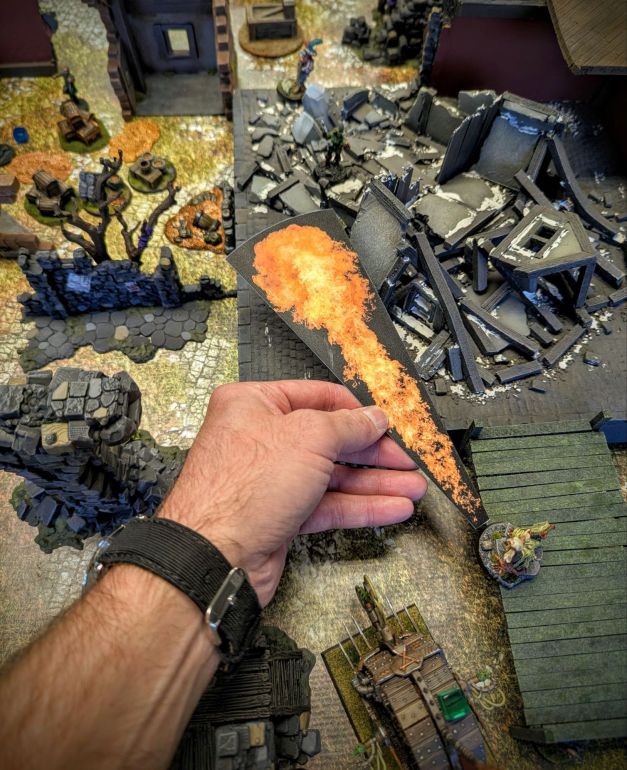
In our game, I had an absolutely tremendous time exploring the magic system in Black Death City. Each faction has access to two very different Spell Lores (i.e. lists of themed spells) which offer two very distinct play styles.
For the Verminkin, I selected Lore of Poxes, which gave me several plague-themed spells … including Spray of Vomit, which I gave to both my main wizard and my apprentice! You can see the gruesome effect in the photo above. Just gross, man, totally gross. That’s gonna leave a stain.
Spray of Vomit proved to be a great equalizer, because I didn’t have any other ranged combat models in my warband. John, meanwhile, had several models with ranged weapons, although his dice rolls didn’t quite prove out the viability of those options. In truth, he didn’t score a single ranged combat attack until very late in the game, when his warband was on the run and it didn’t matter much.
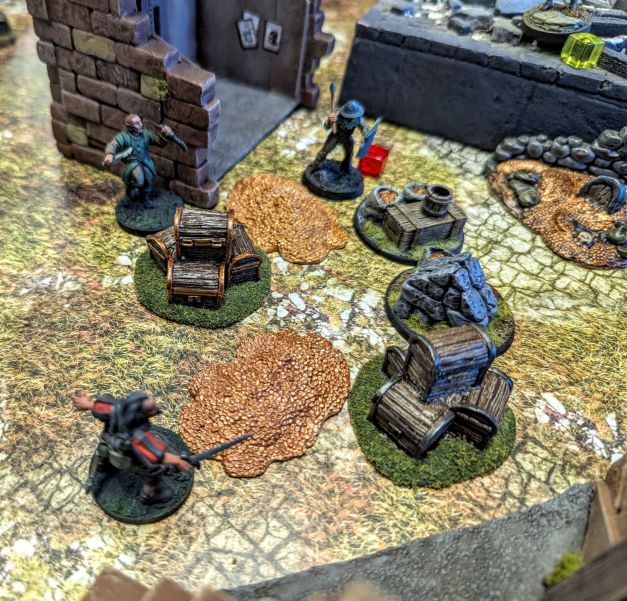
As my rats closed in, John wisely consolidated his soldiers around the treasure in the center of the table. Each treasure token could be picked up and carried off, but not until turn three, so he had to withstand my advance until then.
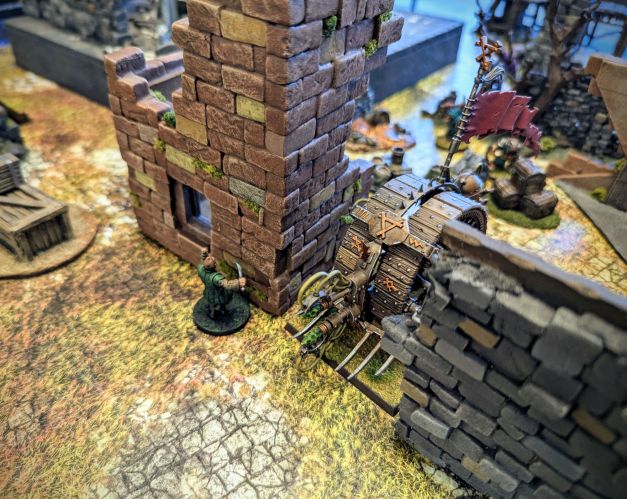
And advance I did! The Doomwheel smashed right into the treasure hoard, followed closely by some trailing rat-henchmen. The Doomwheel rolled 2d6 for its movement each turn, plus an additional d6 when charging, which made for an extraordinary gamble when you wanted to close into combat. We laughed and went along with it, which I’m sure is exactly what players have been doing with silly rat contraptions since the early days of Warhammer.
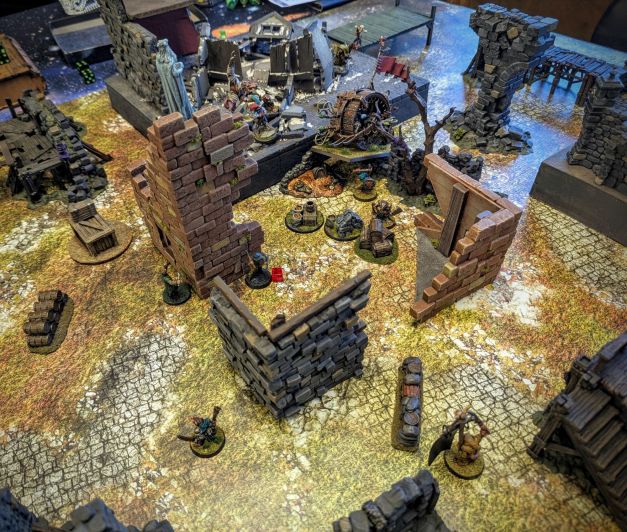
I’m sure my headlong advance would have played out much differently if John had been able to land some meaningful shots with his archers and black powder soldiers. But they missed, which left his poor soldiers at the mercy of my clanking contraption.
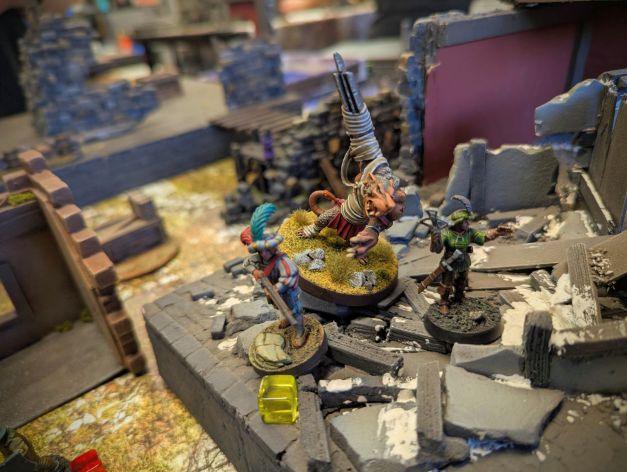
Similarly, a flanking attempt through the ruins was stopped in traditional fashion: by flinging a rat mutant at the problem!
We learned a thing or two about melee combat, which is one section of the rules that could benefit from some playtest and feedback. Don’t worry — we shared our thoughts on the Black Death City Discord server, which spawned quite a bit of great discourse that will no doubt improve the final game in many ways.
In brief: the game has a parry ability that allows fighters equipped with a sword or similar weapon to cancel out a success from their opponent’s dice pool. While fun and flavorful, we wondered if it wasn’t just more effective to use your own successes to pound on your enemy, skipping parry entirely in favor of landing more hits?
From a gameplay mechanics perspective, it seemed to be the most productive path in most situations, but clearly this was not in the spirit of the rules as Mr. Pearson had envisioned them. He wanted parry to matter! And so do we! So clearly there is an opportunity to think deeper on this particularly quandary and refine the parry rules a wee bit.
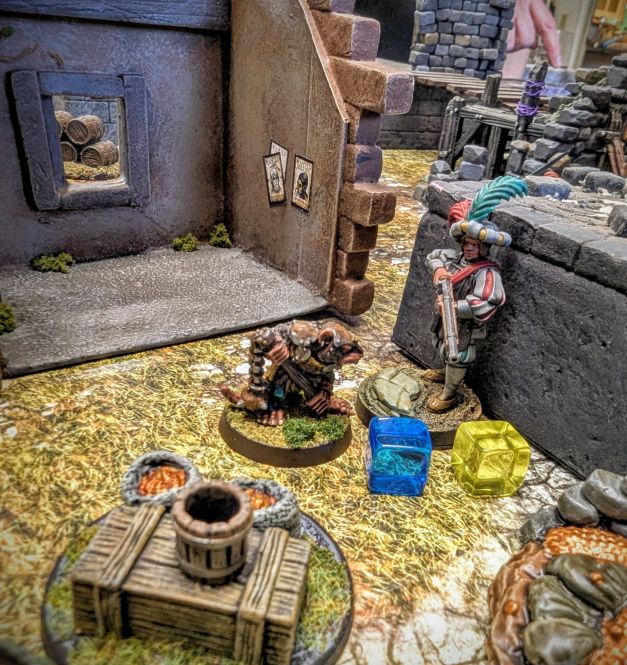
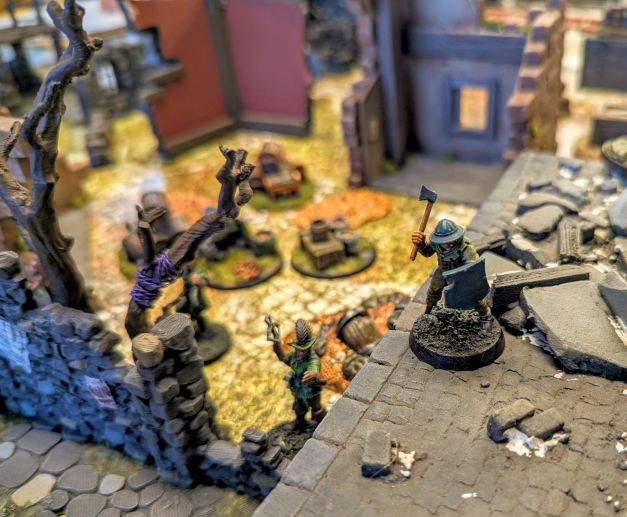
In any case, the ratmen scattered the guards in the treasure hoard and began pursuing lone survivors. Some dodgy humans began fleeing with their pockets filed to bursting with gold coins — what a disgrace! This dishonored noble in the photo below is one such scoundrel.
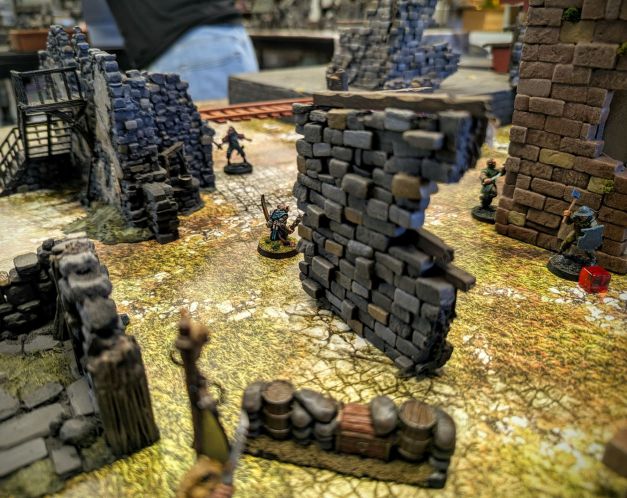
He was chased down like the craven dog that he is and doused with a Spray of Vomit from an apprentice spellcaster.
That was pretty much the conclusion of our game. It seemed that John’s warband might escape with one or two treasure tokens, while my ratmen secured the rest and also feasted on the slain soldiers strewn across the battlefield.
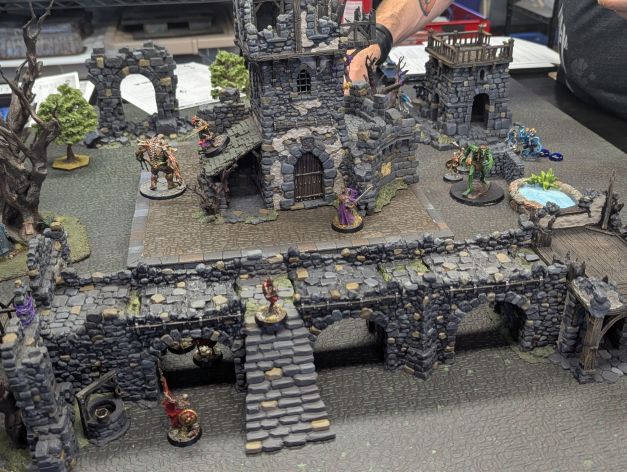
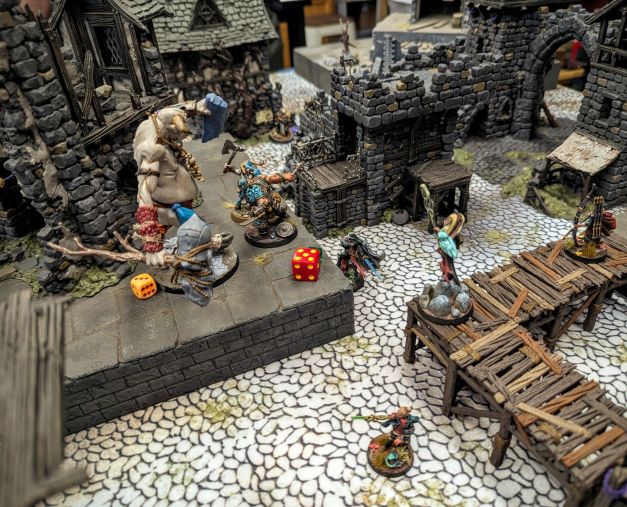
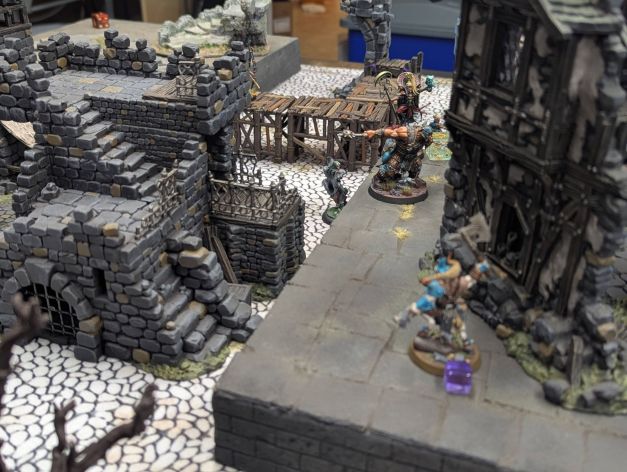
But wait! I have a few photos of the other games taking place around me. Both games featured Lawrence’s gorgeous new batch of printed terrain that he has been busily painting up over the last couple of months. A true treat for the eyes!
With all three of our playtest games concluded, the gang spent some time chatting about Black Death City.
In general, we loved it. We’re big fans of Mordheim — not the rules themselves so much as the gameplay they tend to inspire — and it’s very clear that Black Death City is going to be picking up that torch and carrying it into the future.
The game is entirely playable in its current form. There’s active development on the Discord server around particular topics like melee combat. I’ll be participating in those conversations, along with some other guys from my group. We’re invested!
Black Death City lacks lore, aside from some general references to a ruined, plague-infested fantasy city. As a personal plea, I’d advise Mr. Pearson to avoid adding too much lore to this game. You can do a lot with a little in the realm of fantasy skirmish gaming. At no point should there be so much lore that I start to second-guess my ability to build and play whatever style of warband appeals to me.
As an example, I’d point to Hobgoblin. It features a blast of fresh lore, cold and bracing as the north wind, that hits you like a slap in the face and then leaves just as suddenly. It’s not heavy or clingy like a damp blanket; it doesn’t attempt to smother your army creation or steer you away from a particular kit or model because it doesn’t “fit” the lore. Rather, it’s the sort of truly original content I find myself re-reading because it’s so damn delightful.
So: if there’s to be lore, keep it sparse and spare, with plenty of room at the margins for us to imagine our own warbands’ exploits.
As for Black Death City, we’ll definitely play this one again soon. And as soon as the campaign rules get released, you can bet we’ll dive right in.

