Recently I banged out a few Necromunda-style sci-fi terrain pieces after getting inspired by some posts that came across my social media showing nifty examples of aquarium filter panels being used to create terrain tiles.
I’m a sucker for cheap, creative ways of replicating the various pricey terrain sets that have come along in the last few years. In this case, the sci-fi floor tiles from Games Workshop are undoubtedly cool, but the amount of money required to make an entire tabletop of these premium pieces would probably buy a small island in the Seychelles.
So when I saw that someone had created some decent lookalikes using those super cheap plastic aquarium filter panels, I knew I had to give it a shot.
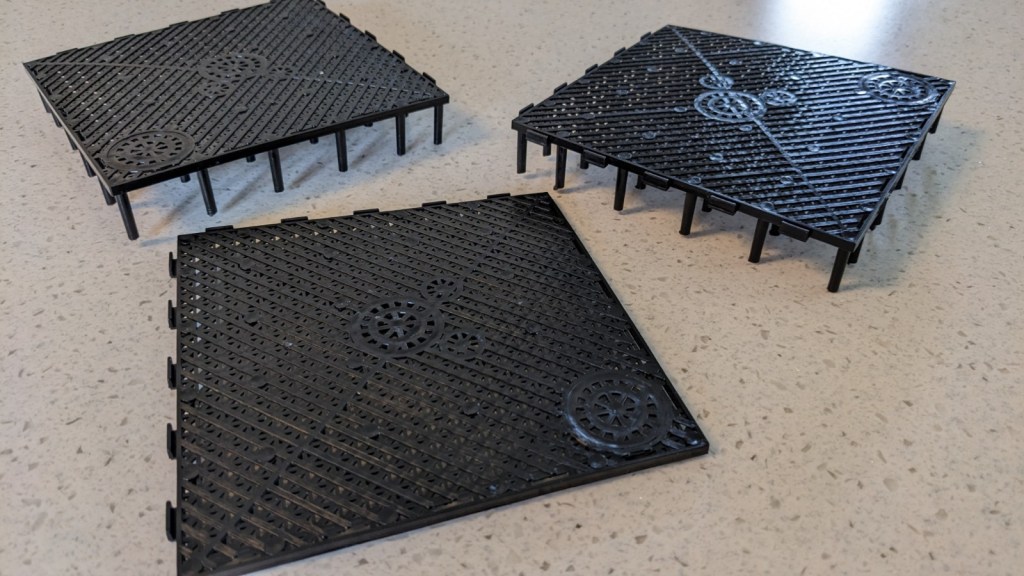
These panels are roughly 6 inches square and came in a pack of 10 for $14.99 shipped to my door. That’s my kind of price!! They come with a pleasing crosshatched pattern, plus a few round circular areas that looked ideal for future detailing.
As you can see in the photo above, they also come mounted on plastic 1-inch pegs that lift them off the ground. Very cool! I ended up snipping off the legs because these panels are made of flexible, somewhat soft plastic, and I knew I’d have to work hard to make them lie flat.
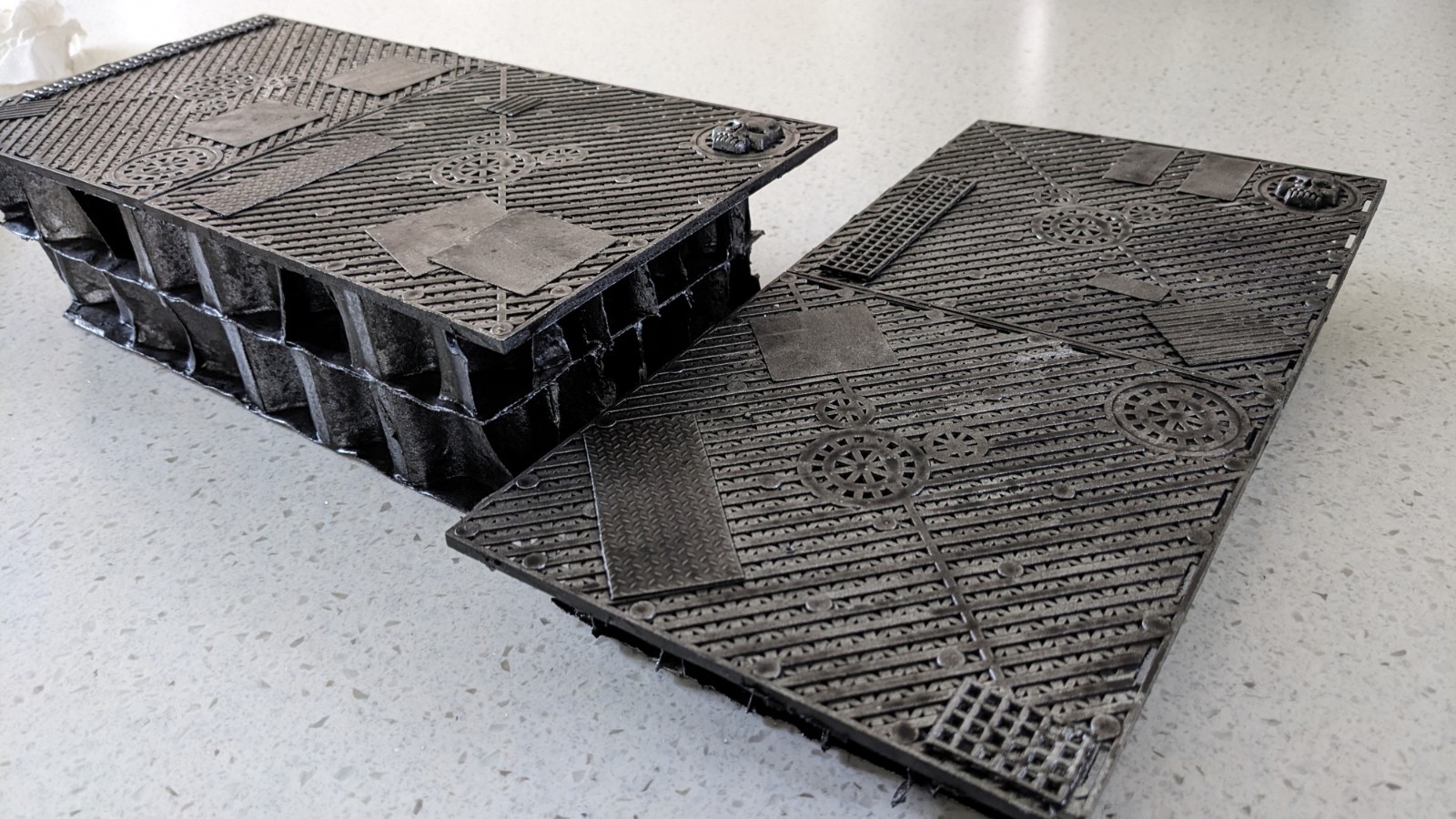
To that end, I mounted the plastic panels atop several layers of heavy corrugated packing cardboard that I had lying around. First I hardened these pieces with several layers of black paint and Mod Podge, then I glued the plastic panels down using a goopy outdoor adhesive. I had to weight them down with books to make sure the panels remained flat – they are soft and somewhat flexible, and the edges threatened to curl up without some weight.
The tiles looked great out of the box, but I decided to take them to the next level by affixing some additional bits – grating, plasticard, corrugated cardboard, just a variety of textures to break up the surface a little bit and create some visual interest. You could skip this step entirely, because the base filter panels look superb as is.
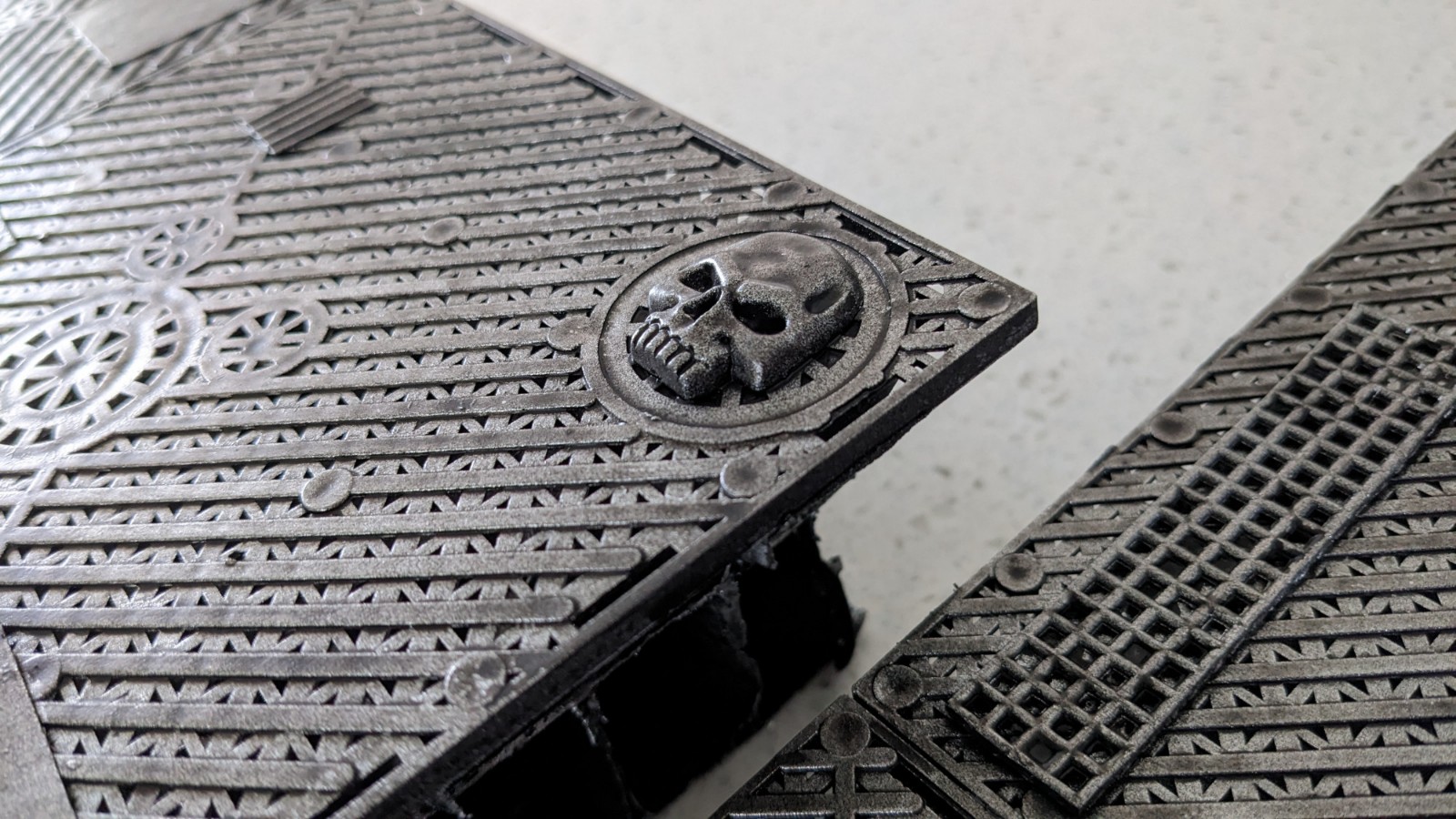
I also added some skull glyph plates that had been languishing in my bits box for years. Because this is 40k after all!
As you can see, the whole thing got sprayed black, then silver using regular old rattle cans from the hardware store. I covered that with a heavy black wash that dulled everything down and set the stage for the grimdark phase, which featured heavy sponge application of browns, oranges, and yellows, plus some decals and propaganda posters to punch up the zaniness.
Oops, looks like the decals weren’t quite dry in these photos. They look great now, though!
The circular details on the filter panels look particularly fantastic. They could be hatches, manhole covers, or drains leading to a fluid reclamation system. Whatever they might be, they look tremendous!
I’m inordinately pleased with how these turned out. I’d say 75% of the painting work was accomplished with rattle cans of spray paint, and I never used a detail brush at all – just sponges for the final highlights.
The best part was that I only used 4 of the 10 tiles in the pack to make these two delightful terrain pieces. More to come for sure, and soon!
Following their tactical defeat in the darkest depths of the sumps in Hive Sacrament, the forces of the Imperium fell back in the face of a frenzied pursuit by a hodgepodge of cultists. Some were sworn to serve the hereteks of the Dark Mechanicum; others bore the sigil of the many-armed Star-Children. Shockingly, among their number strode a few power-armored Astartes of the Dark Angels. Why would the Sons of the Lion make common cause with such vile heretics? Truly, it was a riddle wrapped within an enigmas.
Welcome, dear reader, to the second session of our Grimdark Future campaign, The Cauldron. The first session was an epic 8-player affair, featuring two side-by-side games set in the lower levels of Hive Sacrament. With the forces of the Imperium generally routed (with some exceptions), it seemed appropriate for the heretics to continue their uprising by pushing into unexplored areas of the underhive.
The heretics caught up to their quarry in an abandoned service sector, which showed signs of having been the site of a battle years or even decades ago. Here, amongst the blackened platforms and rusted catwalks, the defenders of the Imperium would make their stand.
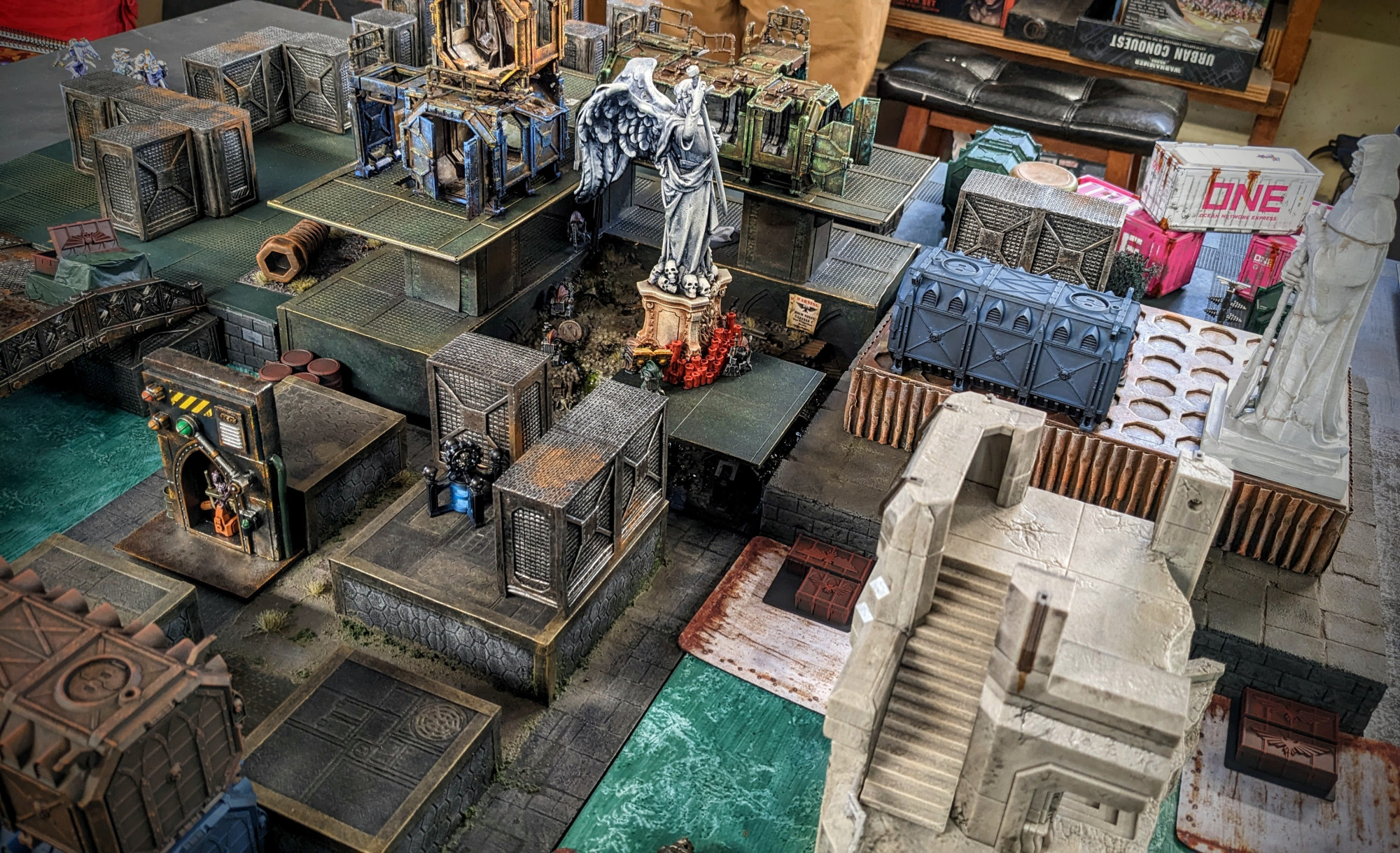
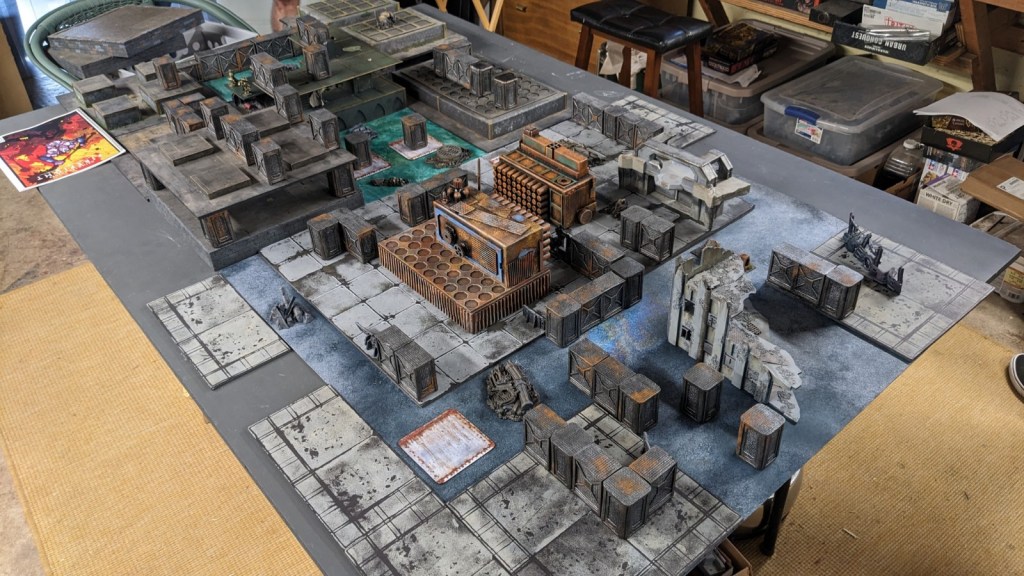
Here’s our table setup, featuring some exciting new pieces of terrain.
We’re playing Grimdark Future Firefight for the first portion of this campaign, starting at 250 points and escalating to larger games as the campaign proceeds. For this game, each player brought 350 points of units. The game was structured as a 3-on-3 team game, which was large but not unmanageable (since we are veteran OPR/Grimdark players).
As the game got underway, the cultists boiled forth out of the depths of the underhive, sweeping like a foul tide into defensive positions that were thinly held by elements of the Adeptus Sororitas, Imperial Guard, and Space Wolves.
John’s Guardsmen and Rian’s Sisters of Battle had a fairly advantageous deployment zone, as it featured a lower level where they could maneuver in the backfield in relative safety and out of line of sight. From a tactical standpoint, I couldn’t easily see their units from where I was sitting, and I honestly forgot where some of them were located! Literal stealth!!
Daniel’s newly painted Genestealer Cult warband, the Starchosen of Manifest Salvation, played a central role in the heretics’ assault. Quite a few of his hardest-hitting units had the ambush or scout ability, which in Grimdark Future Firefight gives them the ability to either deploy further forward or pop out and ambush unsuspecting units later in the game. He used both abilities to great effect.
In the pic below, Daniel’s crusty mutant races forward to menace a fire team of Imperial Guardsmen. This beastly creature was defeated, but his mere presence disrupted John’s advance and helped isolate his snipers so my long-range cultist riflemen could pick them off.
Speaking of snipers, they proved to be a high risk / high reward unit for John’s warband. They seized the high ground early on and laid down punishing fire on the few heretics who were caught out in the open. After some losses, the heretics adjusted their tactics, sticking to cover and using their relatively few long-range firepower to eventually take down the snipers.
On the flank, Parker formed up his Space Wolves and advanced to meet the cultists. After some hot dice rolls in the opening turns, I was confident about my chances here. Unfortunately, the Space Wolves rallied and pushed back the cultists, ultimately seizing the objective on this flank.
In the end, the heretics had swarmed over most of the board, despite taking horrendous losses. The game came down to a handful of key dice rolls in the final couple of turns.
One such clash came when Parker’s Space Wolf equipped with a jump pack (!) and a flamethrower (!!!) landed behind my long range cultist sniper. In a miraculous display of zealotry, the cultist made all his saving throws and managed to return fire and pin the Space Wolf, effectively neutralizing the threat on the final turn of the game.
And so an uneasy silence settled across the abandoned hive sector. The defenders of the Imperium withdrew to better defensible positions elsewhere in the underhive. The cultists went to work harvesting equipment and weapons from the fallen warriors and carrying out unspeakable rituals in the black depths of the hive.
Truly, a dark tide is rising in the depths of Hive Sacrament. While the pilgrims still go about their holy duties in the upper levels, the fate of the Gamma Euphorion star system is being decided in the grim, gore-splattered underhalls of the resplendent hive city.
And so our second campaign session concludes with the hard-pressed defenders of the Imperium once again seeking to stem the tide of heresy. Stay tuned for more – our next game(s) will see the players bringing 500 point warbands for Grimdark Future Firefight. More to come soon!
I absolutely adore Tabletop World’s crisp resin buildings. They’re well worth the price, even with shipping from Europe to the USA. I painted up a couple smaller cottages a couple years ago, but in late 2022 I embarked on my largest project yet – the epic Mansion building!
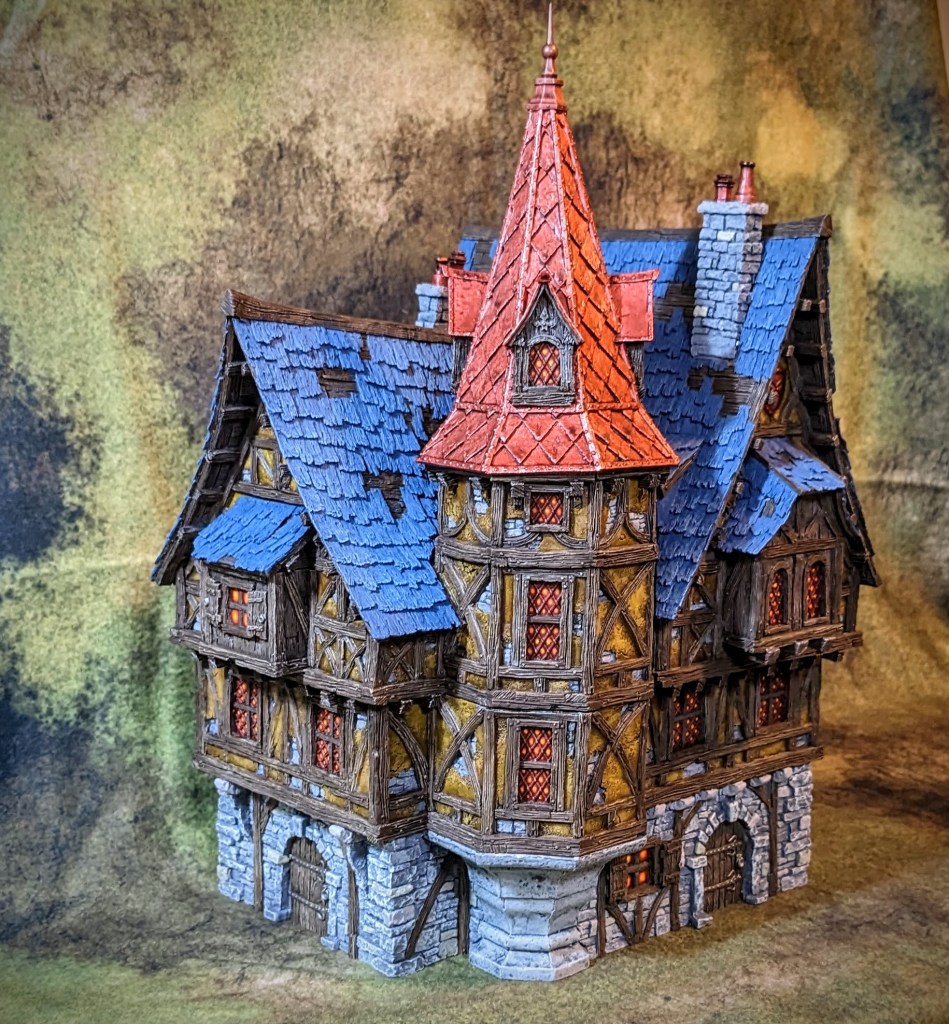
I’ll cut to the chase and show you the final completed model in all it’s four-story glory.
TTW terrain pieces are fully detailed inside and out, and the casting is absolutely superb – I’m talking machine-shop precise. The 7 or 8 pieces that make up this kit fit together with incredible precision, and no flash anywhere to speak of.
I started with a simple gray basecoat, which was to form the foundation for the stonework that defines the base of the building (and peeks through the wattle & daub of the upper levels). I picked out a few stones in off-gray colors to create some variety, then drybrushed the entire piece in progressively lighter shades of gray. This created a decent undercoat for the rest of the colors.
The timbers became dark brown after two coats of raw umber. I really like raw umber for terrain, as it gives a brown hue with a touch of green that is transparent, allowing the gray drybrushed highlights to show through.
The windows on my other TTW buildings always draw the eye when they’re on the table, so I wanted to recreate that effect here. I’m going for a warm effect that suggests rooms lit by candles, braziers, sconces, and fireplaces. If you could peek in these windows, you’d see bawdy feasts and ribaldry on display. It’s a fun effect, looks good from a distance, and it’s quite unlike how most people paint windows.
Here’s that completed pic again. It’s hard to see in this photo, but the upper turret is painted copper, not orange. The roof of the turret is festooned with rivets, which to me suggests metal of some sort. Copper it is! Maybe in a few years I’ll go back and add in some patina and verdigris.
Now you might be wondering: blue wood shingles for the roof? Sure, why not? It’s a fantasy setting, so anything goes. The blue pleased me when I was looking at different colors, so I went with it.
So that brings my total collection of TTW buildings to three (3)! But I’m not done yet – my buddy Lawrence, who is even more of a fiend for these pieces than I am, has been busy scooping up lots of TTW terrain off ebay and miniswap, and he’s offered me a duplicate blacksmith’s cottage to paint up. So look for that later this year, once I’ve rebuilt my stamina for these gigantic terrain projects!
In the depths of Sacrament, far below the glittering hive towers and their resplendent terraces, below the incense-filled halls of statuary and throngs of offworld pilgrims, below the vast administratum strata, filled with warrens of offices and functionaries dedicated to the daily operation of the sector’s most popular shrine world, below even the turgid reclamation levels where basic utility functions are carried out by low-wage menials — deep in the depths of the underhive, something stirred. A psychic signal, pulsing and building in strength. An indifferent malevolence seeded decades ago that is just now beginning to pupate.
What will its emergence mean for the hive world of Sacrament, the world of Gamma Euphorion Prime and its attendant moon Drusichtor, and the greater Juventius Sub-Sector? Not much is known, but we can be certain that the outcome will be both grim and dark.
Welcome, gentle reader, to the official kick-off game for our 2023 narrative sci-fi campaign: The Cauldron. We’re starting small, with a series of skirmish games using Grimdark Future: Firefight to build our warbands and probe the edges of the Gamma Euphorion Prime setting.
The campaign name is a reference to the pressure-cooker environment in the beleaguered shrine world planetary system, where a dormant genestealer threat may be awakening, just as techno-cults rise to pursue their own nefarious aims, and plague disciples arrive from offworld bearing gifts for the shrine world’s pilgrims. Can the light of the Emperor pierce such absolute darkness?
The primary setting is the hive city of Sacrament, on the planet Gamma Euphorion Prime. A secondary setting that has already been explored in a recent game is Drusichtor, a moon of Gamma Euphorion Prime that boasts a massive industrial mining operation.
For the kickoff game, we assembled eight total players — possibly a record for John’s game room! We divided up into two smaller games of Grimdark Future: Firefight. Both were structured as 2-on-2 team games. As is typical, I got rather a lot of photos of the game I was involved in, and fewer photos of the other game. Read on for luscious photos and a gameplay report!
We pooled our collective grimdark terrain to create these two battlefields, representing an upper level in the underhive (on the right) and a fetid lower sump (on the upper left), replete with stagnant pools of water and rusty walkways.
The combination of textured terrain tiles, playmats, elevated risers, and scatter terrain really created a satisfying hive environment, with lots of cover and claustrophobic areas. Plus, all of our disparate terrain seems to more or less match!
We imagined these games as taking place roughly atop each other, on different levels of the underhive. The sump level, with its drains and waterways, played host to an incursion from well-intentioned warband of space dwarves working alongside the questionably loyal servants of the Imperium. This oddly matched pair of factions went up against the faith-drenched forces of the Adeptus Sororitas and their allies, the Astartes of the Salamanders chapter. Unshakeable loyalty versus … well, slightly more porous loyalty! But loyalty nonetheless!
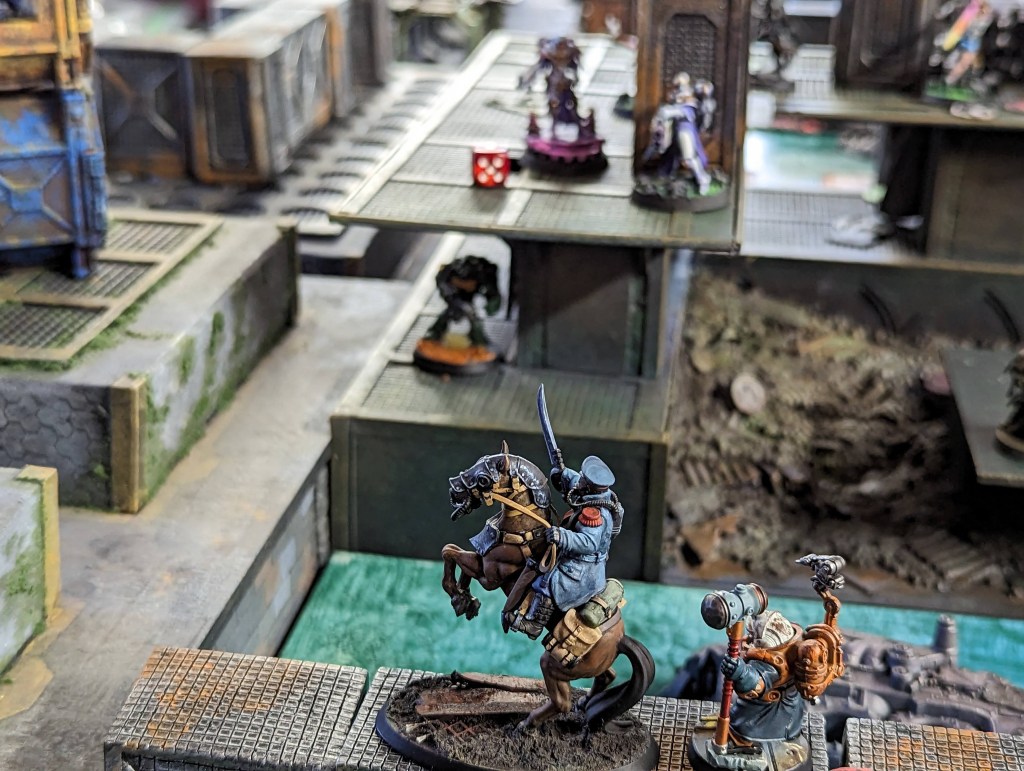
And, a horse!
The game that I was playing in took place in the upper portion of the underhive, a few levels above the clash in the sumps. My game featured a tenuous alliance between two warbands of tech-obsessed Mechanicus scavengers (are they good guys or bad guys? who can say?), battling against a team-up straight out of Codex Astartes: Space Wolves and Dark Angels!
Did I mention this game had a horse as well?
Two horses in the underhive?! How do they even eat? It doesn’t make any sense…
Anyway, given that we were playing Grimdark Future: Firefight, it should come as no surprise that the games were fast and furious, with lots of careful maneuvering and explosive combat.
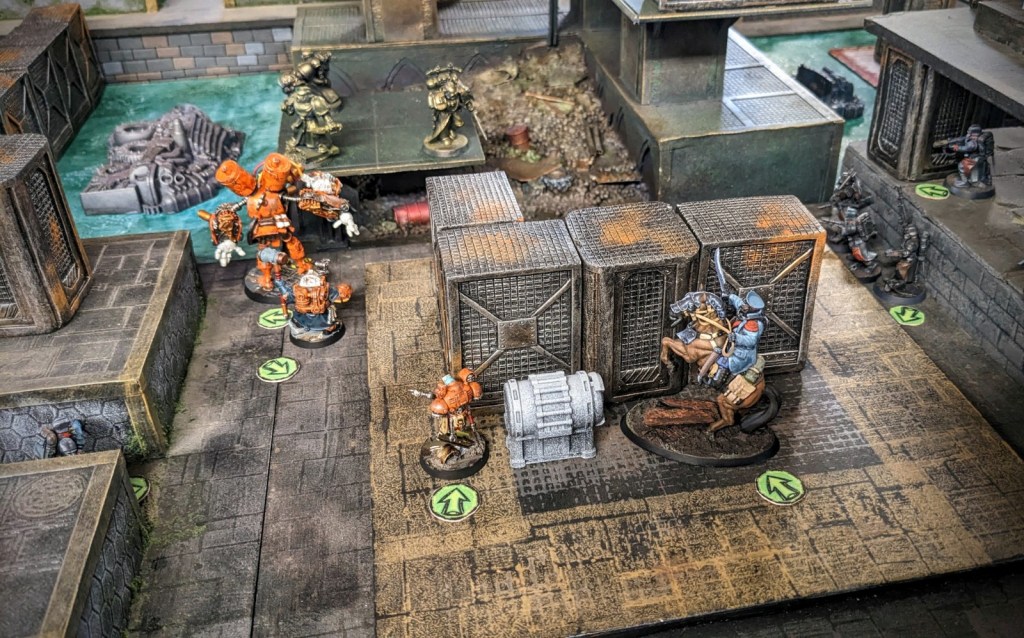
The sump level game began with the orange-armored space dwarves advancing alongside the servants of the Imperium, led by the sweatiest cavalry officer on the entire planet of Sacrament.
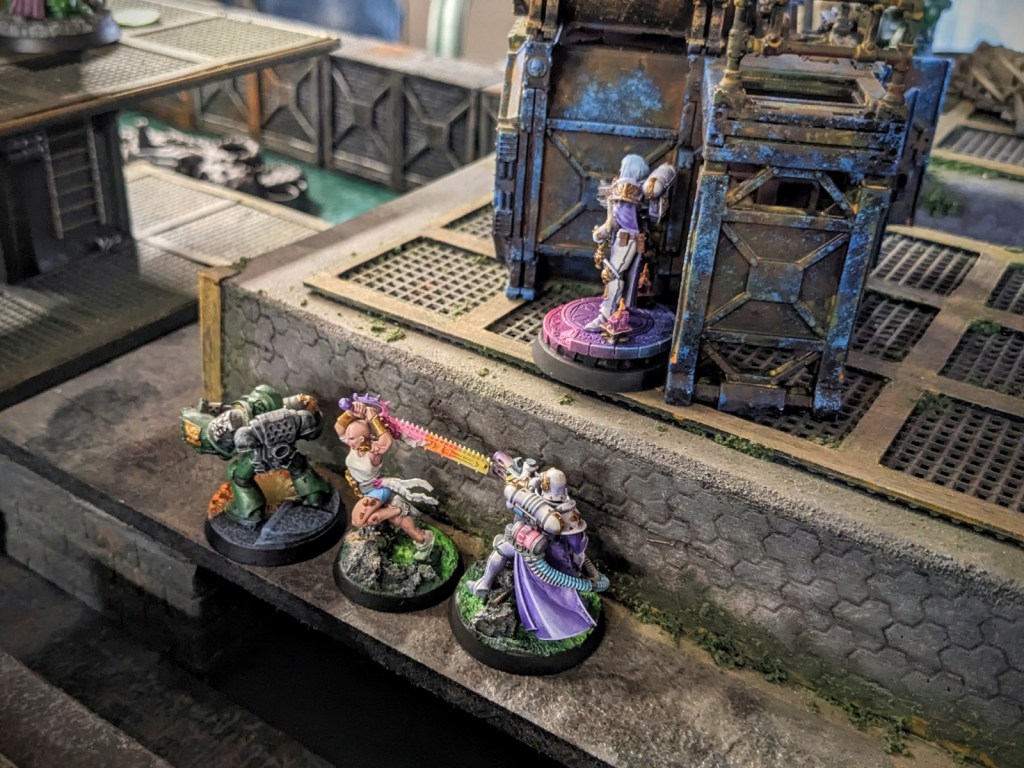
Creeping through the damp, fungus-ridden corridors in their bid to waylay the interlopers were the Sister of Battle, running a herd of chainsword-wielding repenters ahead of the battle-armored Sororitas.
The grubby agents of the Imperium, perhaps misled into thinking the Salamanders were their true foe, crashed headlong into the Sons of Vulkan and were probably massacred, if this photo gives any indication of their fate.
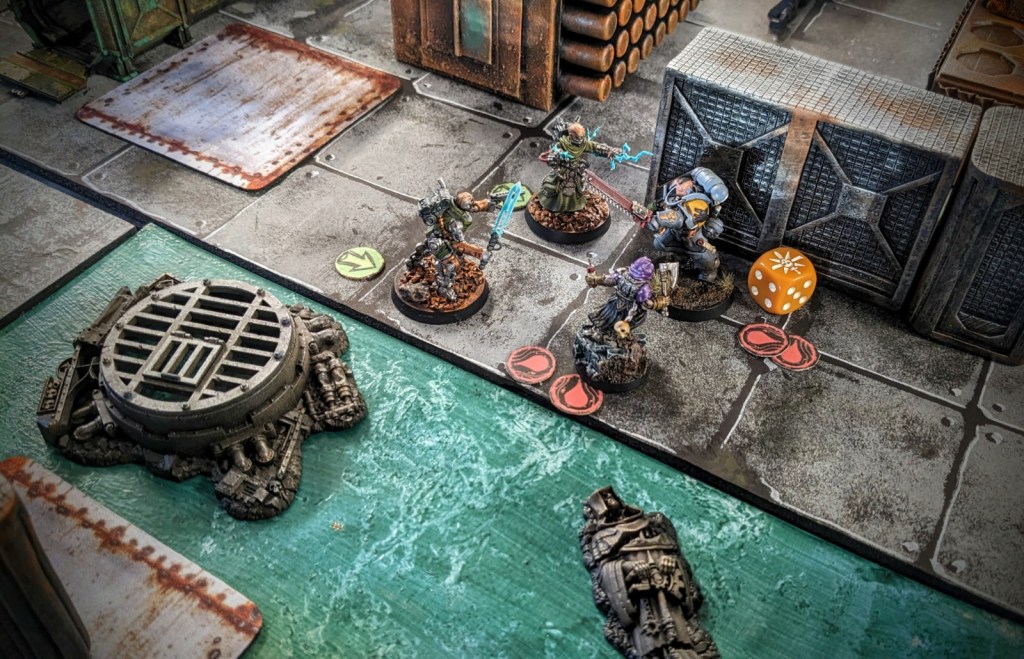
Over in the upper levels of the underhive, two teams of Mechanicus-minded tech cultists began filtering through the dim hallways, intent on finding and destroying their foe.
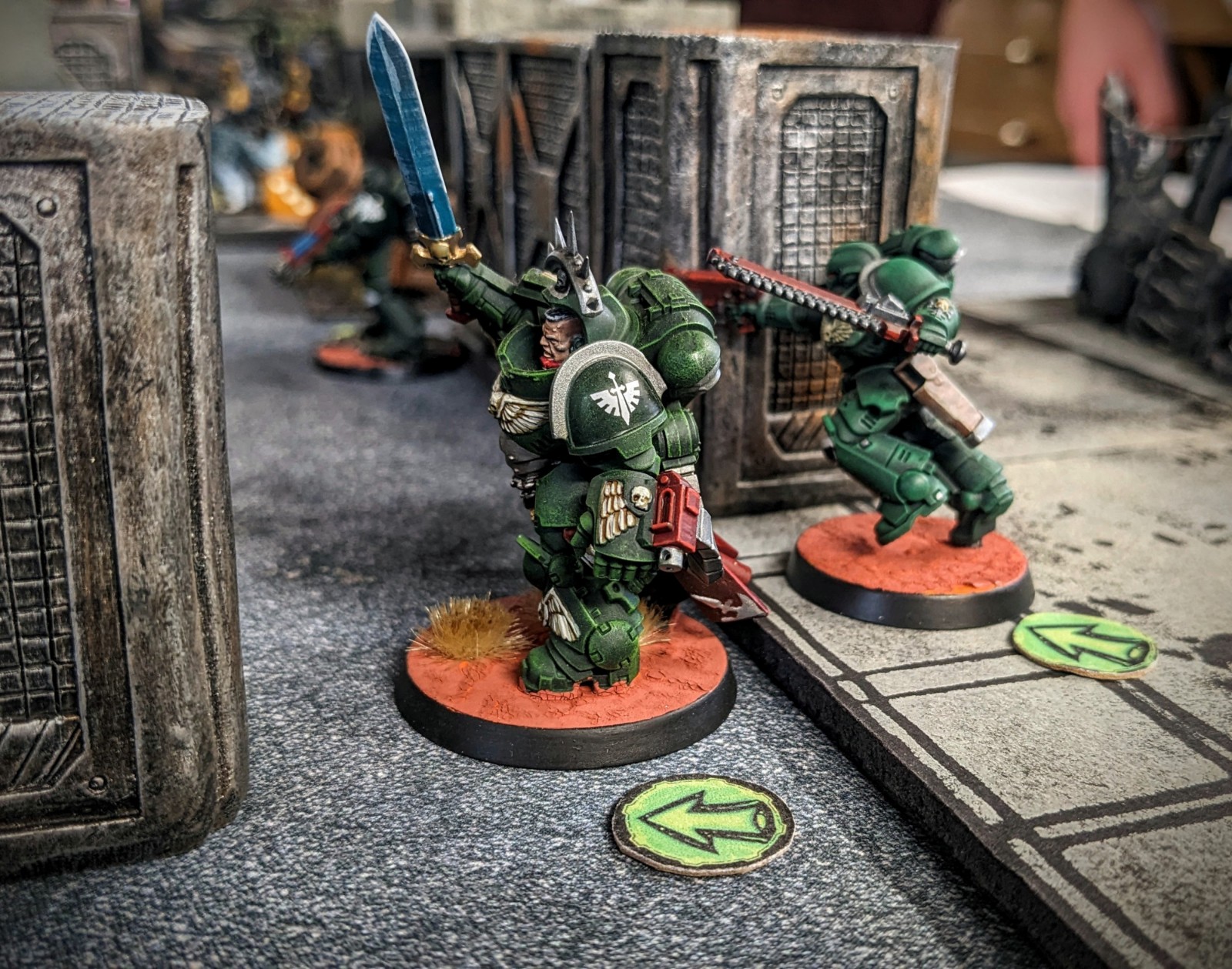
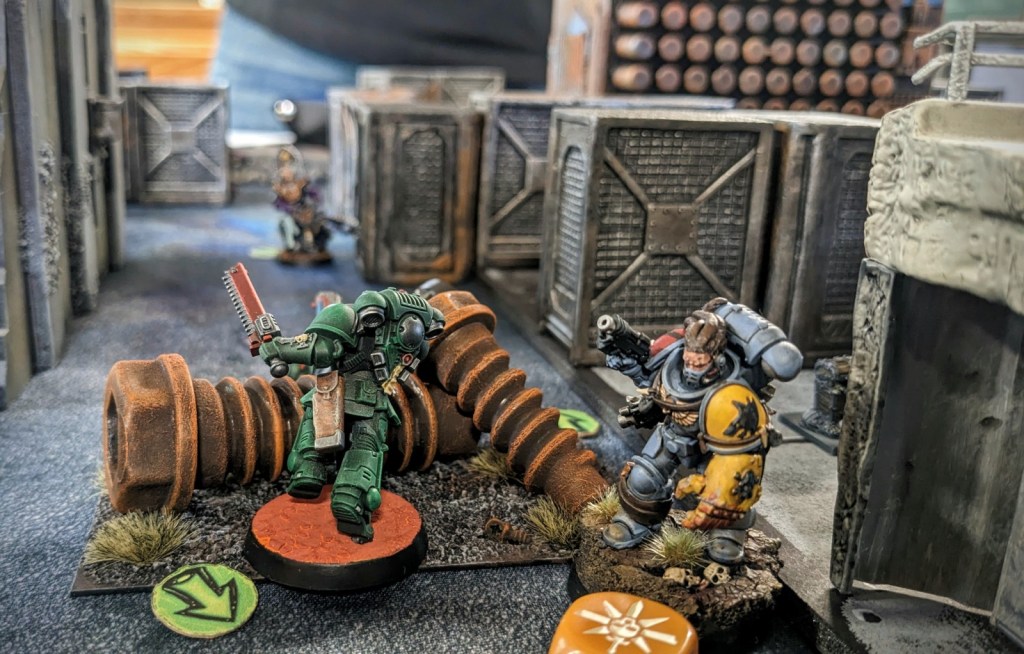
The Space Wolves and Dark Angels were few in number, but they were frightfully tough. Jim had just three Astartes models in his warband, and I think Parker had a few more, something like five or six. They looked very imposing as they strutted across the battlefield in their beautiful Astartes power armor.
Thankfully, the cramped terrain setup provided plenty of cover for our scrappy cultists as they fought to close in on the objectives that were scattered around the battlefield. This is definitely the ideal setup for grimdark skirmish gaming: lots of cover and elevation, with several routes for advancement so that nobody was funneled into a bottleneck.
Owing primarily to Daniel’s hot dice, the Mechanicus warbands secured an early advantage when they defeated a couple of the Astartes warriors in the early turns. Because they were so few in number, the Space Marine players really couldn’t afford to lose many models. We were playing a game with five (5) objective markers, and so we needed a lot of warm bodies to cover the objectives.
Having the Astartes on their back feet early in the game provided an opportunity for the Mechanicus cultists to surge forward, putting on a brave face as they charged into combat with a power-armored superhuman. They took casualties, but managed to stun the Space Wolf warrior who was guarding the flank.
Eventually the techno-cultists swarmed over the objectives, overwhelming the Space Marines by sheer weight of numbers. Ain’t that how it always plays out though? A few gallant Astartes, defending the barricades until the very last, until they are dragged down and dismembered by the howling hordes?? Yeah, it played out pretty much like that.
So it was a mixed outcome for our two side-by-side games of Grimdark Future: Firefight. The forces of the Imperium prevailed in the sordid depths of the sump level, but the techno-cultists of the Mechanicum succeeded in driving off the Space Marines and claiming the objectives in the upper portion of the underhive. Who can say what arcane secrets they unlocked for their own nefarious purposes?
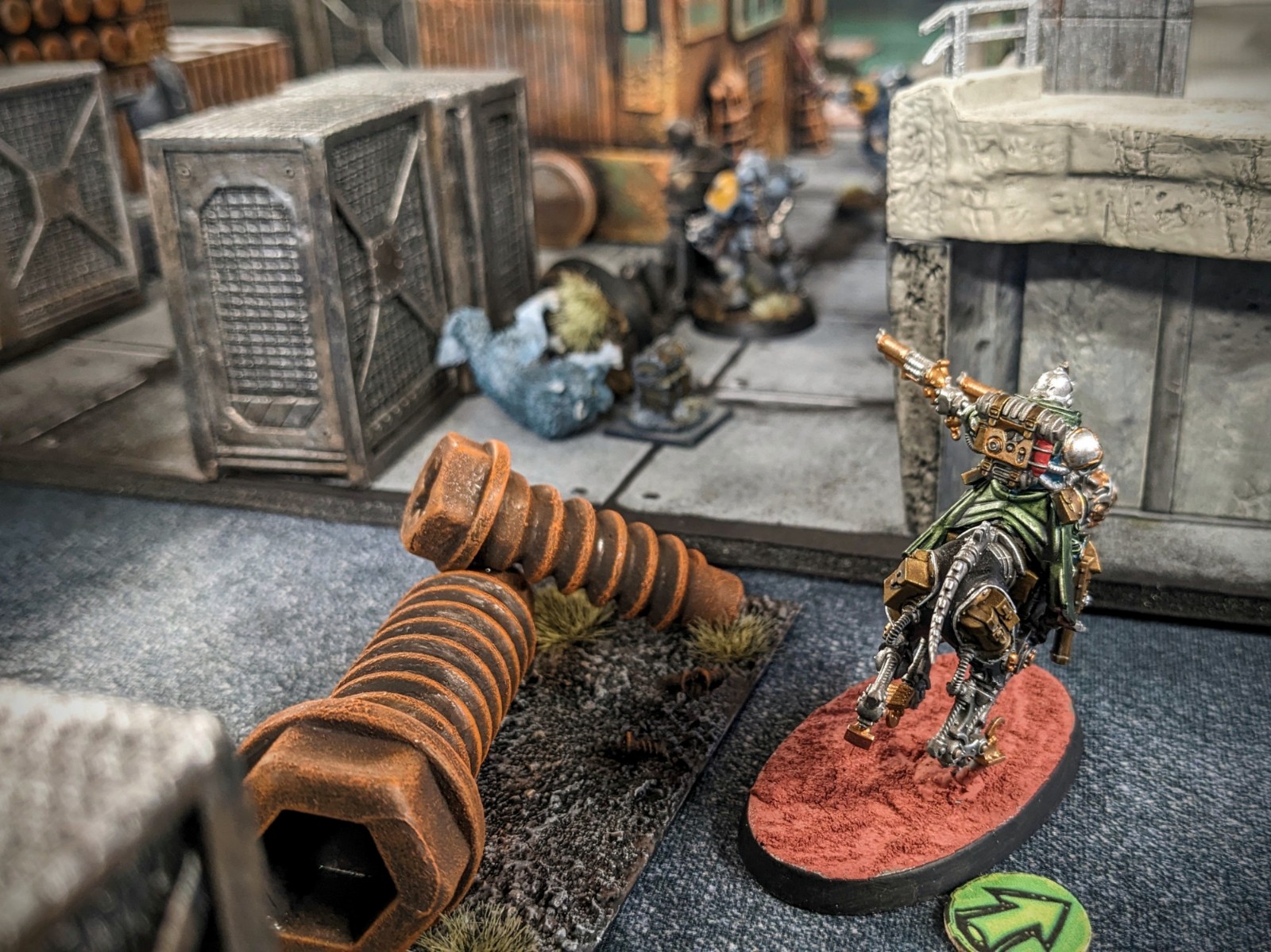
Let us end with another glorious photo of the cavalry officer with nerves of steel and ice in his veins, as he urges his reluctant mount forward to seize these, er, run-down corridors in the name of the Emperor!
Once again Grimdark Future: Firefight provided a couple of nice, fast-playing skirmish games. Each player brought 250 points to this game, and our intent is to increase the point value for subsequent games, with a requirement that each game must feature a newly painted model. That’ll light a fire under us! Stay tuned for more grimdark narrative gaming in the depths of The Cauldron!
We got together earlier this for another game of Nightwatch, specifically to introduce a couple new players to the game. And while this game wasn’t specifically set in our ongoing Nightwatch campaign, it was fun in retrospect to imagine the events of this game happening concurrently to the primary campaign. This is the “B-Team,” and what they may be lacking in combat prowess they more than make up for with the size of their h e a r t s !
Anyway, this was a fun one-off game where we didn’t worry too much about the outcome … we just focused on rolling dice and having fun!
Somewhat by accident, we set up a rather extensive urban battlefield for this game. It turns out that everyone had thought *they* were responsible for bringing terrain, so we ended up with way more terrain than we needed. Hence this cluttered, yet strangely beautiful setup.
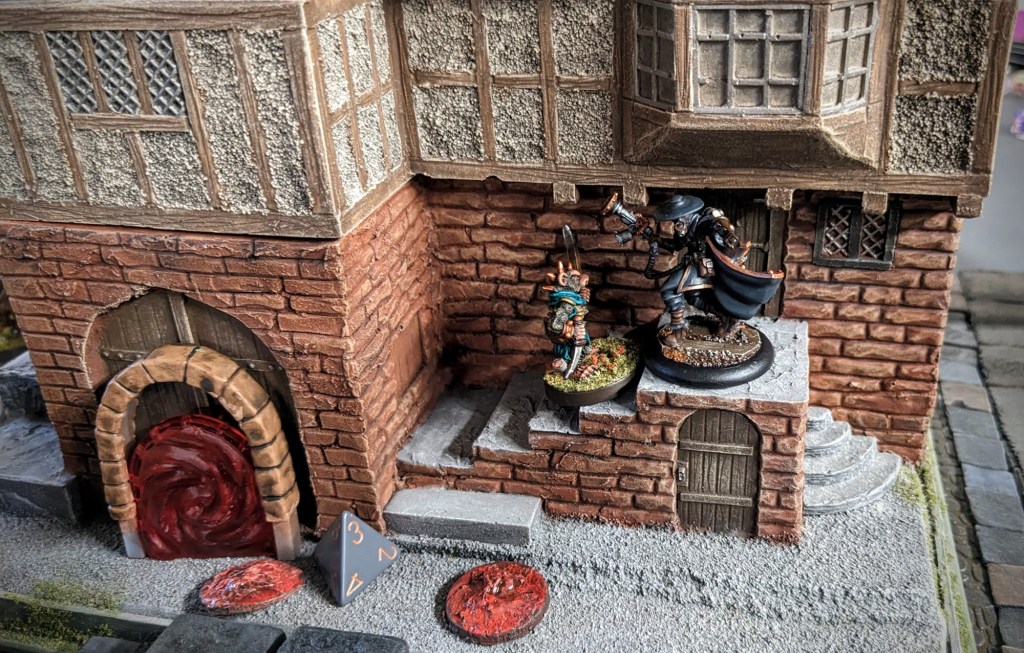
The scenario called for the players to defend the small well in the grassy courtyard in the center of the table. The red portals represent possible spawn points for the waves of bad guys that will emerge at random to menace us.
We had a wide variety of heroes in our game … a bladesman, a wizard, an alchemist, and a ranged combat specialist. Overall, a nicely balanced group, ready for anything that could possibly get thrown at them.
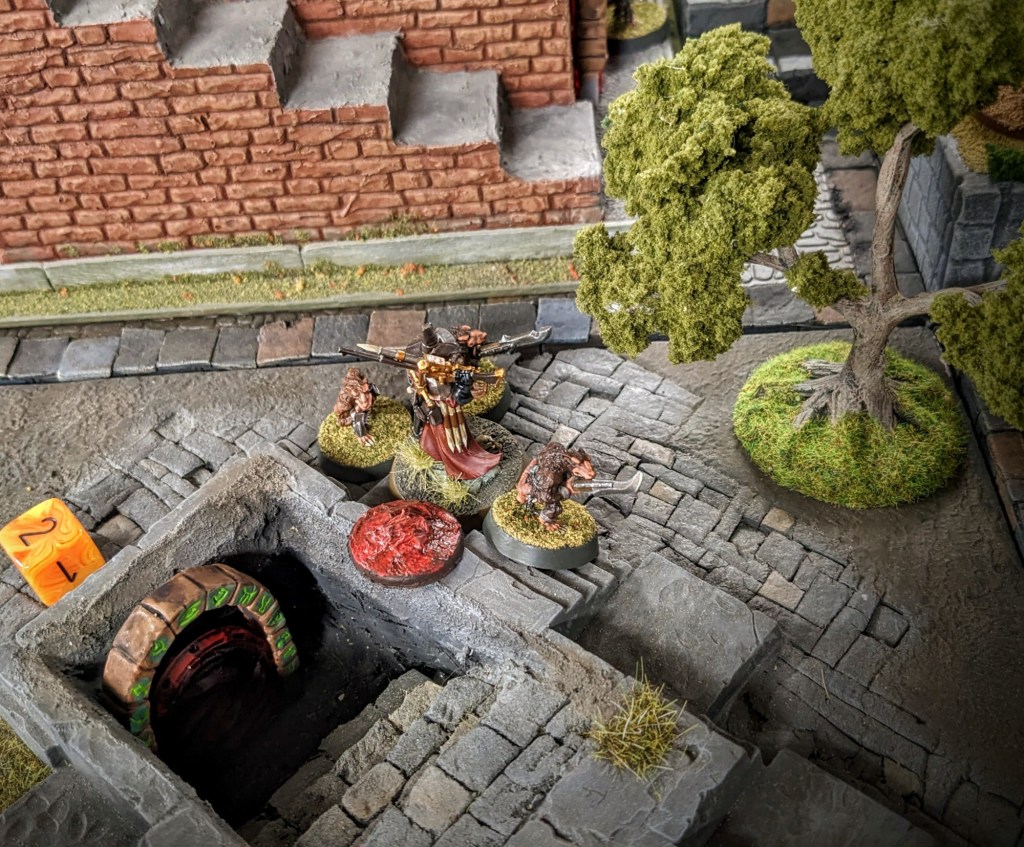
The action started on the first turn, when hordes of vermin poured forth from sewers and drains beneath the village. Nightwatch describes its bestiary in general terms, and leaves it up to the players to decide how to represent them with miniatures. In this game, we decided to draw on our collection of ratmen models, starting with Vince’s rat swarms to represent the vermin, followed by my vintage metal Skaven for the hordes.
The terrain tile above had a nifty subterranean staircase, so naturally we placed a spawn portal down there. And we cackled with glee whenever the vile ratmen would come boiling out of the stairwell!
Vincent’s nifty town bulletin board ended up seeing heavy action as the battle raged around it. I need to make one of these, too!
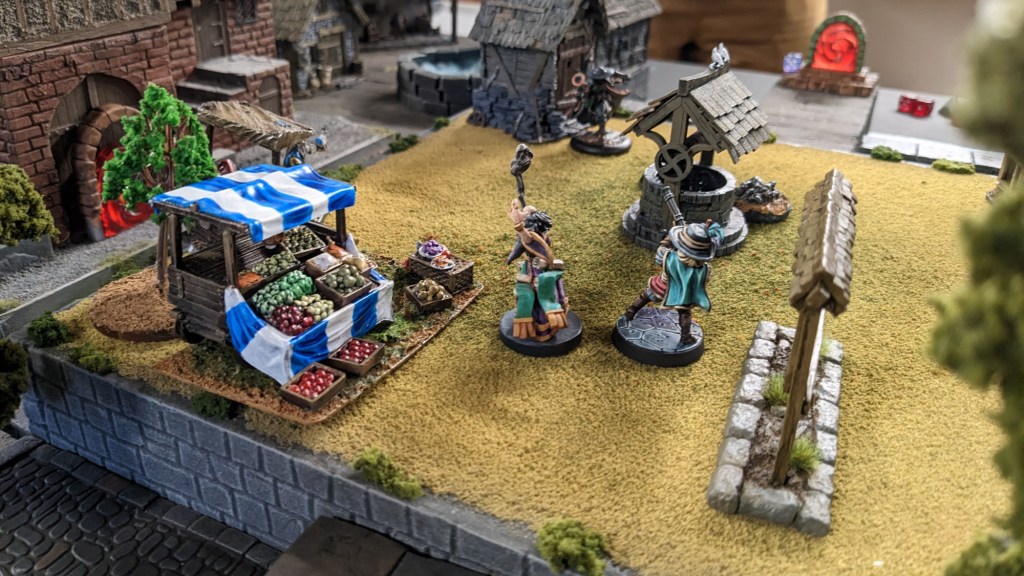
In the photo below, Mumblemore dances atop the veggie cart while in the background you can see a smattering of gore tokens representing the bad guys who have been taken down over the course of this game.
We’ve found that casualty markers or gore tokens are pretty important for this game, because you need to mark the location of slain corpses so that individual hunters can move into contact with them to undertake various and sundry tasks: robbing their pockets, slicing off an ear, maybe pulling out a gold tooth. It’s all covered under the Burdens section when creating a hunter.
The battle got pretty heated by the end of the game, with ratmen surging up from the subterranean depths and the heroes flinging spells and grenades all around the battlefield. The first couple of sessions of a typical Nightwatch campaign aren’t particularly deadly, which makes them perfect for a learning game like we set up here. You can dig in, explore the rules, slay some bad guys, and then survive to make it back to town and go through the post-game campaign steps.
That’s exactly what we did after this game, actually! Even though we weren’t playing a typical 7-session campaign, we nonetheless went through the post-game campaign steps to determine how much loot we found, which artifacts we ended up with, etc. It was great fun and made us even more excited to return to our ongoing Nightwatch campaign.




















 Comrade's Wargames