
Now there’s a fitting name for a battle report! Indeed, as the title suggests, Paul and I met up for a game of 40k. Specifically, we decided to play the scenario entitled “The Big Guns Never Tire.”
In addition to being inspired by one of my all-time favorite little snippets of 40k lore, this scenario was also a great opportunity for Paul and I to get two of our newly painted centerpiece models — a Tau Riptide for him and a Chaos Land Raider for me — onto the table for a thematic game.
So we set up a quick narrative scenario — the Tau and the Night Lords were picking through the ruins of Saint Scythia (one of the urban areas on Caluphel Prime) and came upon an abandoned defensive line. Both armies were determined to station their heavy support units on the high ground.


This game marked our second outing with Warhammer 40,000: Dark Imperium, also known as 40k 8th edition. We played this game at 75 Power Level but still didn’t feel like we got our “full armies” on the table.
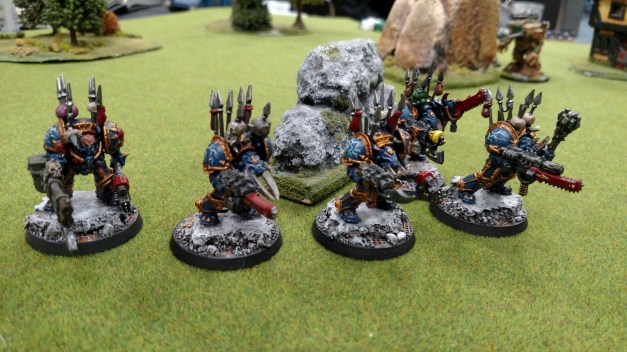
The battlefield, with its ruined defensive earthworks bisecting the table, created some interesting tactical decisions. Clearly the Tau would have to pull off a successful flanking maneuver in order to bring their long-range weaponry to bear. For my part, I was looking forward to trying out some newly painted Khorne Berzerkers and Plague Marines in my army.
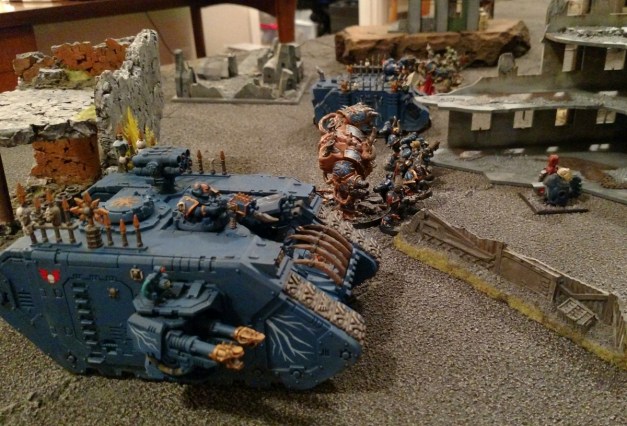
The game itself turned out to be something of a curb-stomping of the Night Lords by the Tau. I was outgunned in every sense of the word. I consistently found myself in situations where a half-squad of 5 Chaos Marines would be facing down a 10-man squad of Fire Warriors at short range, resulting in Paul rolling 20 or 30 dice to attack.
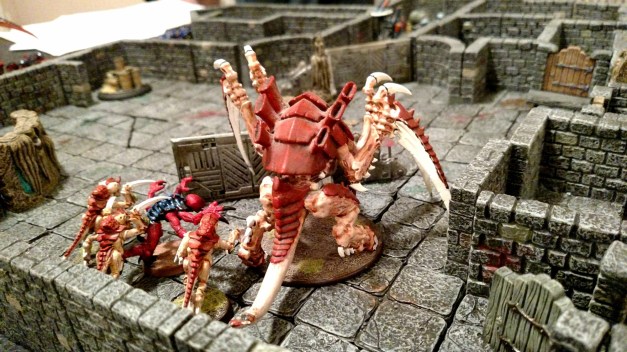
To make matters worse, I dramatically underestimated the potency of Paul’s Crisis Suits. He had three, and each was an absolute menace when arriving via orbital insertion in my backfield.
And lastly, I just didn’t know enough about tactics for this new edition of 40k. Neither of us did, really, but Paul was able to gain the upper hand through sheer firepower and win the day.
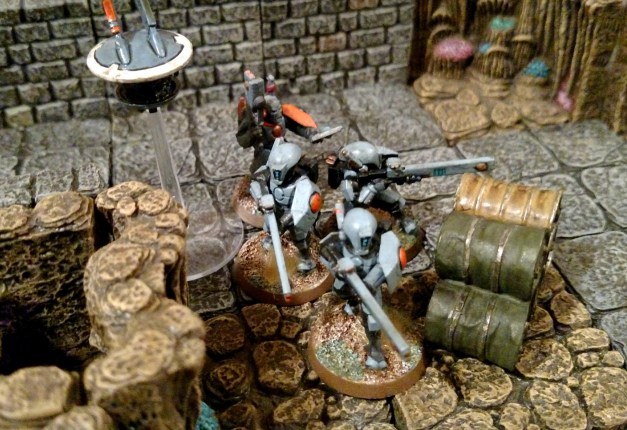
The game started with Paul conducting a very smart flanking move with his Devilfish and a squad of Fire Warriors. They landed on a ruined building near a squad of Night Lords, proceeded to annihilate them and then march down my left flank in workmanlike fashion.

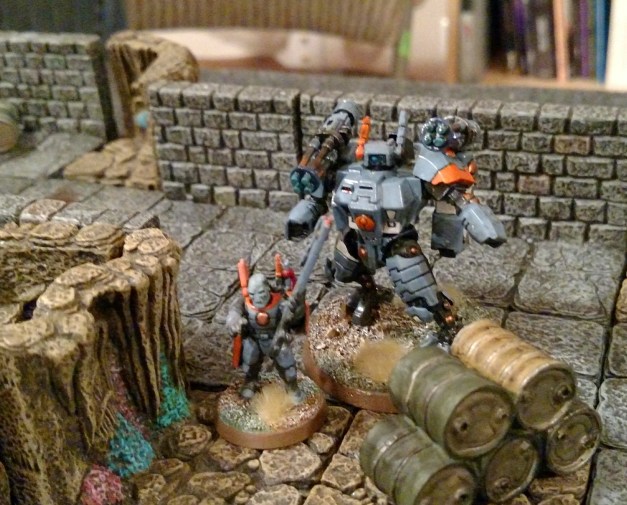
You can see the ruined building with the stairs in the photo above. It’s a long, narrow multilevel fortification, probably 30 inches in length, with two objectives on either end. I sent a squad of cultists into this ruin to claim the first objective, and Paul countered that move by sending in his newly acquired Kroot squad! They were so new that I think they still had packing peanuts stuck to them from eBay.

Farewell, cultists!
Nearby, two Chaos squads (5 Night Lords and 5 Plague Marines, plus a Rhino APC) found themselves hemmed in by the approaching Fire Warriors and the Devilfish.

This was literally a case of them being caught in the open, and the results were brutal. They went down firing, but these guys were doomed from the start…
I made marginally better progress on the right flank. Whether by chance or due to an unconscious desire to pit our two newest toys against each other, both my Land Raider and Paul’s Riptide had been deployed opposite each other on the battlefield. So it made sense for them to spend most of the game pouring firepower into each other. Which nut would be the first to crack?
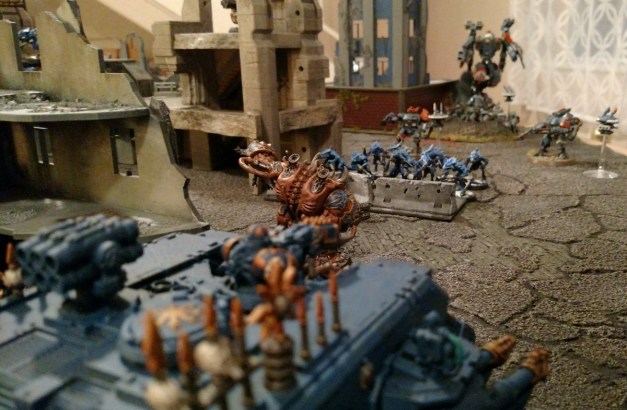
Spoiler: It was the Land Raider! Thanks in no small part to the timely arrival of a couple of Crisis Suits from their orbiting Manta transport. The Land Raider took a lot of punishment but it couldn’t stand up against a Riptide and a pair of Crisis Suits.

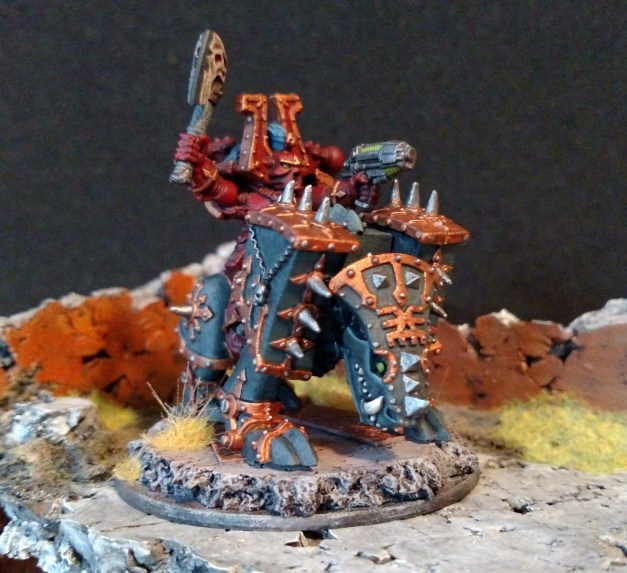
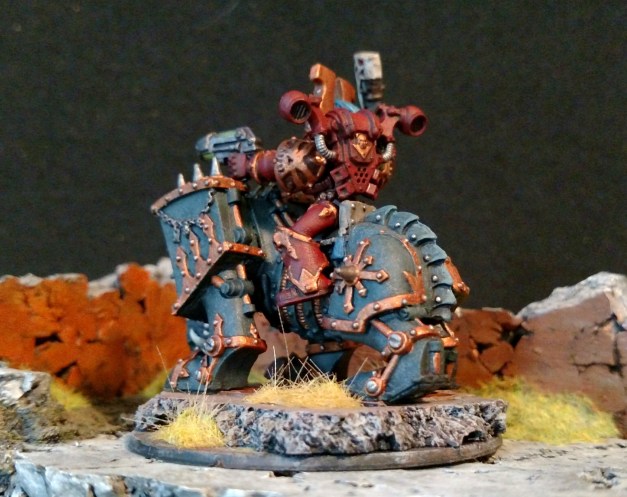
Before the Land Raider burned up, I was able to disgorge its payload — a snarling band of Khorne Berzerkers, along with my newly painted Chaos Lord astride a fearsome Juggernaut!
They looked impressive, no doubt about it, but close combat has changed in 8th edition. You’re no longer “stuck in” when you enter close combat…now, units can withdraw at any time and for seemingly little penalty. Mechanically, this encourages lots of charges and countercharges (which is fun!), rather than one big game-ending morass.
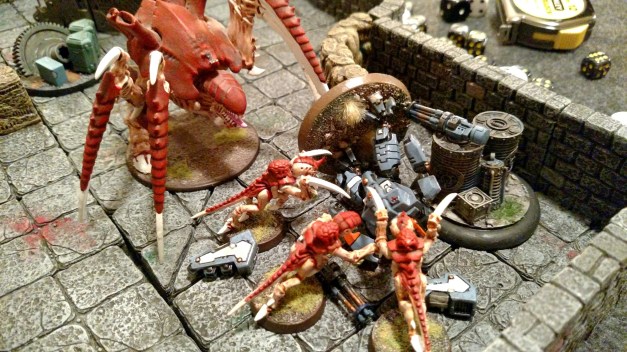
Anyway, the Berzerkers charged and did some damage! But those darn Crisis Suits have 6 wounds, and I wasn’t able to kill even one.
Sidenote: Overwatch is brutal in 8th edition! Any unit can shoot with all its weapons, and even though you only hit on 6’s, it all adds up, particularly with units that have a lot of firepower that improves considerably at close range.
Which brings us to the final indignity of the night …

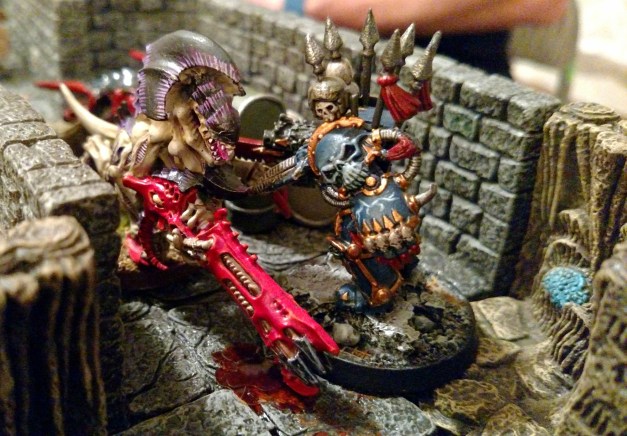
This was the final act for my vaunted Chaos Lord in Terminator armor. The caption here could probably be best summed up by, “What’s that? He’s behind me?”
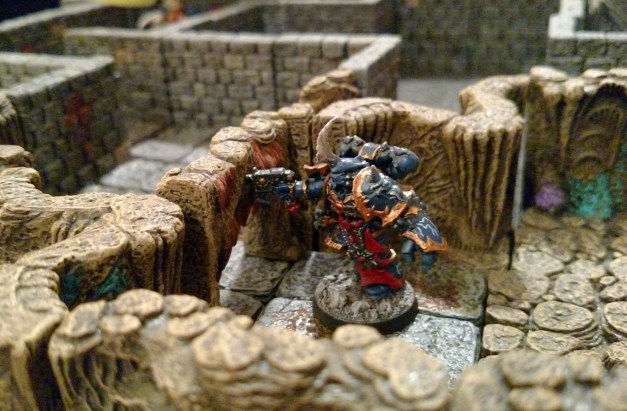
What actually happened was that my Chaos lord arrived via teleport to seize and objective (that sweet chaingun-looking thing behind him). Paul sent in a lone Crisis Suit to take him out, and to my utter surprise the Chaos Lord weathered a full round of shooting and survived.
So on my turn I gleefully prepared to charge — and was utterly annihilated by a series of lucky overwatch rolls. Yep, there is no dignity, not even in death.
At this point I had just a handful of units on the table, so I gallantly conceded.
Conclusions
It was interesting to re-examine my unit choices after such a sound defeat. In this case, I had left my two units equipped with deep strike — a squad of Chaos Terminators and a squad of Raptors — on the bench, as I wanted to play with my shiny new Plague Marines and Berzerkers.
But in this case, I think those would have been points well spent. The ability to threaten Paul’s flanks would almost certainly have changed his battle plan.
In addition, next time I’ll play to the Tau’s weakness in addition to my own strengths. Namely, the psychic phase — Tau don’t have access to psykers, so this is essentially a “free roll” for most other armies, provided they take advantage of it. I’ll be bringing a few Chaos Sorcerers next time to see how they go.
Lots more units and tactics to try out in future games…stay tuned!
















 Comrade's Wargames