I’ve spent some time lately returning to my fantasy dwarf heartbreaker army — The Expedition to Hearthspire. This army has been in existence, either in concept or on the actual tabletop, since the late 2000s, when I scraped together a handful of dwarves to play A Song of Blades & Heroes with my old game club back in Chicago.
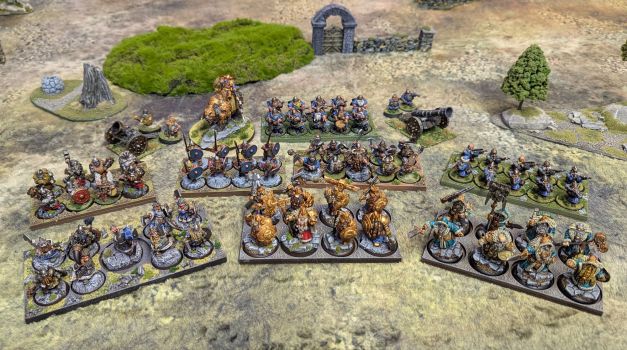
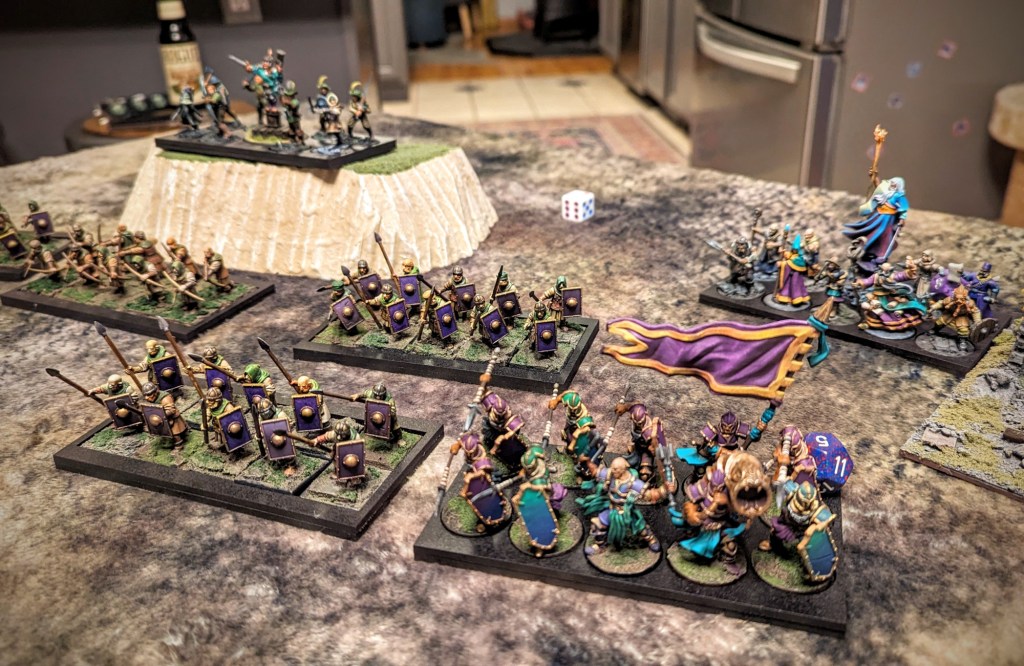
Since then, my collection of dwarves has increased consistently. Models became units. Units became a small army, then a larger army. Now I’ve got a fairly vast collection of painted dwarves, ready to undertake the quest for the ancient city of Hearthspire. Here’s the latest family photo, taken last month when I mustered the whole group for a game of Hobgoblin with John.
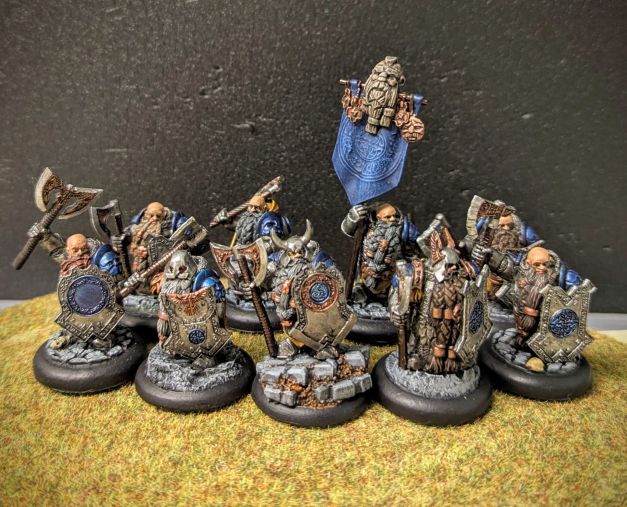
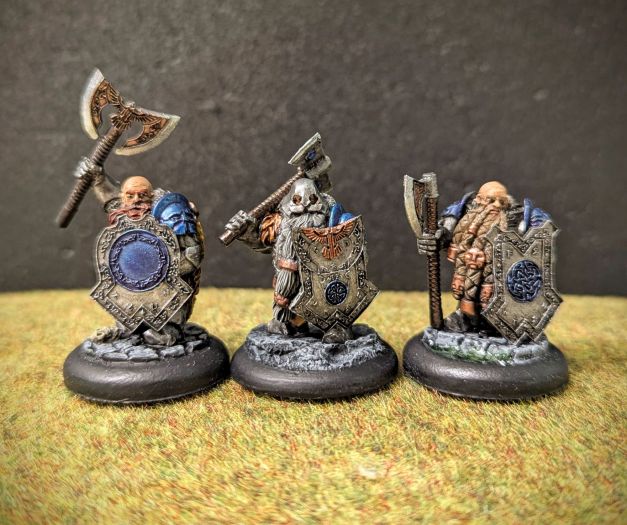
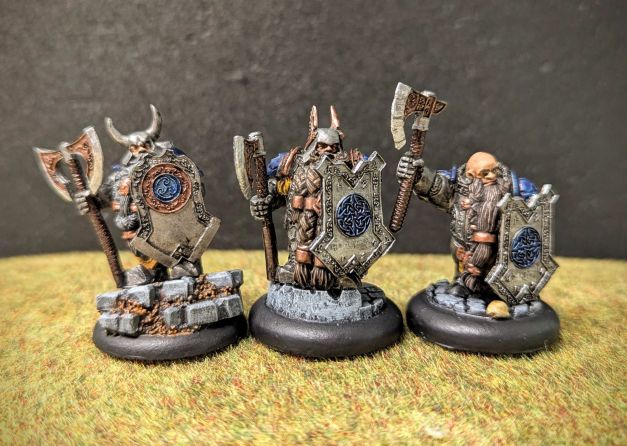
After that game, I felt inspired to paint up some reinforcements to further bolster the dwarven throng. Hobgoblin is an old school rank-and-flank type of game that encourages large armies. So I assessed the current state of my dwarf army and identified the distinct need for some elite, heavily armored dwarven infantry to anchor the center of my battle line.
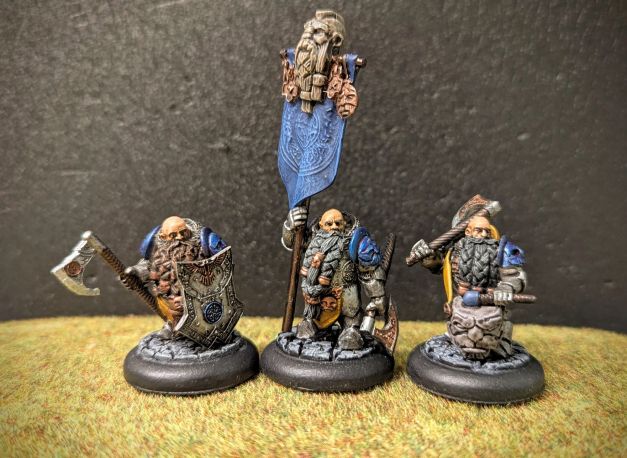
I found what I was looking for in a big box full of various units and figures from Scibor Monstrous Miniatures – one of my all-time favorite makers of chunky, characterful dwarf models. (Yes, it’s true, I have so many Scibor kits in my dragon hoard that they have their own dedicated box.)
These guys were a lot of fun to paint up. I’m not always fond of bare heads (something about my lack of precision and patience when painting faces) but these guys weren’t too difficult.
I painted these guys up over the summer, and they’ve yet to see the battlefield. I’m sure they’ll eventually take to the field in a game of Hobgoblin – I played a session earlier this year with John and got my butt kicked. (And I convinced myself the reason I lost is because I didn’t have a sufficient critical mass of armored dwarvess. Problem solved!!)
Stay tuned for more content in general from Comrade’s Wargames. After a long drought, I’m easing back into the saddle to share more quality hobby content with my tens of readers.
Last month a new game landed like a hand grenade right in the midst of Comrade’s Wargames – THE DOOMED, the new apocalyptic sci-fi skirmish game from Osprey Publishing, written by Chris McDowall.
My group had been eagerly awaiting the release of this game. The premise sounds delicious – warbands of grimdark sci-fi soldiers battle across a benighted planet overrun with nameless horrors. The setting is not defined in great detail, but it seems clear that THE DOOMED is aimed at baroque sci-fi, the sort which features demons, inquisitors, cyborgs, cultists, and motley bands of hardened soldiers. Sound familiar? It certainly tracks with what we’re all about here at Comrade’s Wargames.
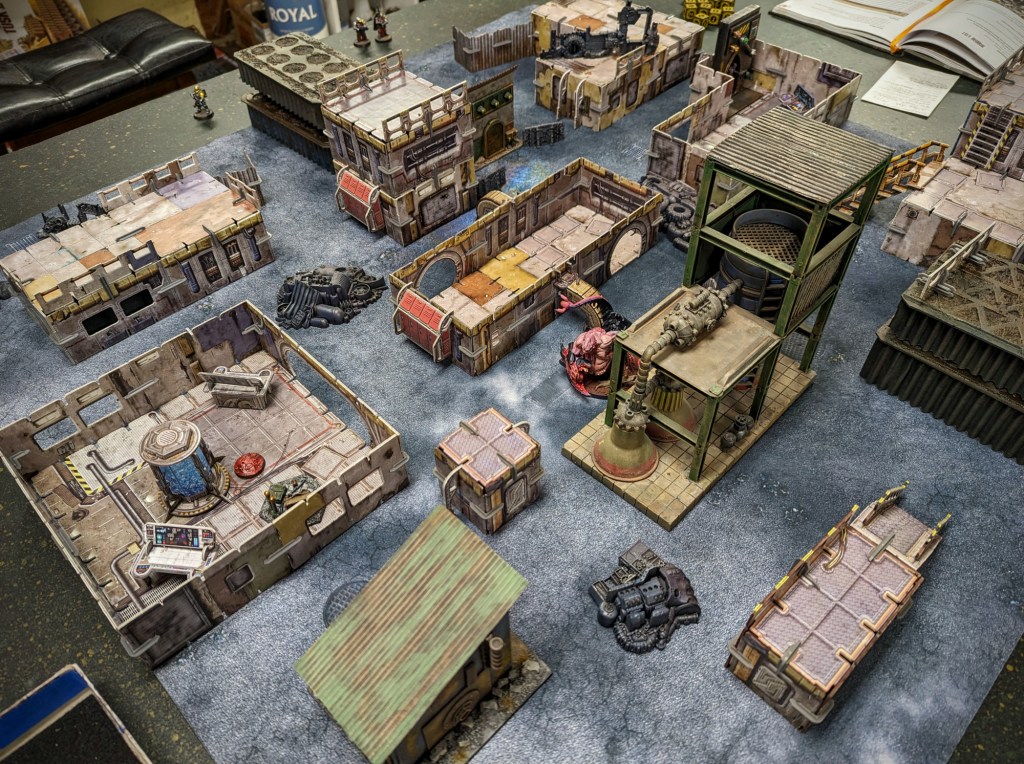
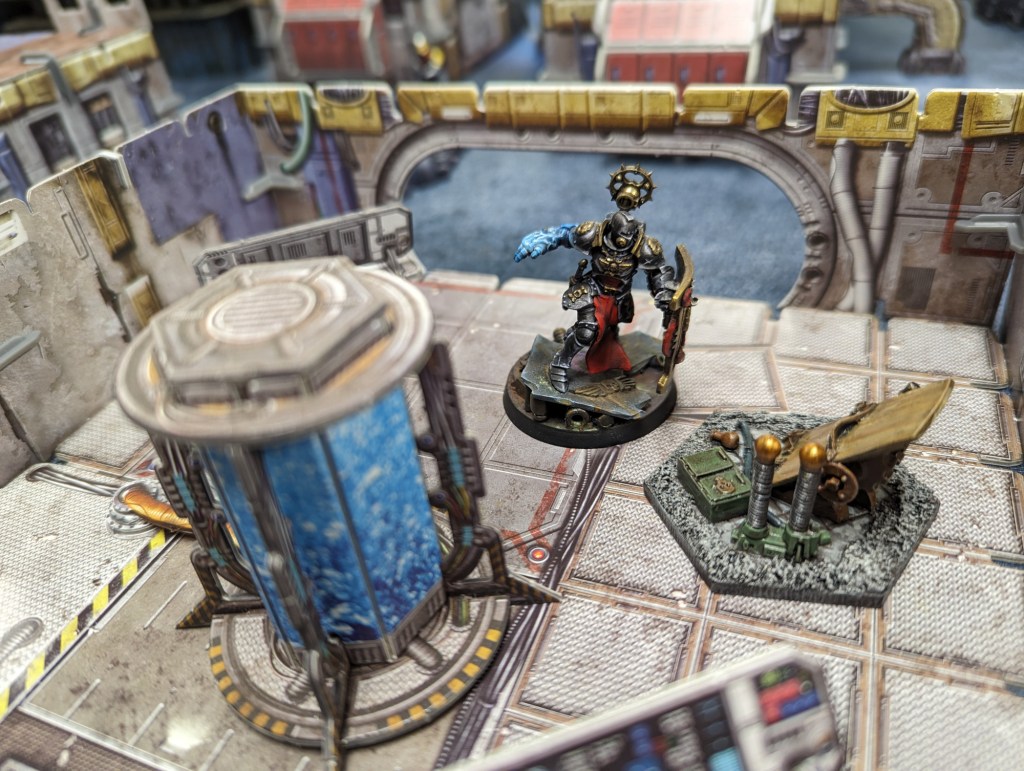
We got in a game toward the beginning of October, so I’ll intersperse some photos and impressions of our game throughout this post. Here’s the setup for our game: an abandoned laboratory.
THE DOOMED (sorry, caps lock just seems to pop on whenever I type the name of this game) is a skirmish-sized game meant to be played on a smallish table filled with terrain. The maximum size of any warband is eight models – no more than that. There are 4 flavorful warband lists to build your forces. In addition to two opposing warbands, every game features a Horror – a chaotic monster of some sort, usually with a few weaker minions nearby. Each Horror has its own set of special rules that govern its behavior on the battlefield and the behavior of its minions. Along with the Horror, each scenario also specifies some nexuses, which are basically “weak points” on the battlefield that must be defeated before the main Horror can die. Imagine egg sacs, or power stones, or prey carcasses … as long as those exist, the Horror is effectively “shields up” and largely invulnerable. The nexuses must be dispatched in order to defeat the big boss.
As you can imagine, this was an absolutely delightful game concept. Player-vs-player, with the added twist of a rampaging spoiler faction that operates under its own set of rules. To be clear, THE DOOMED is not intended to be a competitive game. Instead, it is designed to represent savage combat between warbands where the greatest threat is probably not the opposing player … it is the Horror that stalks the tunnels, slaying without prejudice or preference. The game is designed to promote collaborative gameplay alongside traditional matchups. Will you join forces for a turn or two to punish the big bad, and then go back to gleefully slaughtering the opposing warband? Who will break the gentlemen’s agreement first?
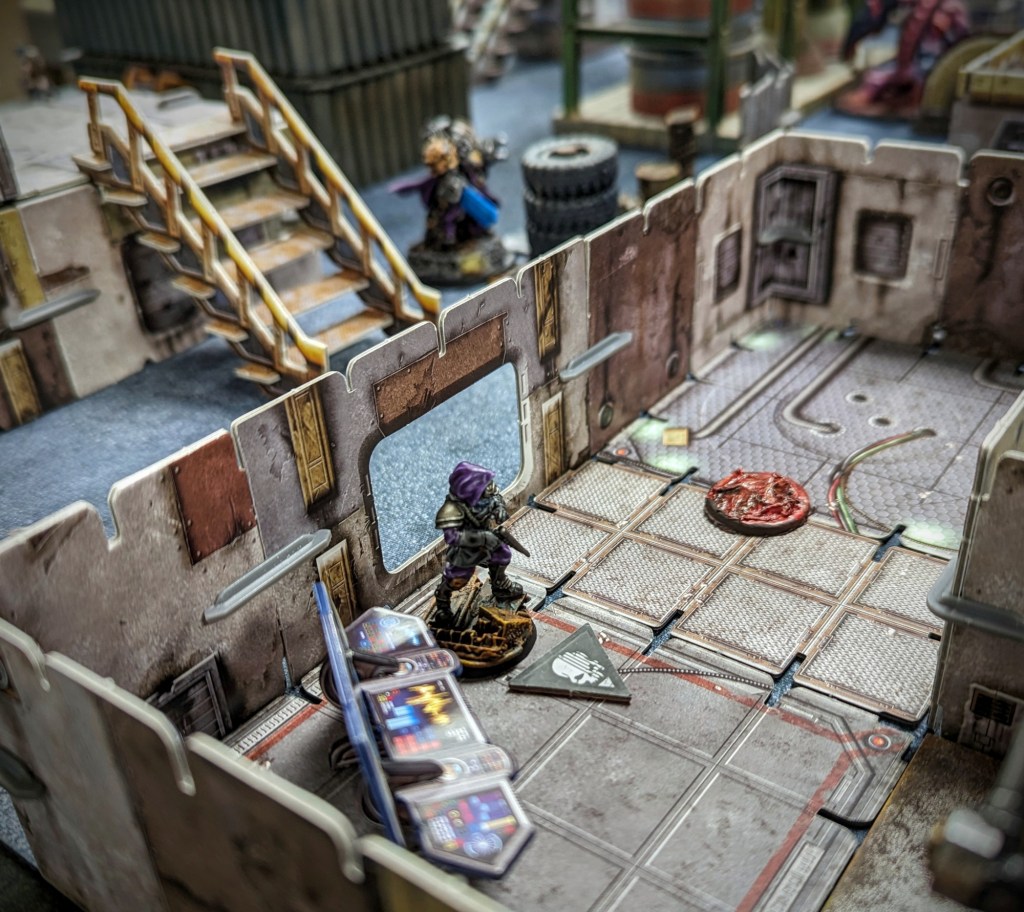
Our game got underway with some cautious exploration by both warbands. Inquisitor Ash, commander of John’s contingent of feudal sci-fi guardsmen, led her warriors to examine the first laboratory.
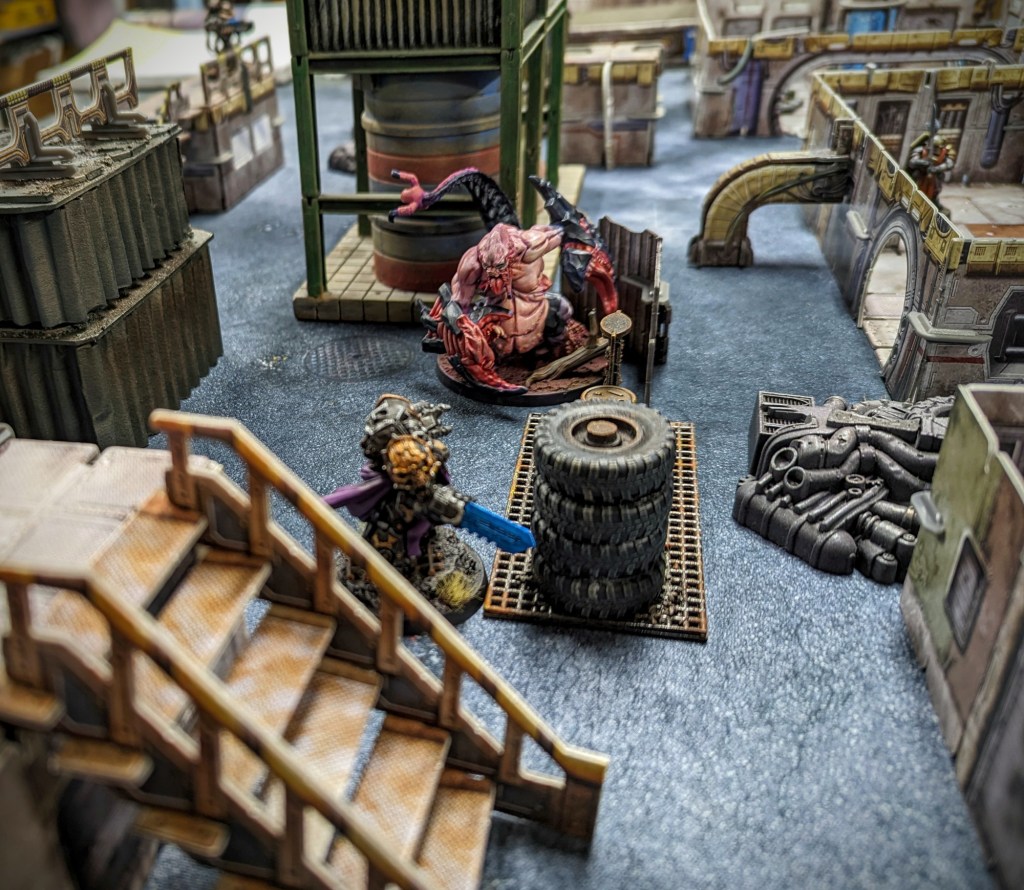
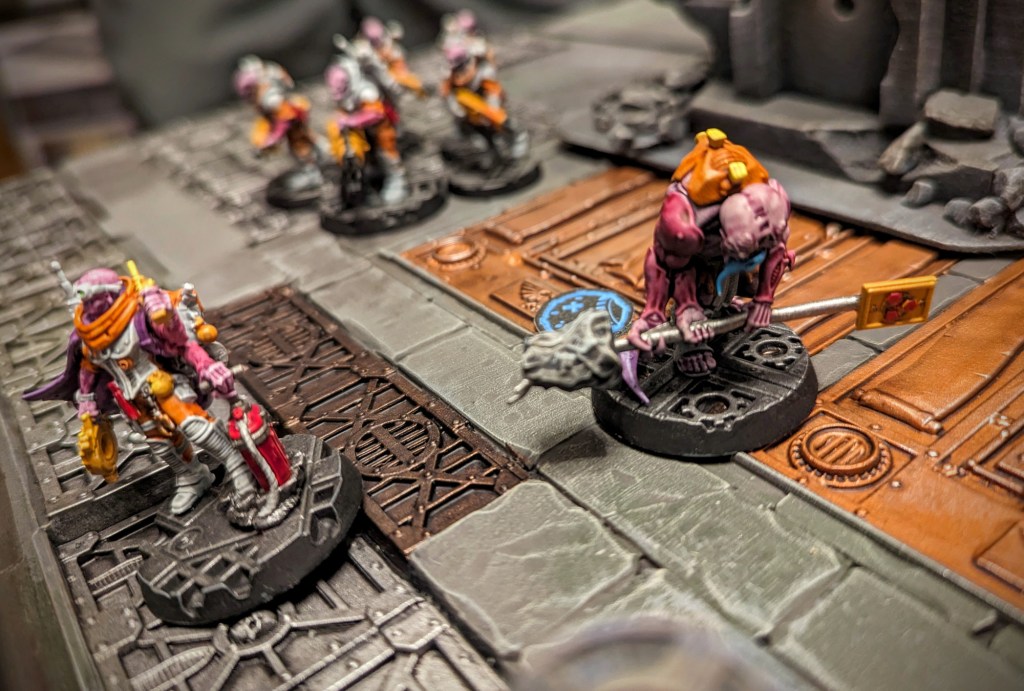
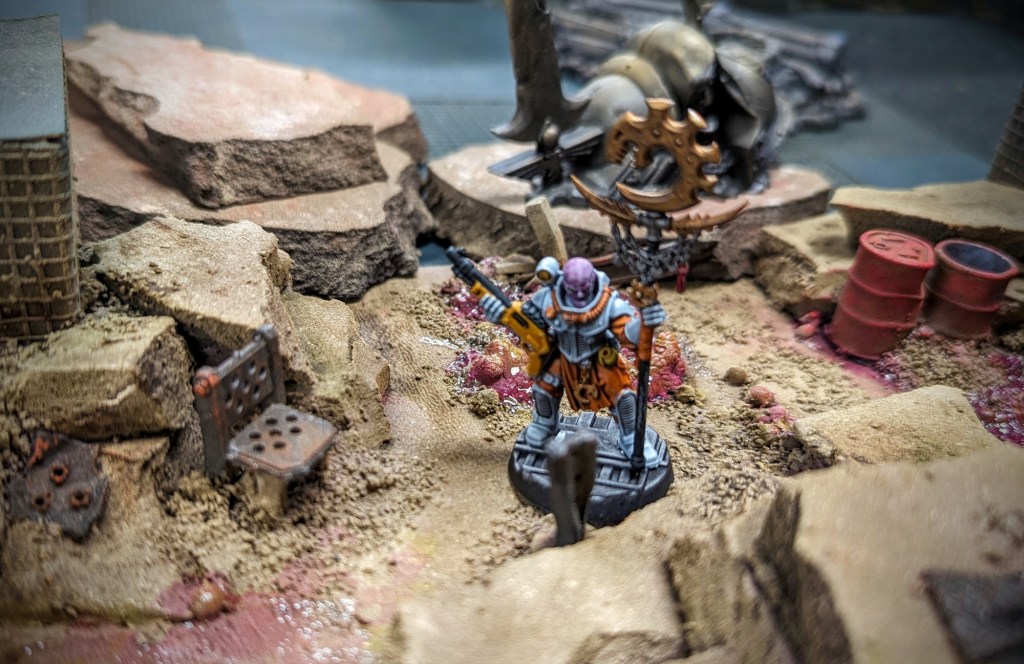
Meanwhile, my Dark Mechanicum warband led by Ozmas Hyperfane, the Sanctified Ferromancer of the Sixth Liturgy, filtered into the abandoned science facility by another route, which unfortunately brought them into close proximity to THE DEVOURER (i.e. the Horror that we selected for this scenario). The Devourer activated and promptly began pursuing my Dark Mechanicum warband.
One of the most innovative aspects of THE DOOMED is that there are no movement rates or weapon ranges. You basically nominate a model, describe where you want to move, and then roll a dice vs. your figure’s Quality to see if you are successful. If you succeed, you move directly to that point. If you fail, your opponent places your model anywhere along the route you described. Yikes! Ranged combat operates similarly … everything is understood to be in range, so the only real limits are line of sight and intervening terrain and cover.
I’ve played games like this before, and they really require – nay, demand – an incredibly dense terrain setup. Thankfully, that happens to align with our interests here at Comrade’s Wargames, and we are blessed with a wealth of beautiful handmade terrain to adorn our battlefields. Just something to be aware of it as you’re reading through THE DOOMED rulebook.
Even as the Devourer closed in and its devilish minions spawned at random points throughout the battlefield, my warband tried to remain focused on the objective, which was to occupy and seize two of the three laboratories. The labs themselves had a variety of nasty rules in effect to make them into truly deadly combat zones.
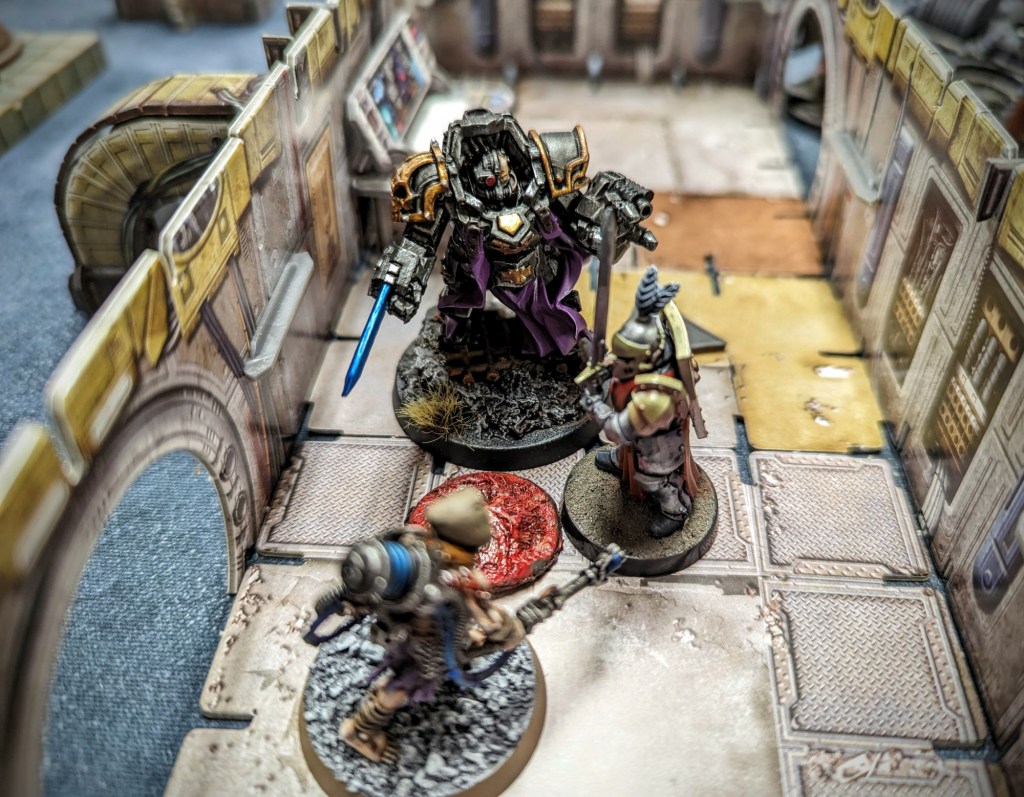
As the halls rang with the sound of desperate combat, somehow Ozmas Hyperfane barged his way into one of the labs and encountered a puddle of viscera which represented one of the Devourer’s nexuses. Aha! Its weak points were revealed!
Before Ozmas could stomp the goo puddle, he had to dispatch John’s feudal guardsman. Thus our first player-vs-player combat was joined!
THE DOOMED has a fairly simple combat resolution system, so it was easy to get up to speed. Weapons have straightforward profiles emphasizing the number of dice rolled to attack or the number of dice rolled to deal damage, along with a special rule or two. The rules system in general seems to play second fiddle to the voluminous sections devoted to the various Horrors, their lairs, their henchmen, and their in-game capabilities. Truly, this is a scenario-based game, and the star of every scenario is The Horror.
The Devourer quickly picked up the scent and smashed his way into the laboratory to confront Ozmas Hyperfane. The confrontation was decidedly one-sided – the poor cyborg was smashed into pulp and wreckage by the enraged beast. Oops … there goes my leader! How could I possibly carry on without this key piece of my warband?
Meanwhile, Inquisitor Ash and her cohort of goons was doing a good job of clearing and securing the other labs. Demonic dogs (spawn of the Devourer) continuously menaced her and her warriors as they struggled to gain the upper hand. More critically, they were responsible for destroying the final two nexus points, thus making the Devourer vulnerable to lethal attacks.
And about that Devourer … to put it mildly, he decimated my warband, slaying them almost to a man. Temporarily out of targets, the big guy stepped out of the laboratory – and into range of my cyborg railgunner, who proceeded to pop him at range with a series of spectacular dice rolls, followed by whiffed defense rolls by the Devourer, which snuffed out the big guy and ended our first game of THE DOOMED.
This was a tremendously satisfying game that brought together several of my favorite tabletop gaming concepts: skirmish sized games with warbands comprised of unique models, AI-driven NPC factions, and objective-based scenario play. John’s terrain was lovely, and his newly painted Devourer model (plus those demonic dogs) was a real treat to get onto the battlefield. The game itself is definitely designed to encourage some fun kitbashing and DIY terrain creation. The massive list of unique Horrors in the rulebook, combined with an equally comprehensive array of scenarios, ensures that we’ll play this one again soon … and that no game will be precisely the same.
We got together earlier in September for a game that could very well represent the grand finale of our Grimdark Future campaign.
Recall that we launched our campaign (The Cauldron) at the beginning of 2023 as an escalation league, wherein each player would start with a handful of models each and play smaller skirmish games of Grimdark Future Firefight, slowly adding more models as we went along through the spring and summer.
I’m happy to report that this approach proved to be a smashing success! We all stayed motivated to build new armies, one unit at a time. At our height, we had 8 players participating in monthly games. Now we’re approaching the end of 2023 and we all have decent sized armies that have gained some experience on the tabletop…mission accomplished, I’d say!
So, this game was a bit of a bookend for our highly successful campaign.
We had 4 players for this game, and everybody wanted to bring some of their larger, more expensive models (tanks, mostly), so we decided to go for a larger 2-vs-2 team game. We set the game in the upper reaches of Ardent Maxima, a hive city on the planet Gamma Euphorion Prime that was in the process of falling to the forces of darkness. Daniel’s newly painted Realm of Battle terrain tiles provided a stunning backdrop for this game.
Chaos Space Marines from the Death Guard legion had allied with Genestealer Cultists boiling up from the depths of the underhive to push the defenders of the Imperium back to the very highest levels of Ardent Maxima. After the destruction of the monument to St. Deneia in last month’s game, the Imperial defenders retreated to link up with their Eldar allies.
The forces of the Imperium and their Eldar allies made their stand in a vast plaza that had been defiled by thick, fibrous tendrils of fleshy matter. The origin of these throbbing purple members was unknown – were they some organic artifice of the Genestealer Cult made manifest, or perhaps a symptom of a planetwide plague delivered by the followers of Nurgle? No one dared ask.
John’s Imperial Guard took to the field alongside Josh’s Eldar – or Aeldari, if you prefer. They had some hard-hitting units, but they would be hard pressed to counter the advance of the forces of evil as the game got underway.
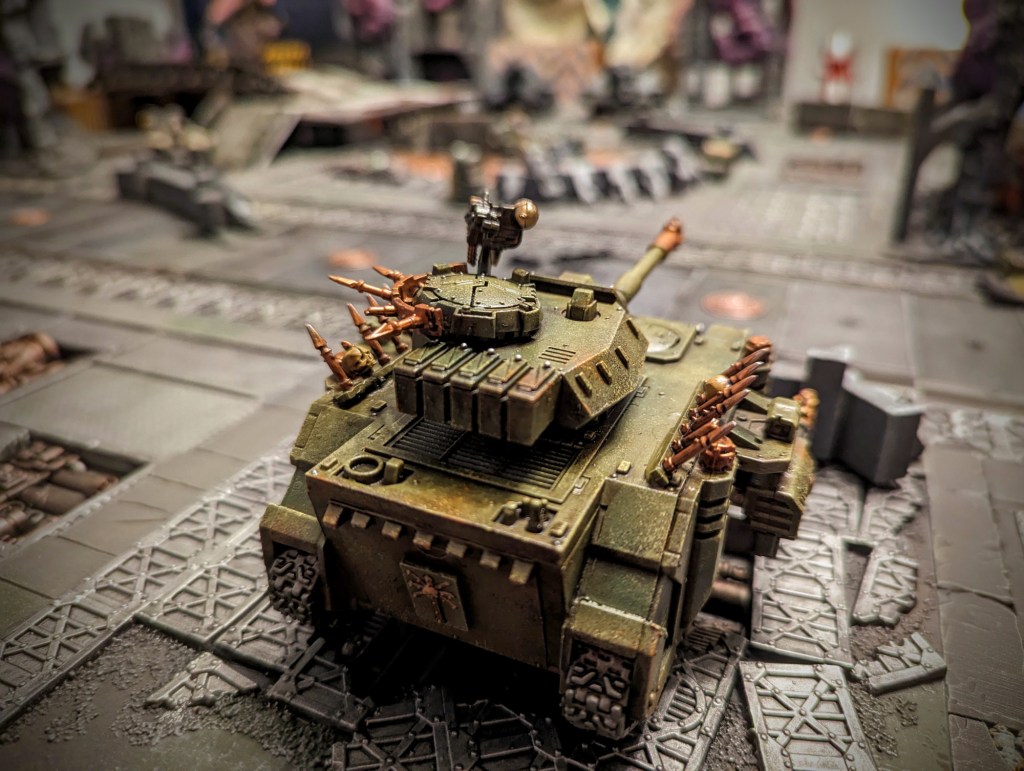
The game began with some long-range firepower as the armored vehicles opened up on each other. My Chaos Predator (a new addition to my army, nice!) dug in behind a makeshift barricade and unloaded its weaponry on the distant shapes of a couple Leman Russ battle tanks, barely visible behind the haze of dust and smoke.
With a roar of combustion engines, Daniel mobilized his fleet of trucks and began advancing on the objectives. Cultists wielding a variety of improvised weaponry scaled the crumbling masonry of a shattered building and brought fearsome firepower to bear on the Imperial armor.
The cultists’ advance brought them crashing headlong into the Eldar vanguard. With a guttural howl, the cultists swept into the frail, spindly looking space elves, blasting the infantry apart with heavy caliber weaponry and rending their grav tank into utter wreckage.
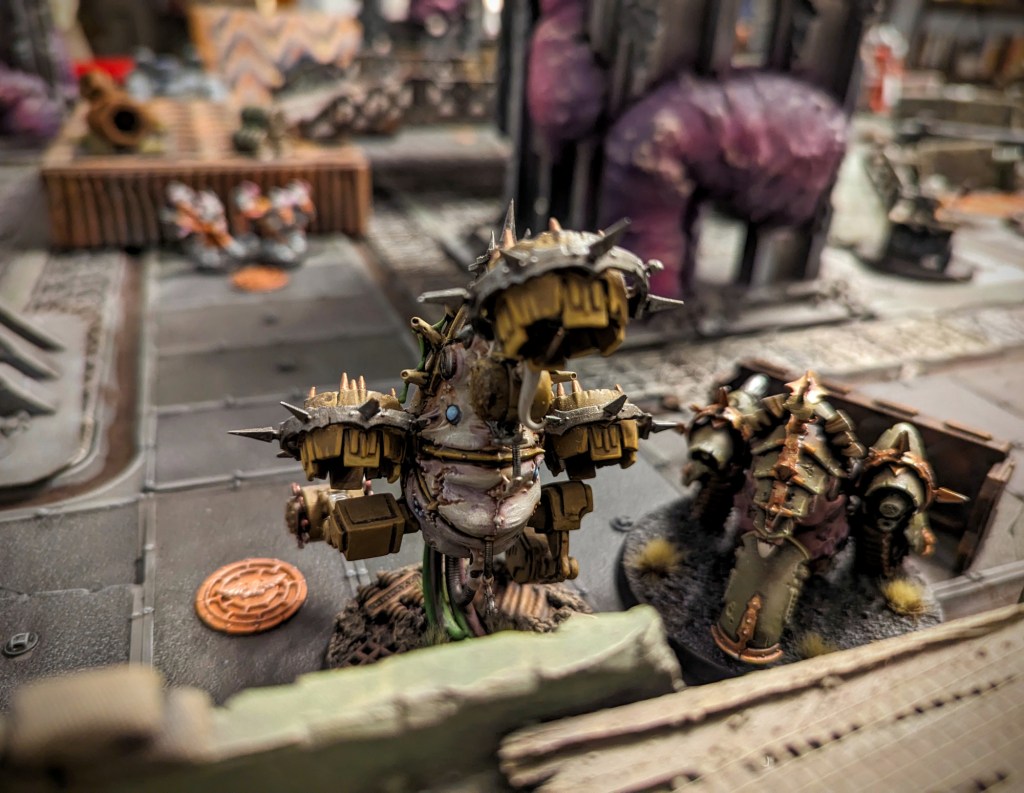
On the left flank, the foul daemon engines of Nurgle roared to life, following the cultists as they advanced to seize an objective located athwart the rusted TECHNOBRIDGE.
Even as the Death Guard daemon engines were pressing their advance on the right flank, realspace flickered and frost scabbed the pitted metal flooring as reinforcements arrived from the Warp: a foul Daemon Prince of Nurgle and a trio of battle-hardened Blightlord Terminators.
These lumbering behemoths arrived in the Imperials’ backfield and immediately commenced sowing havoc and despair. Terminators are jacks of all trades in Grimdark Future – OK at everything, great at nothing. Their mere presence had the desired effect of ratcheting up the tension. The defenders’ line appeared fragile – would it falter??
Ultimately, the TECHNOBRIDGE did not fall to the forces of Chaos. It was defended, at great cost I might add, by Eldar Dark Reapers led by Maugan Ra, backed up by the reliable firepower of the two Leman Russ tanks.
The defense of the TECHNOBRIDGE seemed to stiffen the spine for the Imperial and Eldar defenders, and they mounted a late surge against another objective located within a ruined multi-story building.
The timely arrival of some Imperial Guard Stormtroopers/Kasrkin/Tempestus Scions, backed up by the graceful shape of the Eldar Wraithlord, put the objective into serious jeopardy. There was only one solution – pulp those stormtroopers into a fine red paste by driving Daniel’s rockgrinder truck through the middle of the them! Yee-haw!
This action was followed up by a volley of fire from the Chaos Predator, which had been serving as effective fire support for most of the game.
With the endgame approaching, the Predator rumbled out of its fighting position and motored toward the central objective, located amid some puddles of toxic waste (dangerous terrain, in the parlance of Grimdark Future).
That bold advance was enough to seal the victory for the forces of Chaos. This was a very close fought game that definitely could have gone either way up until the final turn. Those are the best types of games – the ones where both sides are competitive until the very end.
So, this may prove to be the final game of The Cauldron, our grimdark/Inq28 campaign that has inspired a frenzy of painting and terrain building over the last 10 months. If you haven’t read through our past battle reports, do yourself a favor and take in the majesty of The Cauldron on Comrade’s Wargames. You’ll be glad you did.
Last weekend John and I got together to try out Hobgoblin, the forthcoming miniatures wargame from Mike Hutchinson (creator of Gaslands). Hobgoblin aims to be a mass battle fantasy wargame that combines old school rank & flank maneuvering together with a handful of speedy, modern game concepts. The overall goal is a game that lets you use all of your cool fantasy miniatures, arranged in big blocks of troops reminiscent of classic Warhammer, but streamlined to the point where you can play a game to conclusion in a couple of hours.
It’s a tall order, for sure! “Rank & flank” is not at all synonymous with “fast playing,” in my humble opinion. So I was intrigued to see what Mike had in mind as I cracked open the early access PDF. Hobgoblin had a successful Kickstarter earlier this year to produce a nice hardcover version of the rules, and the early access rules have been distributed and updated for backers (such as me) to play around with until the final release comes along.
John’s House Begovic infantry marches to war!
From the outset, Hobgoblin has a lot of the signposts that appeal strongly to me as a non-commercial, primarily indie wargamer. Among them:
Use any miniatures you want.
No specialized army lists – both players build armies using the same list of common units, plus a couple dozen special keywords for flavor.
Your cool toy soldiers always get to fight back, even when they’re in the process of being wiped out.
Only complete units are removed as casualties, no individual model removal.
Only the overall size of the unit matters – the individual figures don’t matter, so you can go nuts creating unit fillers, mixing & matching figures from your collection, etc. A block of “heavy infantry” could be 10 spearmen in chainmail, or 3 steam golems, or 1 young dragon perched on a rocky outcropping on a scenic base.
Along those same lines, the overall sizes of the units are flexible enough to accommodate most bases and movement trays. A typical infantry unit, for example, can be 100mm – 200mm for its frontage, and anywhere from 40mm to 160mm deep. Anything that fits within that spectrum works.
Although there’s not a lot of lore present in the early access rules, it’s clear that there is a ton of lore lurking in the shadows, waiting to be foisted upon us whenever the complete rulebook is published. The tidbits that are present – a vast, subterranean world of endless caverns, bizarre ecosystems filling the sightless depths, bone-grinding magic that feels utterly alien – are absolutely delicious, and definitely leave you wanting more.
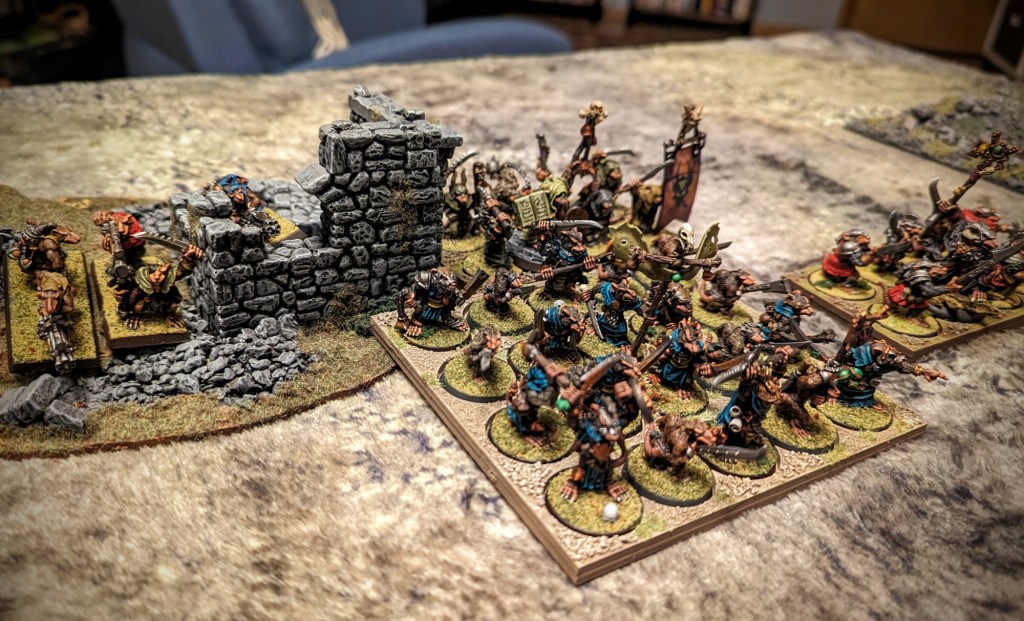
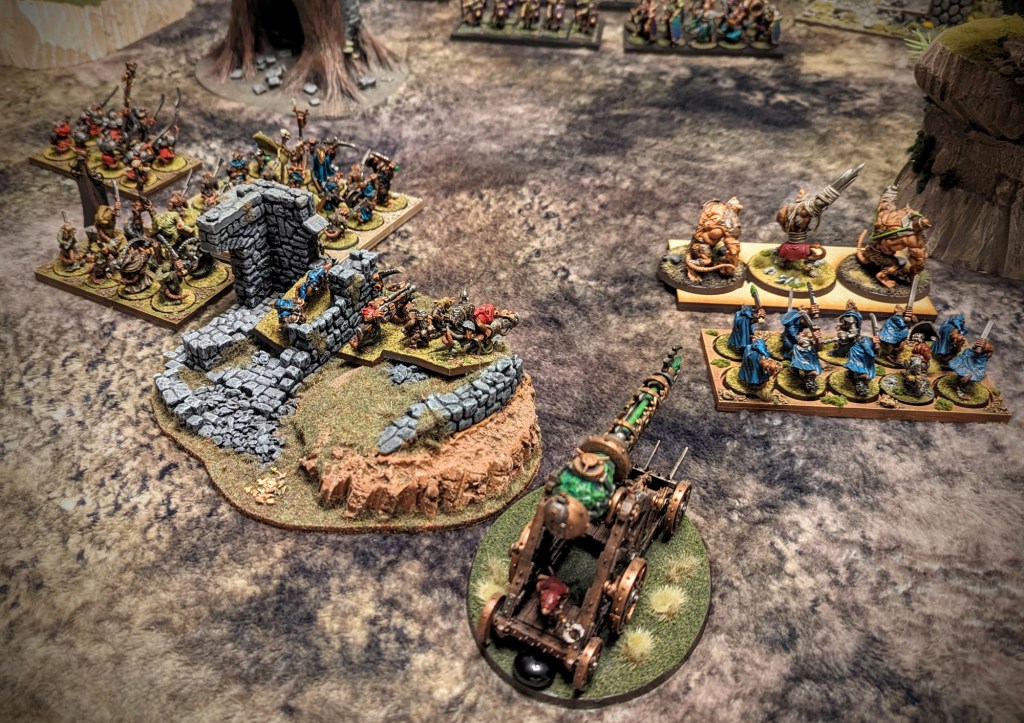
For our game, we decided to try a small game at 3,000 points per player. At that threshold, we were both able to bring 8 units. I pulled out my vintage all-metal Skaven army that I built a few years ago. (Well, almost all metal…I acknowledge that the plastic kits for the Doomwheel and Warp Lightning Cannon are fantastic and much easier to work with.)
John brought his ever-growing troop of sad sack humans led by a despised field commander and a cowardly wizard. (Yes, cowardly and despised are both keywords that you can select for your units. These are both negative keywords, so they actually give you more points back for your army when you select them!)
Rank upon rank of beautifully painted miniatures … tabletop wargaming at its finest!
We rolled randomly to determine our scenario and overall terrain setup using the fun battle generator available online. We ended up with some ruins, a couple hills, and two large impassable towers in the center of the table. These two towers would serve to channel our forces into the central killing field. This definitely accelerated the carnage but also prompted some mind-numbing unit movement as we edged our gigantic rectangles of troops around these impassable obstructions.
An early clash led to some mismatched expectations: the heavy cavalry successfully charged the Doomwheel, but the Doomwheel hit back and wiped out the horsemen!
Hobgoblin uses a modified IGOUGO turn sequence, where players alternate casting spells, shooting, and then moving their units. In general, both players are active and engaged throughout the turn; you’re never more than a few minutes away from having a decision to make for one of your units.
Magic spells cost mercury, which is a resource that gets replenished at the start of each turn. You can hoard it between turns to save up for big spells, and you can also use a mercury token to re-roll a single combat dice. Spells always happen – there’s no rolling to see if it’s successfully cast. If you can pay the cost in mercury, your spell is going to kick off. It’s a fun, old-school effect that has the effect of keeping a sense of inevitability about magic for much of the game. Spells happen. Deal with it.
Fortune cards provide each player with a small number of one-off effects and save-your-ass resources that come in handy throughout the game. A typical fortune card might heal a unit, or grant a bonus in your next combat, or let you reposition a unit prior to fighting. You start with 4 Fortune cards and receive 1 additional each turn.
Ratmen shooters wielding clunky, hand-cranked weapons of doom!
Shooting is intentionally de-emphasized in Hobgoblin. Part of it is due to the lore – this game takes place in a sprawling underground grotto lit only by torches, watchfires, glowing runes, luminescent fungi, and other eldritch sources of illumination. In an environment like that, a unit of archers just isn’t going to make a big impact. From a mechanical standpoint, shooting can only ever inflict 50% casualties (measured in doom tokens) on a given unit. Shooting is very much designed to be a harassing mechanic that is employed from the flanks as the armies march toward each other for the massive, inevitable clash in the center.
And clash we did! There’s no innate benefit for charging into combat, so if you want to fight an opposing unit, it’s not essential that you be the first one to initiate the engagement.
My horde-sized block of light infantry attracted a lot of attention during the game. The large size made it difficult for me to maneuver additional units for support!
My horde-sized unit of light infantry was the single largest unit on the battlefield from a footprint standpoint, so it attracted a lot of attention as the game developed. As my Skaven horde began to get enveloped by enemy units, we encountered perhaps the most divisive aspect of Hobgoblin – the fussy wheeling and shuffling and repositioning that forms the heart of the rank & flank movement system.
Another look at the horde of light infantry. They’re being engaged by two of John’s units: a squad of heavy infantry (with the banner) and a squad of light infantry.
If you like rank & flank movement and lament its absence from many modern wargames, then you will appreciate when Hobgoblin is trying to recreate. For my part, I learned that I don’t miss rank & flank movement. LOL! I never played classic Warhammer and so I don’t have an innate affection for large squares of troops wheeling around the battlefield.
I particularly dislike the uber-awkward model placement that results from shuffling giant movement trays full of models in half-inch increments. I’m talking about trays of models perched on terrain with giant gaps underneath, or unit trays hanging off the edge of a sheer cliff because that’s how far you were able to move this turn, dammit! I very much subscribe to the “moving diorama” philosophy of wargaming, so aesthetics are important to me throughout a game. Hobgoblin lets this pendulum swing a bit too far in the direction of “gameplay over aesthetics” for my tastes. That’s really my one gripe about Hobgoblin.
Another example of engagement. The red-clad heavy infantry unit of ratmen is touching the opposing light infantry unit with just one corner, but that counts as engaged. No squaring up in Hobgoblin!
The combat resolution is extraordinarily satisfying – most units roll 10 dice and consult a chart to see their target number. Hits result in doom tokens, which accumulate throughout the turn but are only resolved at the end of the turn, after all units have had a chance to move and fight. Units that receive too much doom are defeated and remove from the battlefield – and their demise results in *more* doom for friendly units that witnessed the gruesome spectacle! Cascading doom situations really help push the game toward its inevitable, and gnarly, conclusion.
Fortune cards and mercury tokens provide a small measure of unpredictability – in our game, my giant Skaven horde had accumulated a whopping 26 doom tokens, more than enough to destroy it in the Doom Phase, but I had a Fortune card that allowed me to ignore the doom tokens for one crucial turn. As it turned out, this was enough to let the Skaven hold down the bulk of John’s units long enough to win the game.
John and I definitely miscalculated some of the rules interactions as we embarked on our inaugural game. And we learned a lot about the intended function of various units in the army lists. At the conclusion of our game, we both discussed ways we could have adjusted or fine-tuned our army lists to better reflect the sort of army that we wanted to bring to the battle.
All in all, Hobgoblin is a super solid addition to the pantheon of mass battle fantasy games. I’m not crazy about the rank & flank movement, for reasons that I’ve articulated a few paragraphs earlier. Frankly I’d love to see a skirmish sized game using the Hobgoblin game engine – limited list of units, doom tokens, fortune cards, all of it – and just eliminate the rank & flank stuff.
We’ll be playing this one again soon, so stay tuned for more!
Earlier this month we played out the latest installment in The Cauldron, our 40k narrative campaign. This session took place on Ardent Maxima, a hive city located on the other side of planet Gamma Euphorion Prime.
By contrast, Ardent Maxima is the epicenter of a vast textile operation. Stadium-sized looms spin gargantuan bolts of fabric for use in Imperial Guard uniforms or embroidered draperies or even sailcloth for maritime vessels. Seam-serfs, with help from stitcher-servitors, churn out untold millions of finished products each year. Most of the inhabitants of Ardent Maxima work to support these textile operations in one way or another, overseen by the benevolent enforcers of the Adeptus Sororitas.
Rebel activity from heretical cults recently hit a fever pitch in Ardent Maxima when the monument to St. Veridegora Deneia was blown up by insurrectionists. Even before the dust settled, the enemies of the Imperium were already making their moves to further despoil the site of the once-proud statuary. The Sisters of Battle summoned urgent assistance from a nearby expeditionary regiment of Imperial Guard, newly arrived from the Glouroth Sub-Sector.
This game pitted Daniel’s Genestealer Cult and Jim’s Orks against Rian’s Sisters of Battle alongside a combined Imperial Guard detachment commanded by me and John. It was a classic xeno-vs-Imperium matchup, amid the ruins of the blown up monument!
The forces of the Imperium mustered their soldiers and armor at the perimeter of the plaza where the statue to St. Deneia and stood until recently. Two walkers and a main battle tank anchored their line, along with the rarefied warriors of the Sisters of Battle.
You can see the blasted sandstone chunks of what had once been the statue to St. Veridegora Deneia in the background. Who would dare desecrate such a holy bastion?
Oh. These guys would.
And probably these guys, too.
With a guttural howl, the combined forces of the Orks and Genestealer Cults surged forward, eager to reach the Imperial lines and deliver vengeance upon the miserable curs of the Corpse-Emperor.
Thankfully, the Emperor protects and reloads.
The Imperial battle line let loose with a cracking volley of fire, ripping apart several of the xeno transport vehicles and spilling their inhabitants. Undeterred, the bad guys cinched up their belts and began the long slog to the three objectives scattered around the table.
In the photo above, you can see the first completed tile from Daniel’s Realm of Battle board. He acquired a full set (enough for a 6×4 table) from Mindtaker Miniatures earlier this summer. He brought his one completed tile to this game, and it fit in beautifully alongside the rest of our hive city terrain!
The big ol’ tank in that photo is from Pig Iron Productions. It is a gigantic chunk of solid resin that has been in my collection for many years. This tank featured heavily into some my early games with the Chicago Skirmish Wargames club, such as this one: Operation Scrub Down! Nice to get it back onto the table 12 years later.
But anyway, back to the game. Big things were happening. A xeno transport truck motored up the flank and deposited a squad of greenskins right on top of one of the objectives.
As you can imagine, this transgression would not stand, man, and the Sisters of Battle were in a position to do something about it. Rian’s newly painted Penitent Engine stomped right into the fray and began hewing swathes of orks in twain with its massive buzz saws.
The stained glass windows on this MDF terrain looks absolutely fantastic! It was a fitting backdrop for this utter devastation that was visited upon the orks.
With the destruction of the ork mob on the flank, the xenos’ advance was seriously threatened. All eyes turned to the rubble-strewn plaza where a Genestealer leader had brazenly planted a flag amid the ruins of St. Deneia’s monument. What a shocking, ghastly display of debauchery!
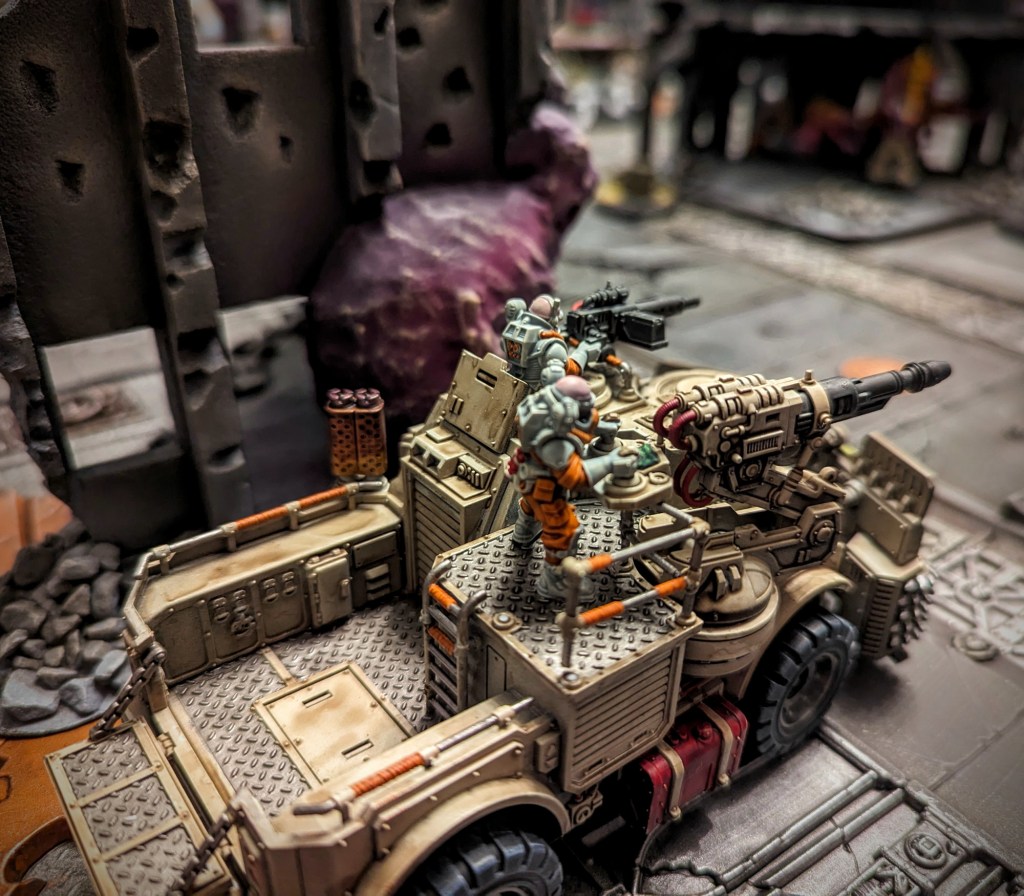
At the time, it seemed like the appropriate response was for John to drive an APC up and open fire on the squirrely cultist with its autocannon. I think St. Deneia would agree, don’t you?
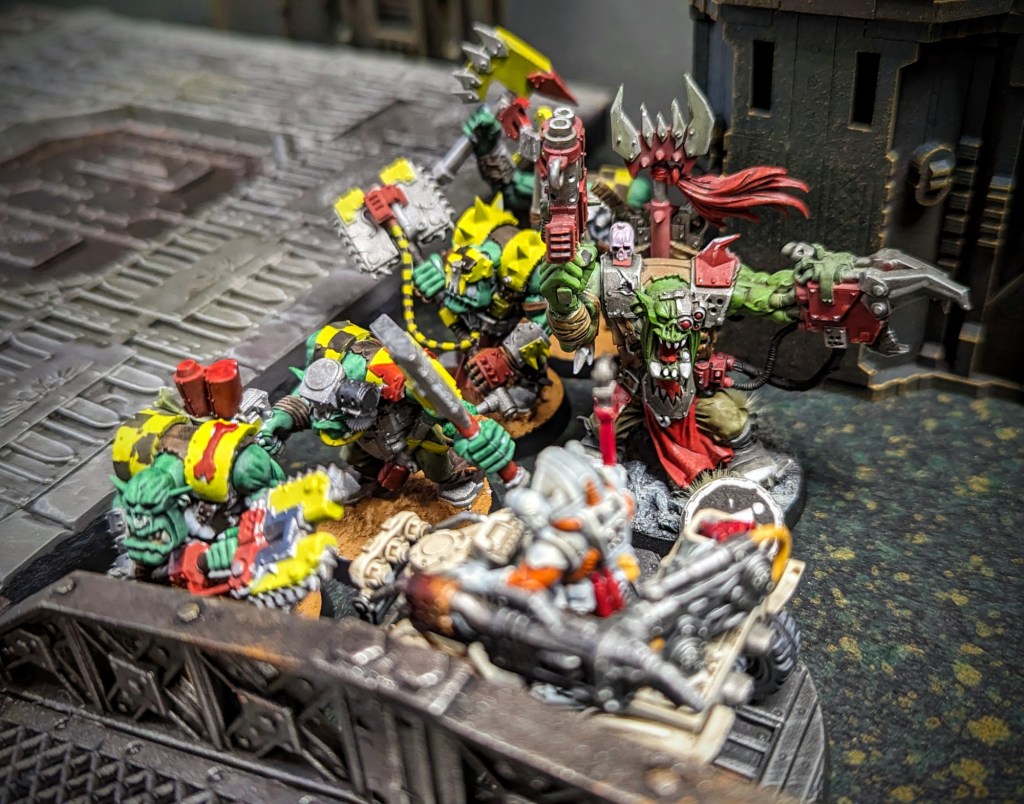
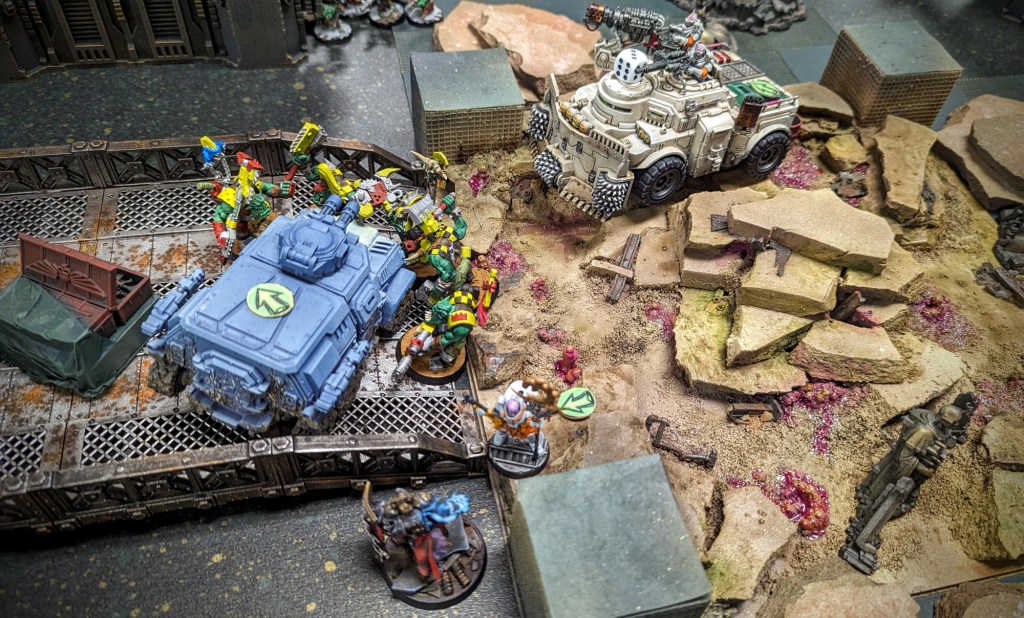
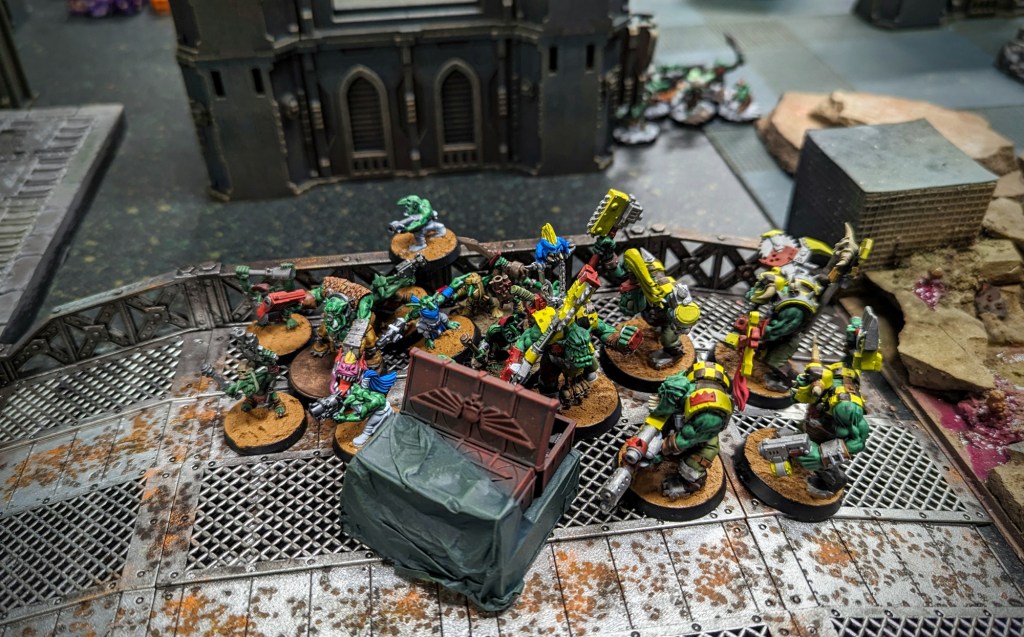
While the plaza was getting chewed to pieces by high caliber rounds, a different sort of confrontation was taking place near the Technobridge in the center of the table. A small kill team led by Inquisitor Ash was closing in on an elite ork warband led by Jim’s mighty warboss! If they could dislodge the warboss and defeat the quad-wheeler camped out on the objective, they could secure a vital area of the battlefield.
At this point, the tide of the battle turned. Warp lighting arced across the battlefield as the forces of Chaos arrived, no doubt drawn by the carnage and slaughter of the ongoing battle!
In game terms, the xeno team had a third player (Lawrence) who had brought two mighty demons to the game, and both arrived via the ambush special rule (similar to Deep Strike in 40k). So the initial cakewalk that the Imperial Guard experience was just an illusion! The bloodthirsty demons swooped in and began carving up the rear lines. Check out these photos of their arrival.
Doom had come to the plaza of St. Deneia!
The arrival of the two gigantic (and beautifully painted) demons caused a cold sweat to break out on the collective brows of the defenders of the Imperium. How could they carry on in the face of such abject evil? Trusting in their faith in the Emperor, the heroes mustered their courage and stuck to the game plan.
The plaza had become a killing field, as Orks and cultists swarmed in for the final clash. On the perimeter, heavy weapon teams and the remaining walkers poured fire into the advancing mobs of bad guys – even as the demons rampaged in the backfield. Would it be enough?
Eventually the orks consolidated their hold on the central objective. It seemed clear that the game would be decided here. Based on the photo below, it sure looks like the Orks have this one in the bag.
However, zoom out a bit and you can see what was awaiting them as we entered the final turn of the game. Legions of steely-eyed Guardsmen, backed up by tanks and walkers, ready to pour on the fire and do their duty to the Emperor!
The two demons, for all their might, didn’t have enough offensive power to thwart the Imperial Guard’s game plan. The defenders of the Imperium succeeded in purging the filth from the plaza of St. Deneia, notching one important victory in the battle for Ardent Maxima.
This was a large and tremendously satisfying game of Grimdark Future. We had 3,000 points per side, divided up amongst the players on the two teams. This game marked the first outing for several newly painted miniatures, as well as a triumphant return for some, ah, legacy models from my collection.




















 Comrade's Wargames