I’ve had a lot of fun building terrain for our grimdark / Inq28 style sci-fi campaign (The Cauldron). I tackled somelargepieces for our modular underhive board, and now I’m back to showcase some smaller bits of scatter terrain to spice up the battelfield.
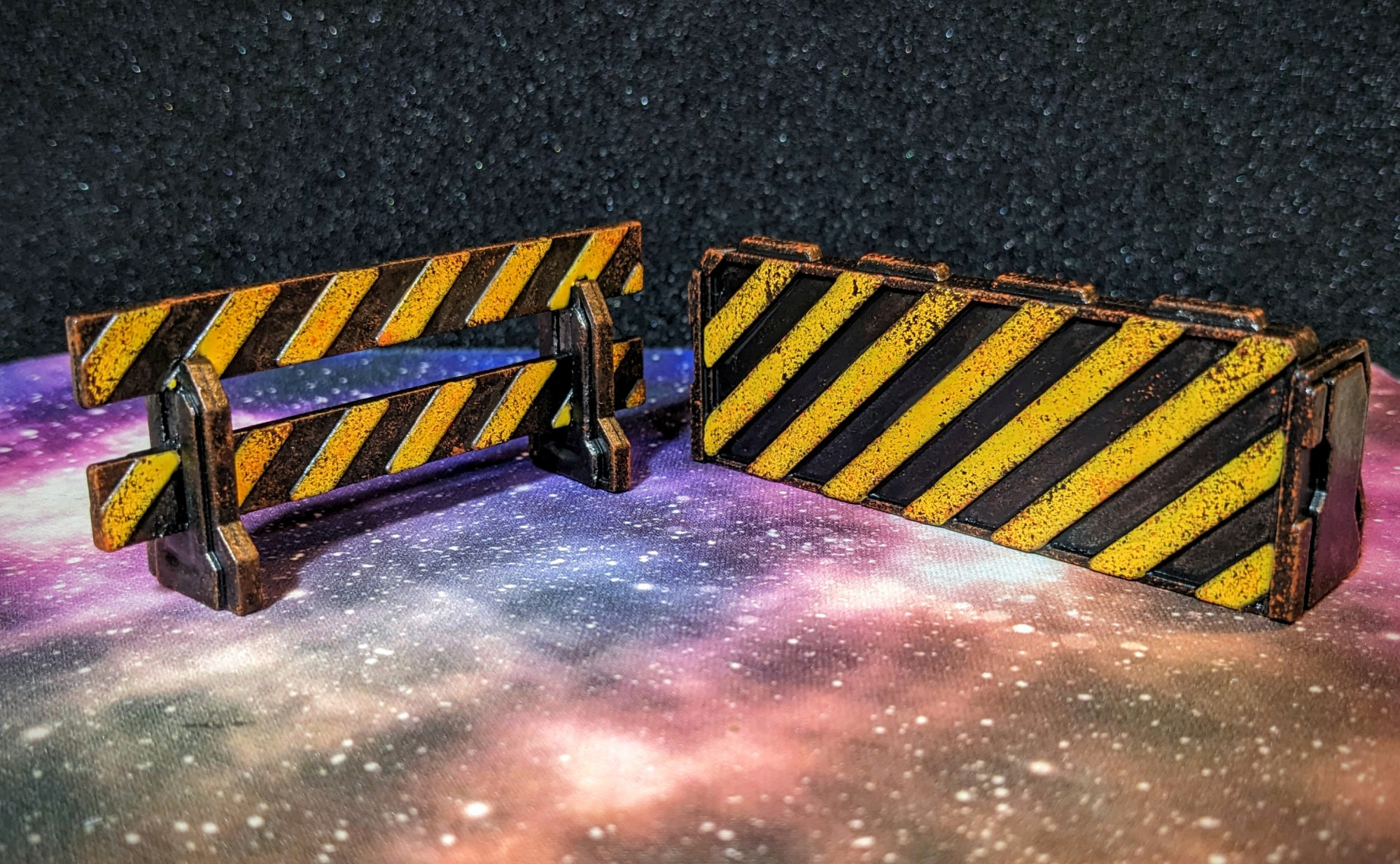
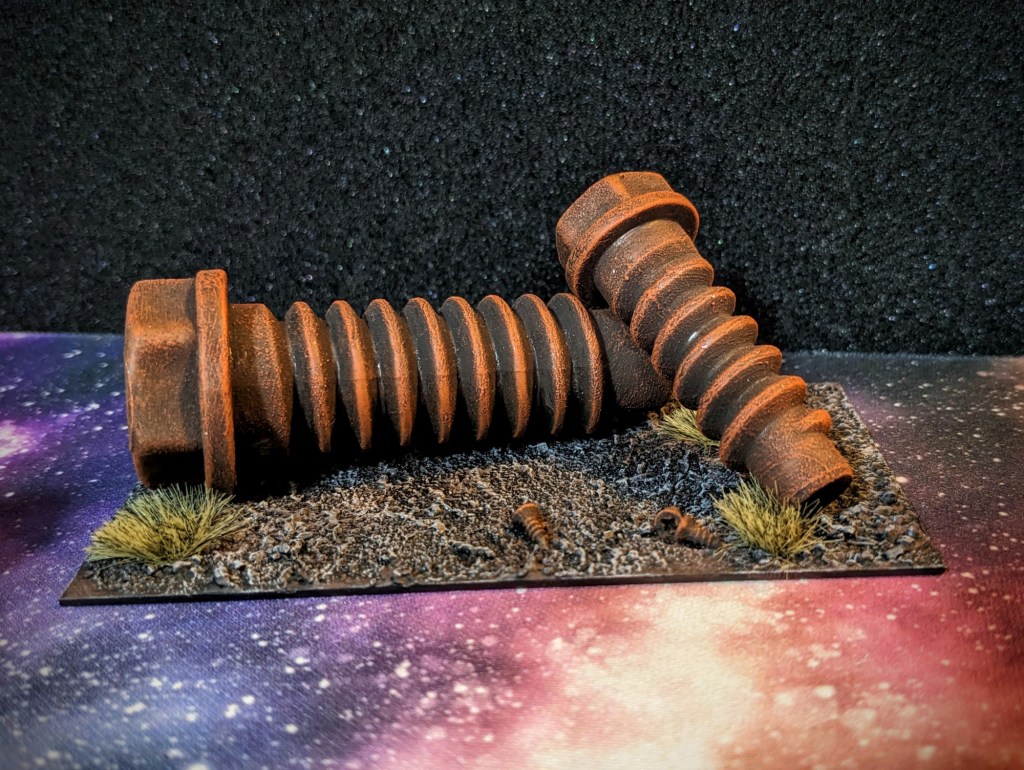
Up first are some industral pieces: two barricades (from Mantic’s Deadzone set, I think) and two gigantic oversized bolts that I liberated from my kids’ toy box and painted in crusty, rusty colors.
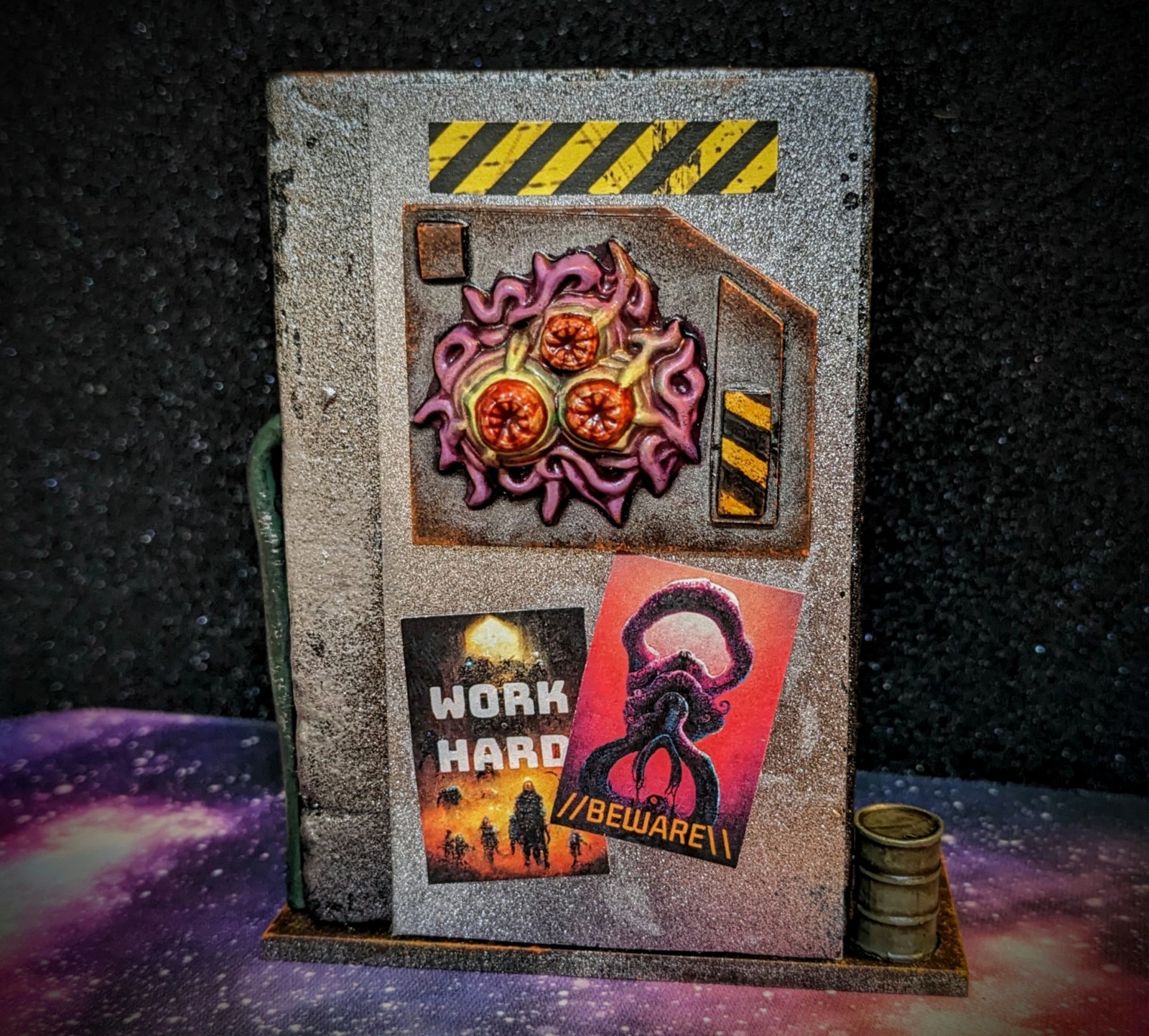
Up next we have some very simple alien growths, perfect for use as objective markers or to dress up a wall or panel. These are Tyranid cysts from some sort of 40k set. I affixed them to small pieces of plasticard painted in a simple rusty metallic paint scheme.
These pieces can be used on the ground as objective points, but to me they work even better when affixed to a wall or door with a bit of sticky tack.
They look like the sort of oozing, ichor-filled growths that would adorn a tunnel or hallway within an area that’s being overtaken by foul xenos. Yeah, that’s the stuff.
This last piece was something I’ve been wanting to kitbash for a long time – a servitor medicae station, one of countless thousands of such sites located throughout the working class levels of Hive Sacrament.
These little stations feature prominently in Darktide, the 40k first person shooter where you play as part of a ragtag Inquisitorial warband purging the taint of chaos from the cruel underhive.
This terrain build was pretty simple – a piece of pink foam fitted with a vaguely religious alcove piece kindly provided by John’s 3D printer. On top of that I affixed some industrial lamps, cables, and grating – all OSHA approved, of course. The servitor model was an old piece from the Inquisitor Karamazov kit that’s been bouncing around in my bits box for years.
After a couple of large, multiplayer sessions in our grimdark sci-fi campaign (The Cauldron), it was a nice to downshift a little bit and try a smaller, more intimate affair for this most recent game. We crafted a custom scenario centered on THE TECHNOBRIDGE, a terrain creation that you can read about at the link.
For this game, we set up a custom, somewhat assymetric scenario that saw Rian’s Battle Sisters assaulting the heretics’ fortified hideout. The Sororitas had three objectives that they had to complete in sequence: lower the bridge, enter the bunker on the far side to retrieve the corrupted data cores, and then escape into the sewer pipe.
The heretics had more forces (500 points compared to 400 points for Rian) but they arrived in piecemeal fashion over several turns. It was an interesting custom scenario that forced some do-or-die decisions on Rian as he advanced across the Bridge of Faith!
The game began with the Bridge of Faith raised (i.e. not present on the table, as you can see in the photo above). The small control station on the far side of the chasm operated the bridge. Rian would need to seize the control station in order to lower the bridge.
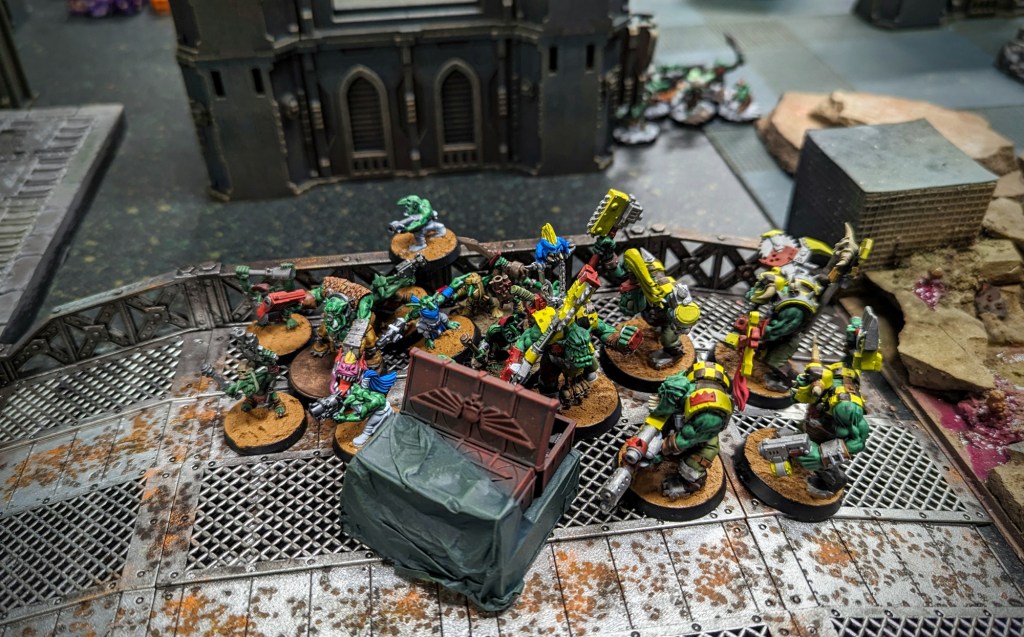
The sandbagged area represents the heretics’ fortified hideout. They also had an armored bunker and some other emplacements under their control – a potentially tough nut to crack, except that they had a limited number of warriors on the table at the start of the game.
Rian’s Sister of Battle deployed near their side of the bridge. They intended to seize the control panel as early as possible, to effect an assault across the relatively open bridge.
The game began with the Battle Sisters laying down covering fire from elevated ruins near Rian’s deployment zone.
The fast-moving Sisters Repentia, unarmored and wielding gigantic chainswords, raced ahead under withering fire and captured the control panel. The bridgehead was under the Imperium’s control!
I realized at this point that I didn’t get too many shots of my own miniatures. I didn’t have a ton of guys on the table at the start of the game, and my figures mostly lurked in their fortified hideouts taking potshots at his advancing soldiers. Interestingly, both Rian and I chose purple accent colors for our respective factions.
Now, most of the Adeptus Sororitas chose to advance up and over the bridge…except for Rian’s badass newly painted biker! She spent the game motoring around the lower level of the battlefield, engaging my warriors at range and generally creating havoc in my backfield.
The first clash came as the Battle Sisters consolidated their position aroud the bridgehead. The first wave of heretic reinforcements arrived, and Josh sent one of his cyborg brawlers charging headlong into combat with the Sororitas.
The clash was brutal and short-lived – the Battle Sisters mobbed the cyborg and dispatched him with ruthless efficiency. With that little threat out of the way, they advanced at a cautious, implacable pace.
Unfortunately, a “cautious” pace wasn’t going to cut it for our scenario! The two remaining locations that the Sisters of Battle had to visit (the bunker and the sewer pipe) were still fairly far away, and the clock was ticking. For Rian to succeed, he would need to abandon his cautious approach and light a fire under his nuns’ collective rear ends.
We quickly realized that the Adeptus Sororitas would have to take a “leap of faith” from the platform at the end of the bridge, onto the roof of the bunker, in order to secure the corrupted data core and escape through the sewer pipe by the end of the game.
Thankfully, Grimdark Future: Firefight has simple rules for jumping. Just roll some dice and hope for high results. If you fall, you’re pinned. Can’t be that hard, right? Wellllll…..
As you can see from the photo above, the Sisters’ attempts at jumping across to the bunker left a lot to be desired. Three nuns flubbed their rolls and fell flat, one after the other. The execution was so abysmal that we suddenly wondered whether the Sisters of Battle were going to be slaughtered outright. My Dark Mechanicum leader (Rho-Terak, the Enslaver of Logic) rushed into the fray, killing the Sororitas leader as she lay prone on the groud. Big yikes!
Thankfully, the Sororitas champion on the bike was still present as a threat on my flank. She kept up the pressure just long enough for one of the Battle Sisters to successfully make the leap over to the bunker. Hurray – Rian was two-thirds of the way to victory!
Beyond this point, I did not capture photos of the final moments of the game. The last wave of heretic reinforcements showed up – two small fire teams of three models each – but alas, Josh and I didn’t place them particularly well, and the new arrivals were unable to interdict the Adeptus Sororitas as they raced from the bunker to the sewer pipe to make their escape.
So it was a major victory for Rian and the Sisters of Battle – but only just! If he had dithered, or if the heretics had been able to stall his advance even for one turn, the outcome would have been dramatically different.
This was a fun game with a nifty scenario that featured creative input from all the players. Oh, and we got to use THE TECHNOBRIDGE. So that was a win all around.
You may have seen a fun new terrain piece in the background of my recent battle report (Cultists Rampant!). It’s a gigantic sci-fi bridge from Pegasus Hobbies, and I love how it turned out so much that I bought another one. (It’s also super cheap at $15.99 on their website.)
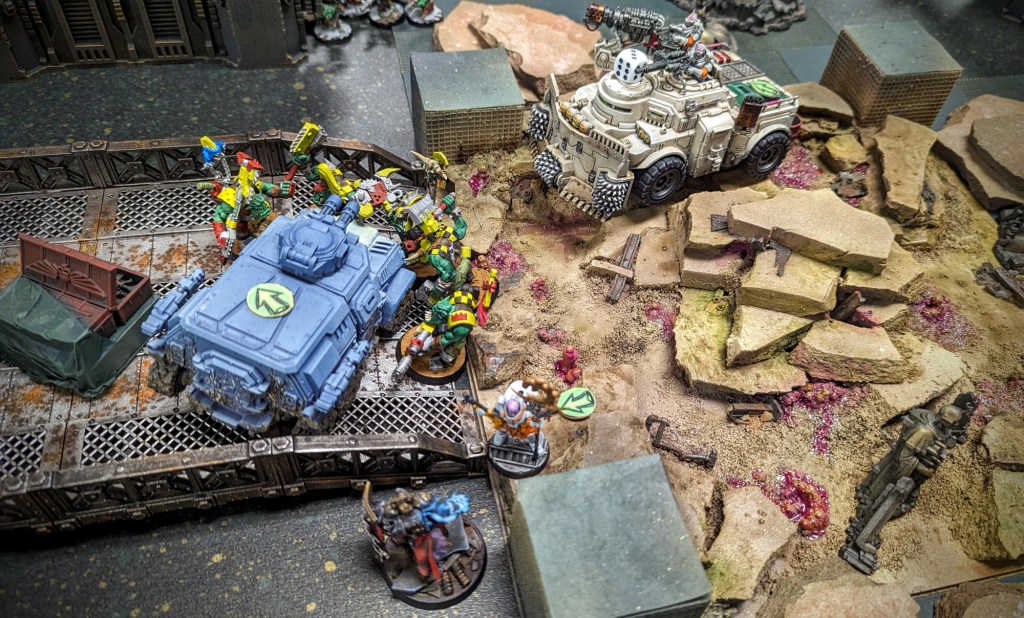
Here’s a peek from the game earlier this month, with a tank parked atop its rusted, pitted surface. THE TECHNOBRIDGE fits right in with the rest of our grimdark sci-fi terrain!
I’m ashamed to report that this simple, effective terrain kit languished in my projects pile for probably 2+ years until I got around to building and painting it. It’s simple to put together – a sprue for the large bridge panels and another sprue for the guardrails, and you’re done! All sci-fi terrain kits should be this easy.
As far as painting, I wanted to try some rock salt chipping to create rusty pits and gouges in the metal surface of the bridge. I painted the whole thing black, then sponged on some bright orange spots in the center of the two bridge channels. I sprinkled rock salt over the orange areas and stuck it in place with a quick spritz of hair spray.
My friend Jim had gifted me a spray can of metallic silver, so I used that spray over the entire model. Once that was dry, I used a toothbrush under running water to gently loosen and scrub off the salt, revealing the spotty orange rust patches. Then the entire TECHNOBRIDGE got a heavy black wash to dull down the shiny metallic finish and the bright orange rust spots. After that, I did some gentle sponging with oranges and browns to punch up the rust effect throughout the model.
This was a VERY fast paint job, accomplished exclusively with spray cans, heavy washes, and various chipping/sponging effects. No small paintbrushes were harmed in the creation of this TECHNOBRIDGE!
I think the overall effect is great, and I’m continually impressed by the sheer size of this terrain piece. You could comfortably drive a Land Raider across the TECHNOBRIDGE. In fact, it served as the centerpiece of a forthcoming battle report from last week’s game of Grimdark Future Firefight! Here’s a sneak peek.
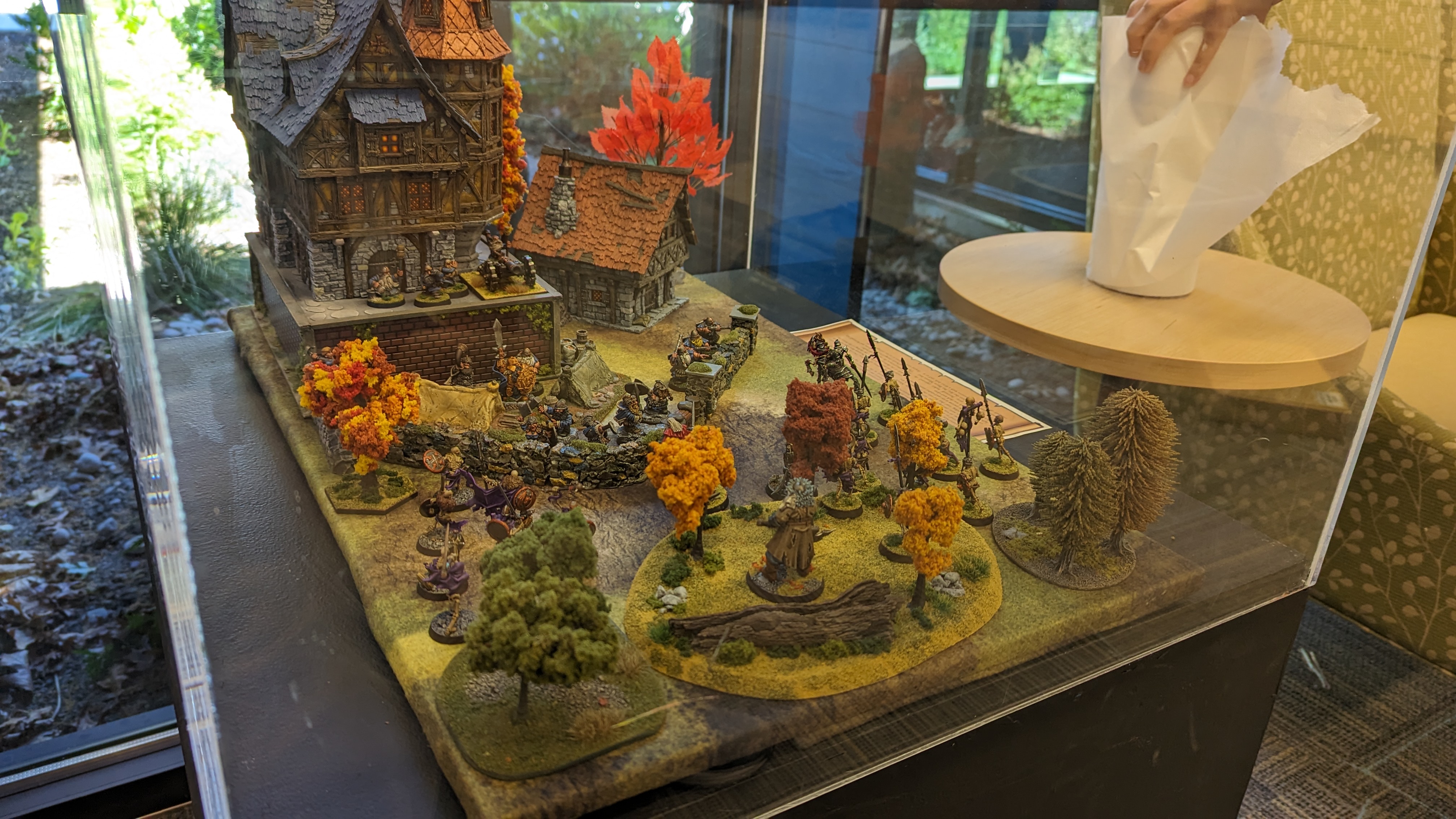
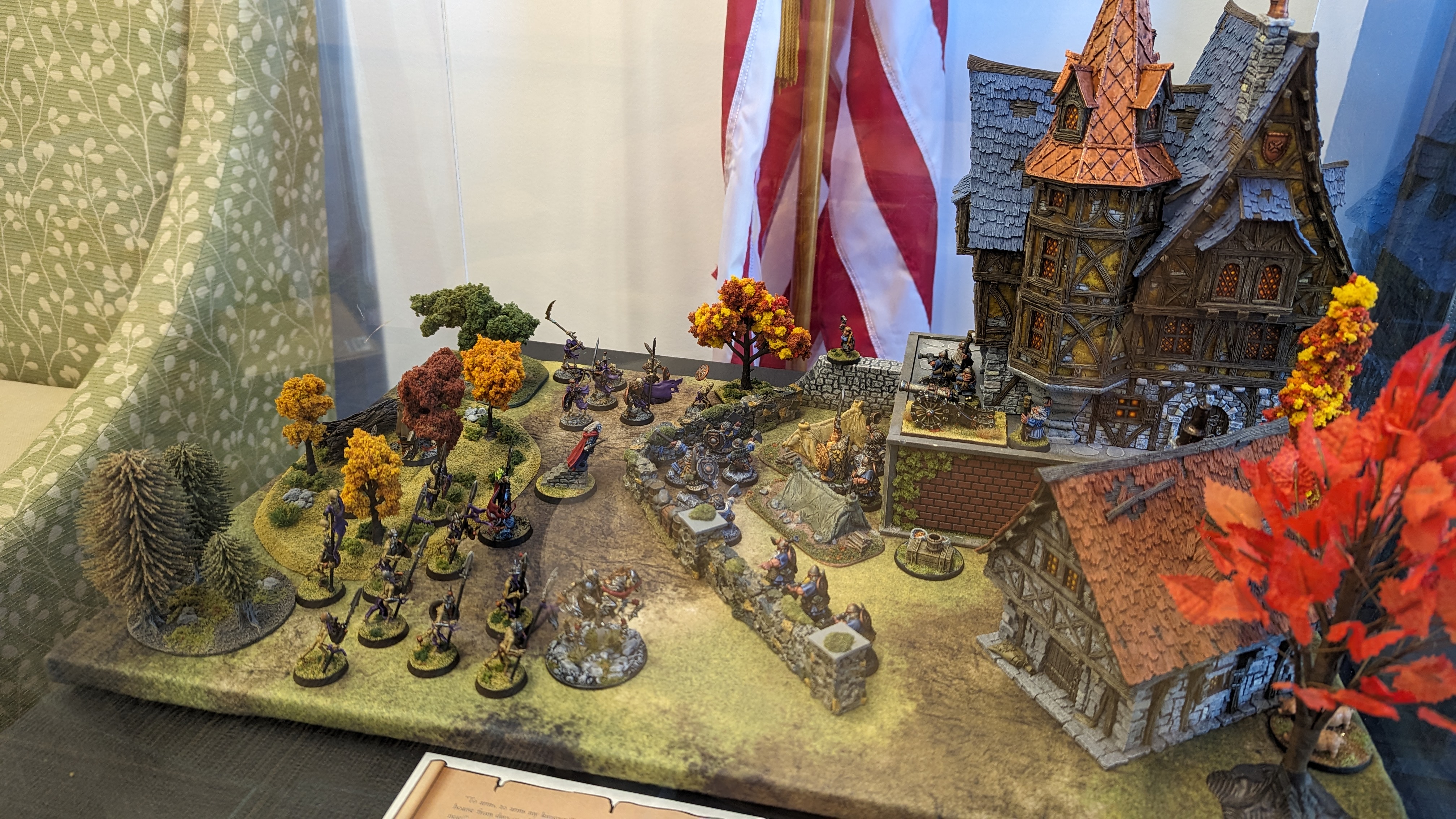
I absolutely adore Tabletop World’s crisp resin buildings. They’re well worth the price, even with shipping from Europe to the USA. I painted up a couple smaller cottages a couple years ago, but in late 2022 I embarked on my largest project yet – the epic Mansion building!
I’ll cut to the chase and show you the final completed model in all it’s four-story glory.
TTW terrain pieces are fully detailed inside and out, and the casting is absolutely superb – I’m talking machine-shop precise. The 7 or 8 pieces that make up this kit fit together with incredible precision, and no flash anywhere to speak of.
I started with a simple gray basecoat, which was to form the foundation for the stonework that defines the base of the building (and peeks through the wattle & daub of the upper levels). I picked out a few stones in off-gray colors to create some variety, then drybrushed the entire piece in progressively lighter shades of gray. This created a decent undercoat for the rest of the colors.
The timbers became dark brown after two coats of raw umber. I really like raw umber for terrain, as it gives a brown hue with a touch of green that is transparent, allowing the gray drybrushed highlights to show through.
The windows on my other TTW buildings always draw the eye when they’re on the table, so I wanted to recreate that effect here. I’m going for a warm effect that suggests rooms lit by candles, braziers, sconces, and fireplaces. If you could peek in these windows, you’d see bawdy feasts and ribaldry on display. It’s a fun effect, looks good from a distance, and it’s quite unlike how most people paint windows.
Here’s that completed pic again. It’s hard to see in this photo, but the upper turret is painted copper, not orange. The roof of the turret is festooned with rivets, which to me suggests metal of some sort. Copper it is! Maybe in a few years I’ll go back and add in some patina and verdigris.
Now you might be wondering: blue wood shingles for the roof? Sure, why not? It’s a fantasy setting, so anything goes. The blue pleased me when I was looking at different colors, so I went with it.
So that brings my total collection of TTW buildings to three (3)! But I’m not done yet – my buddy Lawrence, who is even more of a fiend for these pieces than I am, has been busy scooping up lots of TTW terrain off ebay and miniswap, and he’s offered me a duplicate blacksmith’s cottage to paint up. So look for that later this year, once I’ve rebuilt my stamina for these gigantic terrain projects!
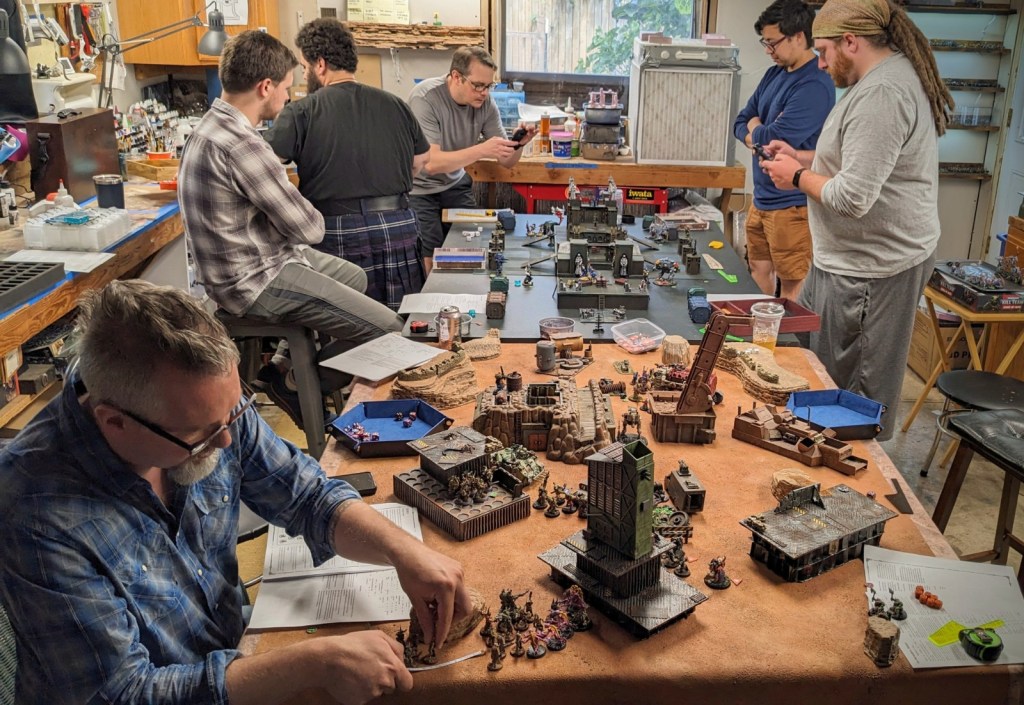
We got together earlier this for another game of Nightwatch, specifically to introduce a couple new players to the game. And while this game wasn’t specifically set in our ongoing Nightwatch campaign, it was fun in retrospect to imagine the events of this game happening concurrently to the primary campaign. This is the “B-Team,” and what they may be lacking in combat prowess they more than make up for with the size of their h e a r t s !
Anyway, this was a fun one-off game where we didn’t worry too much about the outcome … we just focused on rolling dice and having fun!
Somewhat by accident, we set up a rather extensive urban battlefield for this game. It turns out that everyone had thought *they* were responsible for bringing terrain, so we ended up with way more terrain than we needed. Hence this cluttered, yet strangely beautiful setup.
The scenario called for the players to defend the small well in the grassy courtyard in the center of the table. The red portals represent possible spawn points for the waves of bad guys that will emerge at random to menace us.
We had a wide variety of heroes in our game … a bladesman, a wizard, an alchemist, and a ranged combat specialist. Overall, a nicely balanced group, ready for anything that could possibly get thrown at them.
The action started on the first turn, when hordes of vermin poured forth from sewers and drains beneath the village. Nightwatch describes its bestiary in general terms, and leaves it up to the players to decide how to represent them with miniatures. In this game, we decided to draw on our collection of ratmen models, starting with Vince’s rat swarms to represent the vermin, followed by my vintage metal Skaven for the hordes.
The terrain tile above had a nifty subterranean staircase, so naturally we placed a spawn portal down there. And we cackled with glee whenever the vile ratmen would come boiling out of the stairwell!
Vincent’s nifty town bulletin board ended up seeing heavy action as the battle raged around it. I need to make one of these, too!
In the photo below, Mumblemore dances atop the veggie cart while in the background you can see a smattering of gore tokens representing the bad guys who have been taken down over the course of this game.
We’ve found that casualty markers or gore tokens are pretty important for this game, because you need to mark the location of slain corpses so that individual hunters can move into contact with them to undertake various and sundry tasks: robbing their pockets, slicing off an ear, maybe pulling out a gold tooth. It’s all covered under the Burdens section when creating a hunter.
The battle got pretty heated by the end of the game, with ratmen surging up from the subterranean depths and the heroes flinging spells and grenades all around the battlefield. The first couple of sessions of a typical Nightwatch campaign aren’t particularly deadly, which makes them perfect for a learning game like we set up here. You can dig in, explore the rules, slay some bad guys, and then survive to make it back to town and go through the post-game campaign steps.
That’s exactly what we did after this game, actually! Even though we weren’t playing a typical 7-session campaign, we nonetheless went through the post-game campaign steps to determine how much loot we found, which artifacts we ended up with, etc. It was great fun and made us even more excited to return to our ongoing Nightwatch campaign.