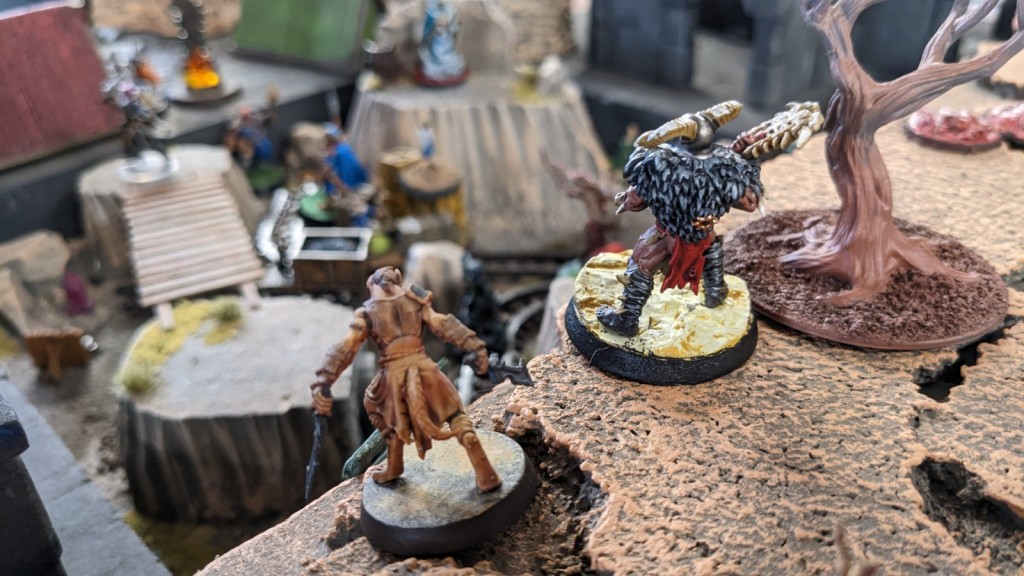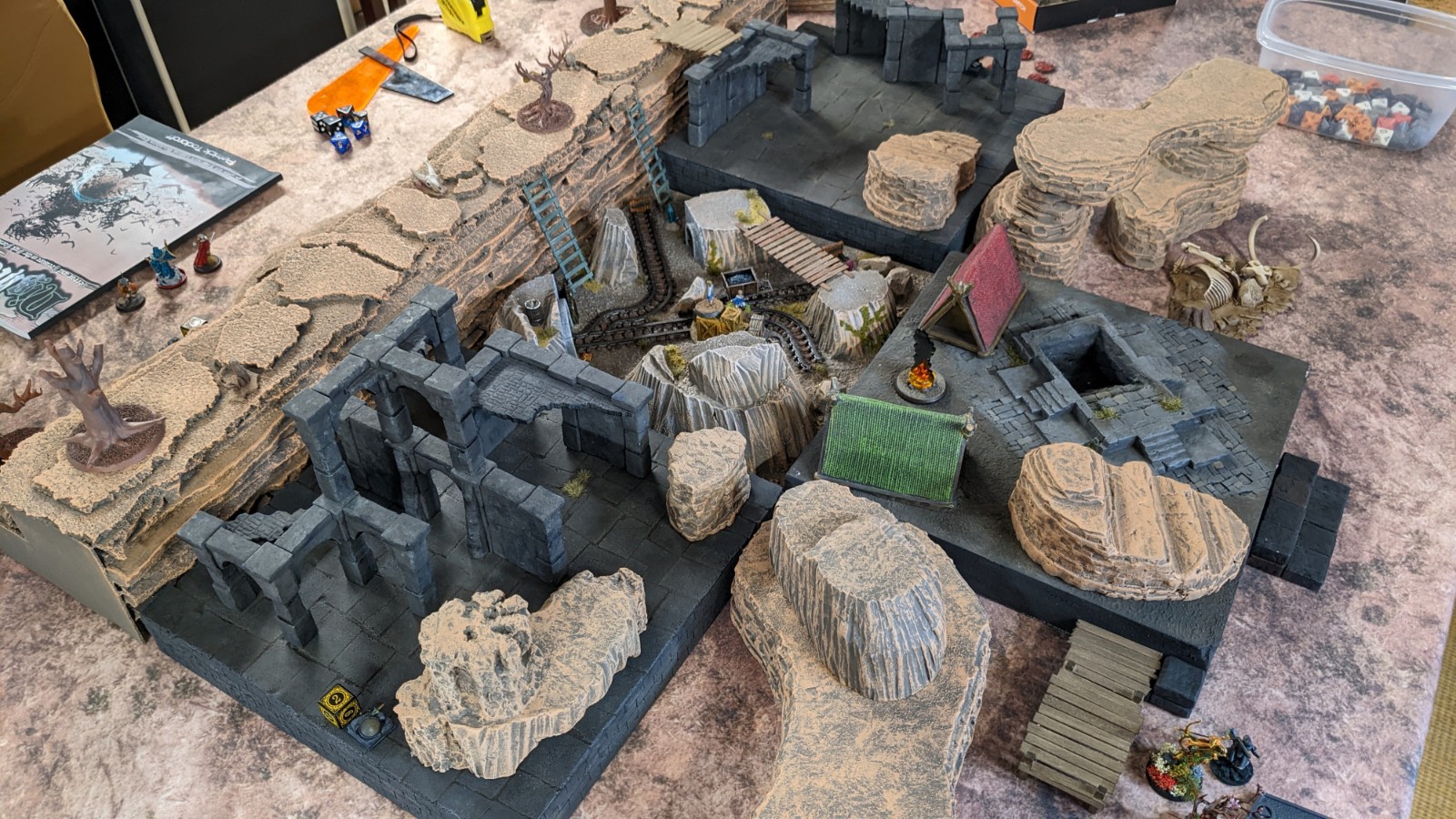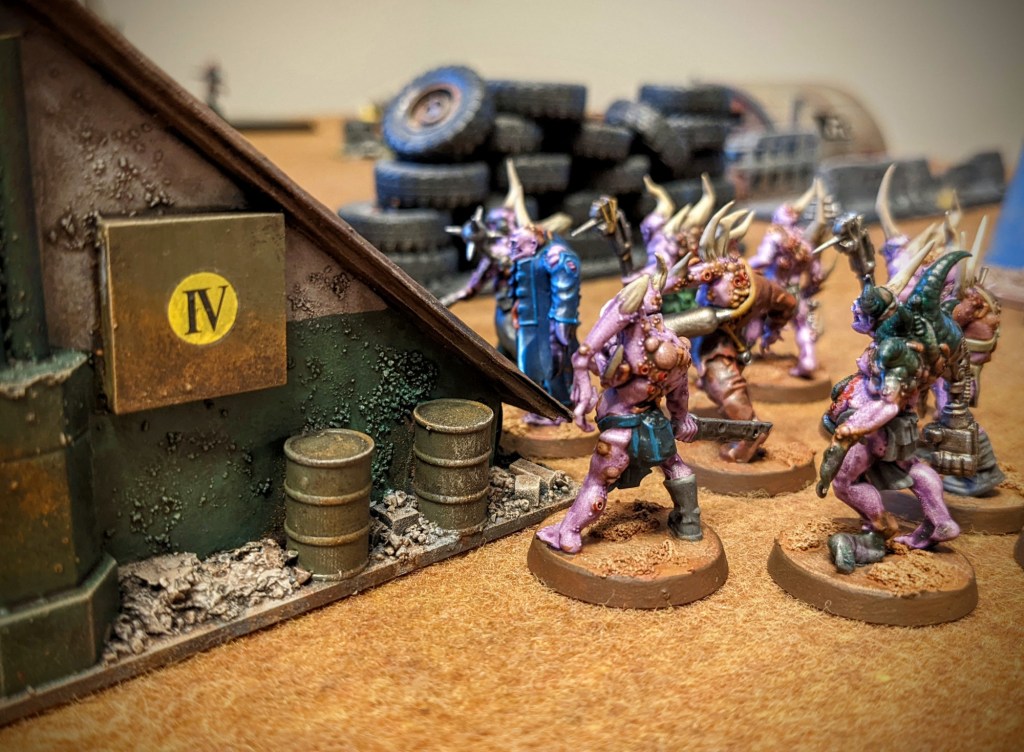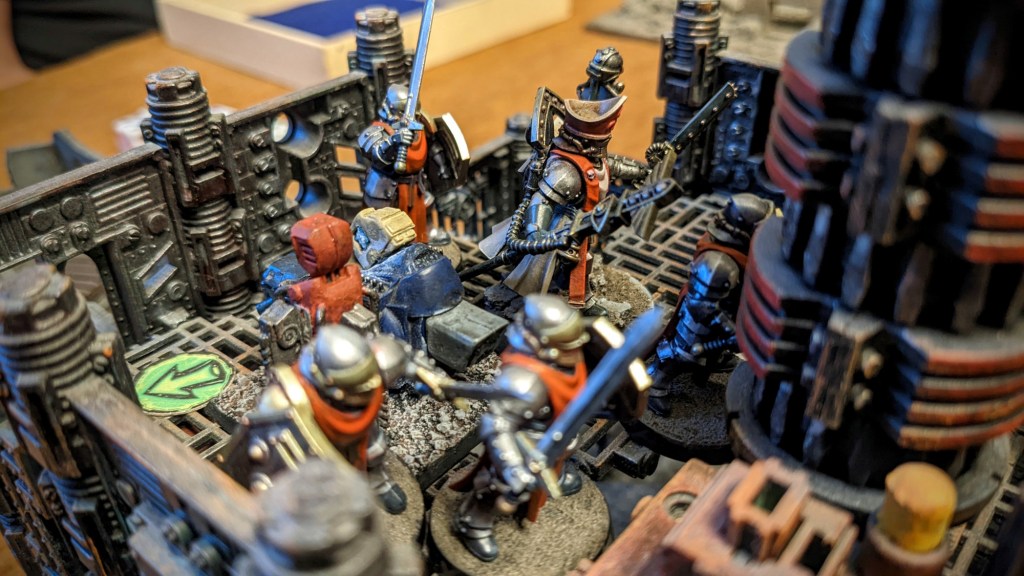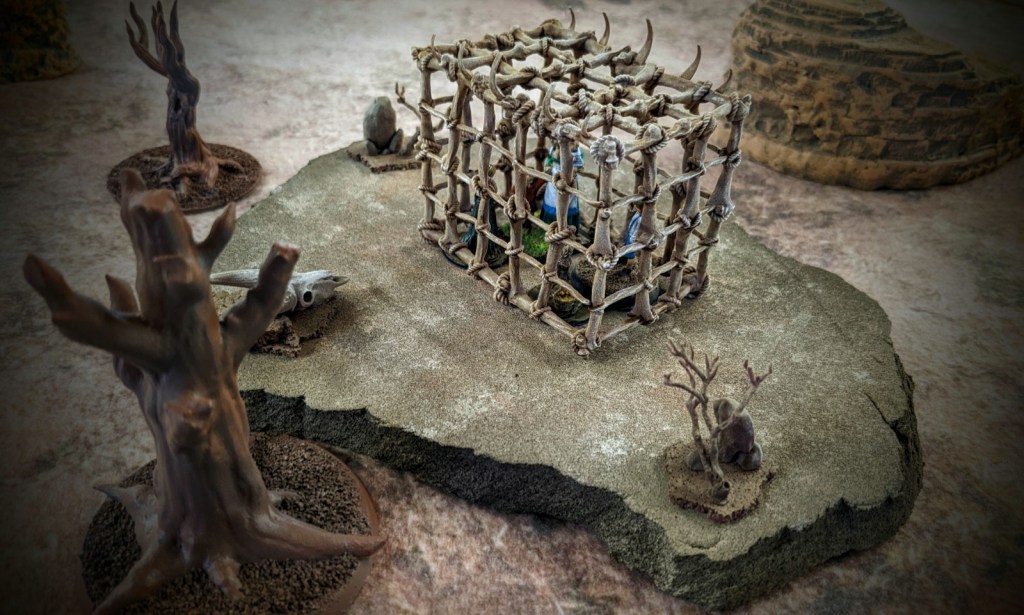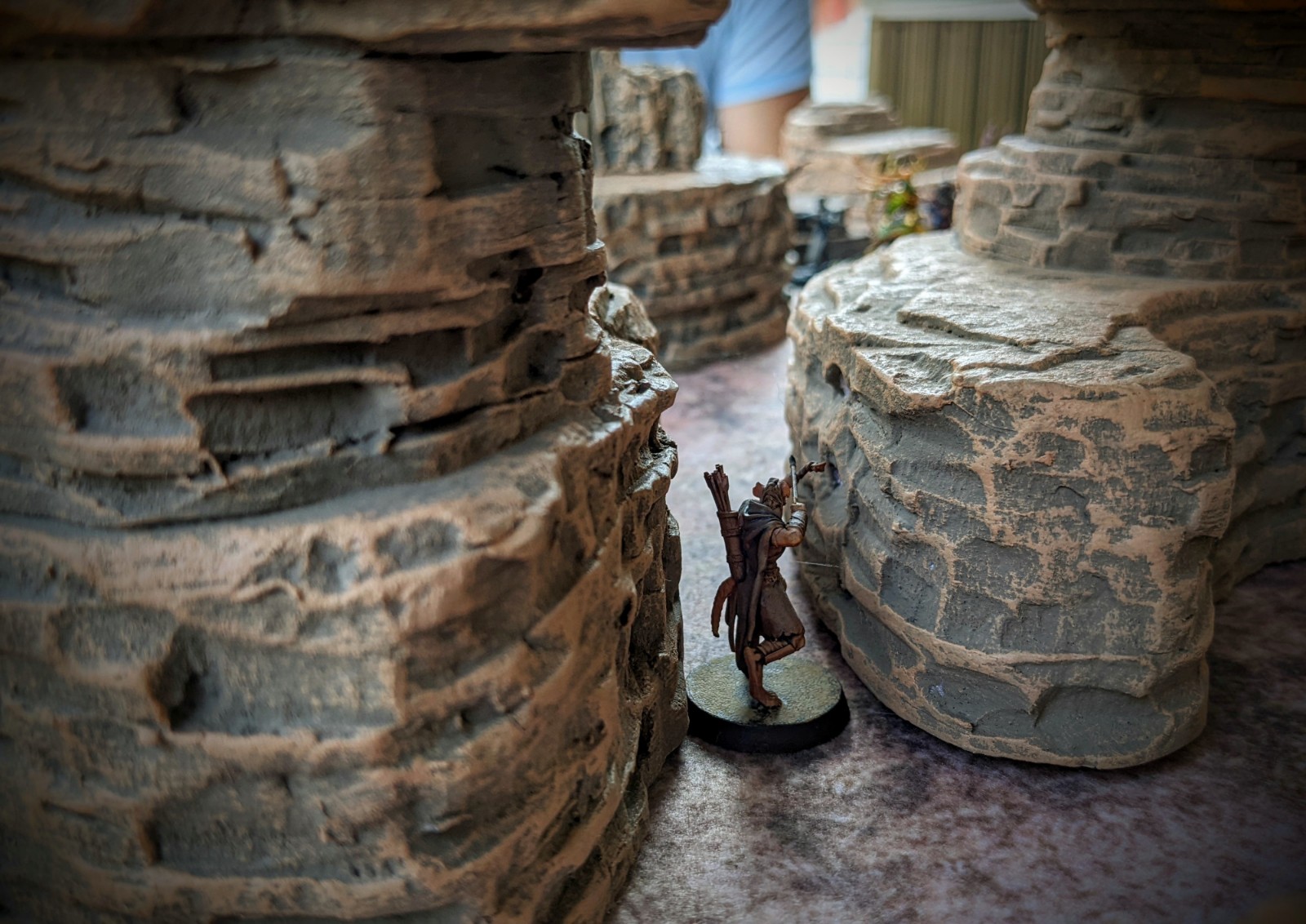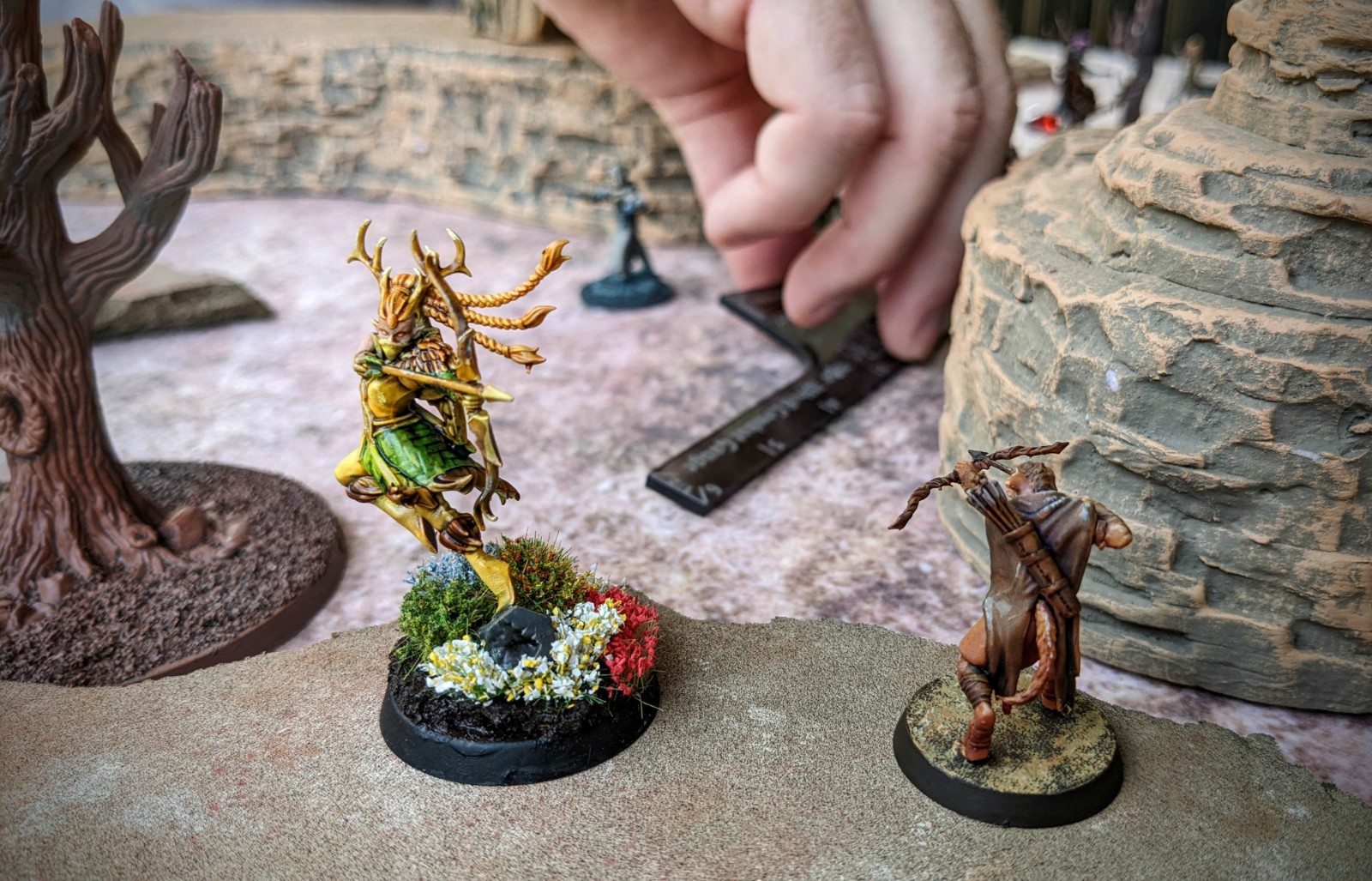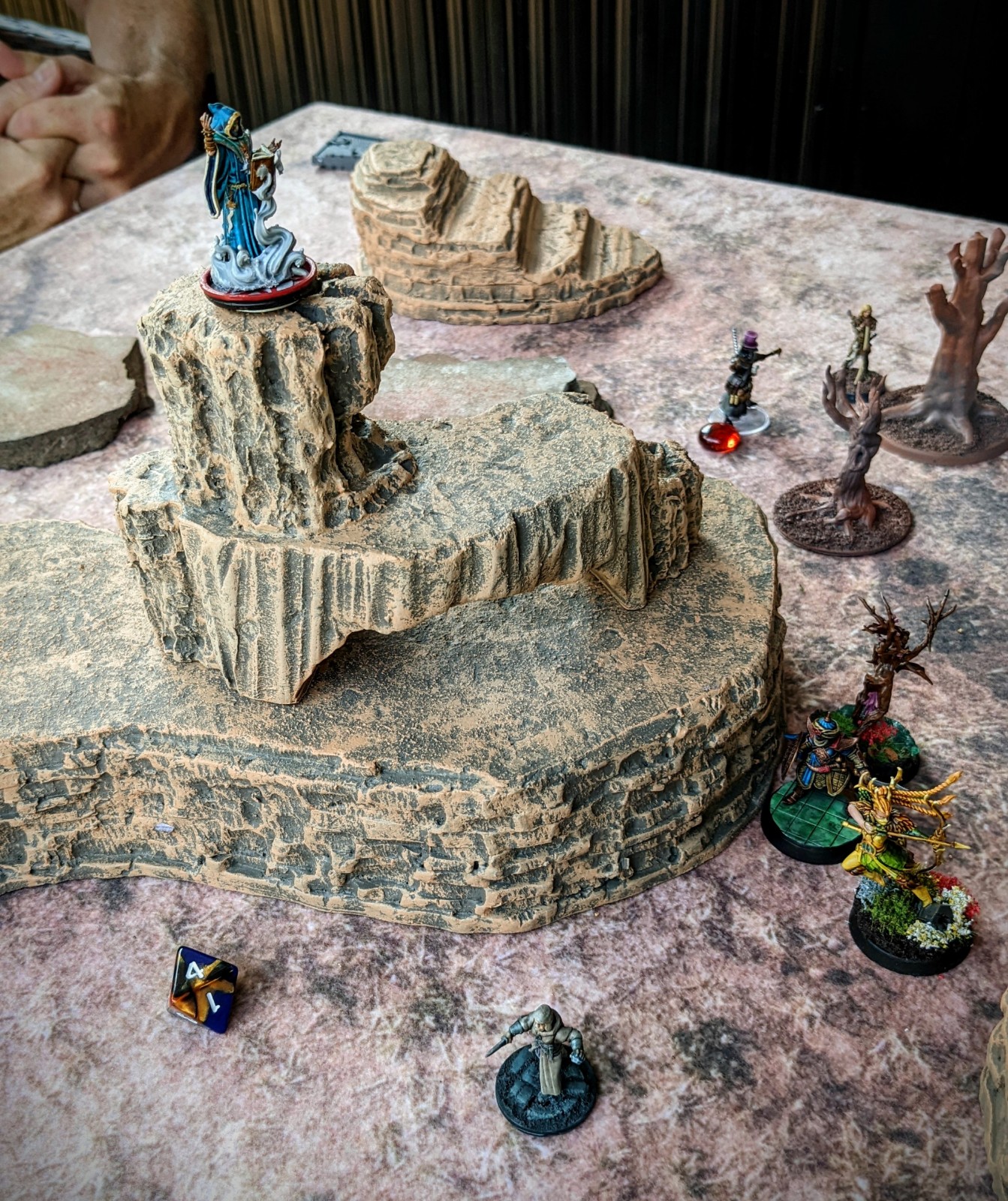
Perched atop a desolate slab of rock stands a cage. Crafted from sun-bleached bones and tied with dusty scraps of sinew and skin, the cage exudes a kind of forlorn solitude. Travelers are wise to give the bone cage a wide berth if they are forced to traverse the wind-scoured desert of the Hattendorf Border Marches. Those who dare to venture close enough may hear faint cries emanating from within the tattered enclosure…
We played our third game of Nightwatch back in late August, but I haven’t gotten around to doing a writeup until just now. The game was centered around a grisly terrain piece that John printed and painted up just for this occasion — the titular bone cage, wherein the beastmen of the border marches had stashed a few sad, whimpering children kidnapped from Heerselt Manor.
How terrible! If only there were some hunters, blooded from recent battles and increasingly capable of tackling the worst that the border marches could throw at them! Where, oh where, could we find such heroes!
Ah yes. They’re here, at this very place, to attempt the very deed I just described.
If the first two sessions were characterized by caution on the part of the hunters, this session could be characterized instead by competence from the hunters. By this point they were experienced, well equipped, accompanied by a few hand-picked allies, and generally ready to accomplish their mission.
Our Nightwatch battlefield was still quite small, around two feet square, which meant that the hunters were able to quickly get into position to pick the locks on the bone cage. This task took multiple turns, and the rest of the warband had to fight off waves of beastmen and gnoll raiders who swarmed out of the nearby canyons.
As I mentioned earlier, this was a seasoned, competent bunch of players. They knew their characters and had a pretty good sense of how to stymie the beastmen raiders. Their overall goal was to keep the beastmen at bay until they could pick the lock on the bone cage – hopefully before the threat level ratcheted up in the later turns of the game.
The beastmen swarmed in, and the bodies started hitting the floor. The characters had nifty weapons and spells at their disposal, and the low-level beastmen who arrived in the early turns were ground up into hamburger by a flurry of lightning bolts, alcemical grenades, sword parries, and longbow shots.
I’m pleased to report that the players’ plan went off without a hitch. They were able to manage the emerging beastmen threat while simultaneously jimmying the lock on the bone cage. They ripped the doors open at precisely the right moment, just before the threat level was scheduled to ratchet up.
I’ll admit I was extremely interested in deploying some of the more menacing beastmen monsters that we had assembled for this game, but those guys will have to wait until the next session. Until then – you win this round, heroes!!
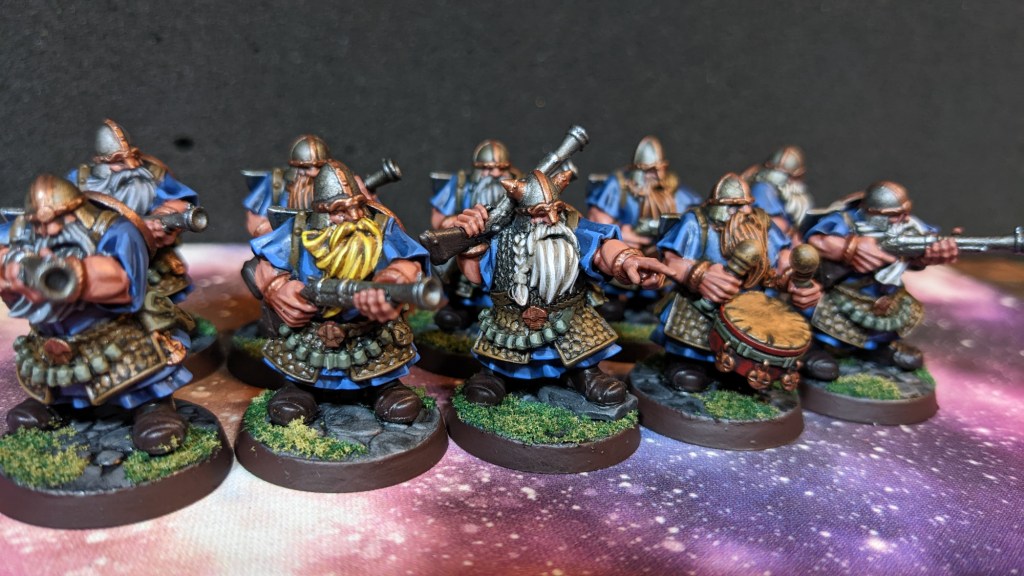
Last month I completed my first unit of 100% printed miniatures! Up until this point I’ve dabbled here and there in painting 3D printed models — several of the guys in my local game group have printers that are humming non-stop to churn out beautiful resin awesomeness — but this was the first time I set about painting an entire 3D-printed unit.
The models came from Highlands Miniatures, courtesy of BartyB’s fiery forge (actually a Phrozen Sonic Mini 4K). The sculpts are simple and unadorned, which I really like — I’m not a big fan of dwarf models that are covered in fiddly bits related to a specific setting or mythos. Guess that’s why I don’t have a lot of use for GW’s three disparate dwarf lines (the Dispossessed, Kharadron Overlords, and Fyreslayers).
These guys are simple, somber, task-oriented dwarf warriors, and I love it. I ended up painting these guys on my lunch break at work, which led to lots of fun conversations with my coworkers as they repeatedly stumbled across my little hobby setup in the breakroom.
These guys were painted in the sky-blue livery of King Nicodemus II, the Anvil of Dawn, which marks them as part of his personal house guard. These models will bulk out the ranged combat capability of the Expedition to Hearthspire, aka my large dwarf army. The army is composed of models from many different sources, which is almost a hobby unto itself — how many oddball miniatures can I paint up and add to my hodgpodge force?!
Be sure to take a look at the dwarves I painted up earlier this year in my Summer Painting Roundup! I’m hoping to get all of these guys onto the table later this year for our winter fantasy apocalypse game!
We played another session on our Nightwatch campaign earlier this month. The first session, back in July, was a great test drive of the ruleset. This session featured the same threat level (fairly low, suitable for beginning characters). We gathered on a John’s back patio on a scorching hot day in western Oregon. (“But it’s a dry heat!”)
The mission involved escorting an academic from the civilized lands into the Hattendorf Border Marches, in an attempt to learn more about the source of the beastmen raids that had plagued mightily this peaceful region.
The hunters needed to cross the board diagonally, from corner to corner, while keeping their bespectacled scientist safe from the ravening hordes.
As before, Vincent, Paul, and Daniel brought their hunters, plus a few hirelings purchased with hard-won silver coins following last month’s session.
John and I shared responsibilty for running the bad guys – the beastmen vermin and chaos raider hordes that would boil forth from several pre-determined points on the battlefield throughout the game. The game featured some new gnoll archers that John had printed and painted just the week before. Very nice!
As the game got underway, it was amusing to see just how cautious the hunters were in their approach. The near disaster of the first session, where the hunters had strolled blithely through the first few turns before stumbling toward the end, had clearly factored into their strategy. They moved at a deliberate pace and tried to stick together as a group.
As before, the vermin and hordes began spawning each turn during the “Darkness” phase, leading to regular and repeated intonations of “DARKNESS DESCENDS; WEEP FOR THE WORLD YOU HAVE LOST” by yours truly. What can I say, I like getting in character a bit?!
The difference was in the players’ behavior. They were tactical and methodic, making full use of their hirelings, magic spells, and various items of wargear acquired in the previous session.
As the game got underway, the corpses of slain beastmen began to pile up everywhere, represented by colored tokens on our battlefield. In Nightwatch, each hunter has a burden – a curse or debt or other drawback that must be managed or overcome over the course of the campaign. Several burdens relate to corpses, such as looting them or retrieving some artifact. So we had to note the location of dead bodies as the slaying began in earnest!
And still the beastmen attacked! Nightwatch has a basic AI system that provides some flexibility for how the spawning baddies behaved. They won’t always just charge directly for the hunters. Sometimes they’ll angle in to focus on a target related to the scenario – like the fragile academic, in this case!
The beastmen and chaos raiders arrived in ever-greater numbers, but the players were prepared to deal with them. The scientist made it safely to the other side of the board by turn 5, right when the bad guy deployment schedule was just about to ramp up into a more dangerous category. Nice work, team!
It was a solid victory for the hunters – but their celebrations will be short-lived. From here, the threat level of subsequent scenarios will increase…more bad guys, in greater numbers, spawning earlier in the game. We’re playing session #3 soon, so check back for the latest on the hunters and their ultimate quarry…
John and I got together last month for another installment in our periodic fantasy campaign inspired by our homebrew fantasy setting.
Dubbed the War of the Coins, the campaign represents a years-long clash between the duchies of Vladisport (a collection of human fiefdoms led by House Begovic) and the dwarven city-state of Miravec, which includes the titular city as well as a collection of holdfasts and walled cities located near the northern edge of the Fellhammer Mountains. The map below displays the city-state of Miravec and its surrounding regions held by the dwarves at the outset of the war.
We developed this setting (the world of Uthdyn) during a collaborative game of Microscope a number of years ago, and it’s since served as the backdrop for Paul’s D&D campaign as well as our Frostgrave campaign and these periodic fantasy wargames.
The complete setting spans several continents across multiple different time periods. This game focuses on one specific turning point in the history of this particular corner of the map.
For tonight’s game, I set up an urban battlefield representing the town of Tor Sigil, a dwarven trading outpost south of Miravec. Before the war, Tor Sigil was a prosperous hub that served as the gateway for merchants and traders heading toward the dwarven city-states of Miravec and Kjelvaskur.
Now, Tor Sigil is the front line of a sustained and bloody campaign of conquest against the dwarves. This game focuses on a last-ditch rearguard action of a small contingent of dwarven defenders as they held the defensive lines in the city to allow the bulk of their army to withdraw and prepare to defend the approaches to to Miravec.
(I may have been channeling a bit too much zeitgeist from the Ukrainian war when writing up this battle report. You be the judge.)
I hosted this game, and took the opportunity to pull out my medieval village terrain pieces, including two beautiful centerpieces from Tabletop World that I painted last year, plus a couple more pieces from Miniature Building Authority. I have a solid collection of medieval village terrain that doesn’t get a lot of action unless we’re playing at my place. Before John arrived, my kids had a lot of fun invading the village with dinosaurs.
You can see our initial deployment in the photo above (and below, I’ll just repost it so you don’t have to scroll).
My dwarven defenders are on the left, and John’s fast-moving skirmish force is on the right. My army featured four hard-hitting artillery units, which I positioned with decent lanes of fire toward the central plaza in the center of the village. John had two cavalry units positioned on the two flanks, ready to ride down by heavy guns and scatter the poor crew. In addition, he had a unit of infantry hidden in ambush – these guys would pop out on from hiding during the game.
The first turn featured a lot of maneuvering as we sought to advance on the four marked objectives on the battlefield. My cannons opened fire, with marginal results.
Turn two was when things started getting interesting. The dwarves, advancing at a stately pace with lots of clanking armor and jingling chainmail, suddenly found themselves facing an ambush, as John’s halberdiers sprang their trap and came pouring out of the alehouse where they had been holed up, nursing hangovers since the night before. Talk about dedication to the war effort!
The same turn, my elite dwarf warriors (in the gold armor) were stunned when a unit of winged pegasus knights swooped in and crashed like a wave, wiping them out to a man.
It was a dire turn of events for the dwarf army. Moving as quickly as they could, the dwarfs pivoted to deal with the ambushing infantry that was running around their backfield. Neutralizing those pesky units definitely took my attention away from the objectives.
Eventually, the flanking force was more or less dealt with, and we resumed our plodding advance toward the central objective (represented by the patinaed statue). In the photo below, you can also see my dwarven berzerker champion (newly painted!) and my blue-skinned frost giant (painted 15 years ago!). Both units played a pivotal role in the final turns of the game.
Opposing them in this clash were John’s stout spearmen. Take it from me – John loves his spearmen. The phalanx rule in Age of Fantasy, which represents units armed with spears, pikes, and other sharp sticks, is absolutely brutal.
While the frost giant carved up the human attackers, gaining a little breathing room near the central plaza, the spearmen formed up to receive a charge from my fearsome bear-mounted dwarf lord. Frothing with rage from the ambush that took out so many of his fearless countrymen, the dwarf lord urged his mount on like a furry missile missile that crashed headlong into the forest of spears.
Stunned and repulsed by the fury of the dwarf lord’s charge, the spearmen fell back. Into the gap stepped (or fluttered, as the case may be) John’s pegasus-mounted champion. The stage was set for an epic clash of HQ-vs-HQ, as the leaders of our two armies traded blows while their foot troops looked on and cheered.
The impact of their mighty blows cracked the stone masonry of the surrounding buildings and ripped up the cobbles in the street. In the end, the pegasus-mounted champion stood triumphant, and the dwarf lord ambled off as fast as his bear buddy would convey him.
That clash actually represented my last gasp at a tactical victory. If the dwarf lord had done his job and defeated the pegasus champion, I could have battled John to a draw and maintained a tenuous grasp on the village of Tor Sigil. With the champion defeated, John had secured a majority of the objectives, and with them, the victory.
The final turn featured a little more action, including some savage combat on the other size of the plaza between my dwarf warriors and another unit of those accursed spearmen. My berzerker champion also carved up several units, more than paying for his points. But tactically, the game was decided when the bear lord was defeated.
Once again, Age of Fantasy gave us a great game with lots of tactical decision making and flavorful results that helped advance our narrative campaign. The dwarves were driven from Tor Sigil – can House Begovic pacify the trading outpost before the dwarves muster a solid counterattack? Stay tuned for more!
Earlier this month the crew mustered at the War Room (John’s garage workshop / game area) for a new campaign of Nightwatch.
Nightwatch is a fantastic, rules-lite skirmish game focused on low fantasy monster hunting. Think the Witcher, or Conan. Each player controls a powerful hunter who specializes in some sort of monster-hunting task. The game is intended to be played as a multi-part campaign, where your hunter attracts thugs and hirelings along the way as they battle ever more ferocious monsters, culiminating in what can only be described as a boss battle. The monsters are controlled by a simple yet satisfying AI system, which also supports solo play.
We were excited to try out this campaign, as we love skirmish games with low model counts that are focused like a laser on achieving a singular tabletop vision. Nightwatch (written by P. Todoroff, the same guy who wrote Zona Alfa) fit the bill perfectly.
We set the game in Heerselt, a border hamlet north of the dwarven empire of Miravec in our homebrew fantasy setting. The hunters were summoned to investigate some mysterious goings-on in the village. Heerselt is in the northwest corner of this map of a portion of our setting.
The scenario called for the players to explore four bent, twisted trees located on the four corners of the play area. Scenarios and objectives vary from game to game, but in this case, most of the game focused on the edges & corners of the game, which meant that the center of the board, with its gruesome trophy outside the ruined manor, didn’t see much action.
Seeing as how this was game 1 of our campaign, each player controlled just their own hunter, with no backup or lackeys. They’d have to do all the dirty work themselves…
Vincent’s alchemist and Jim’s swordsman took the left flank, creeping around the perimeter of the village to get to the twisted trees. Unfortunately, the bad guy deployment zones were also located on the perimeter of the battlefield, and each turn two of the four spots were selected at random. Foul vermin and hordes of evil poured forth!
As it happened, the majority of the monsters that arrived in our game randomly spawned near Vincent and Jim’s characters. They quickly found themselves scrambling to the high ground while fighting off an ever-growing horde of desert raiders and beastmen!
Over on the other side of the battlefield, Paul’s elf archer and Daniel’s wizard had a much better go of it. The elf archer loped across the board and secured both trees, though it took a little time – you have to make a successful dice roll to secure the objective, which the elf failed repeatedly to do, leading to many, many jokes about how the elf just can’t figure out these trees, etc.
And Daniel’s wizard almost certainly won the team player award. He crossed the entire battlefield, flinging lightning bolts left and right, and ultimately helped the party secure the final objective and win this particular scenario.
Towards the end of the game, there were some real questions whether or not the players would be able to win the scenario and escape alive. Nightwatch intentionally ratchets up the danger by deploying more dangerous monsters in the later turns. So while the game started as a cakewalk, with the players easily dispatching the vermin that emerged in the early turns, they were scrambling by the final turns and absolutely needed every last trick that each of the four characters could muster to secure the victory.
Here’s a peek at the action as they reached the final tree and closed out this game…
Nightwatch gave us a smashingly fun game for our first outing. Our adventures will take us deeper into the badlands known as the Hattendorf Border Marches. I’m particularly excited to see some hirelings show up … this game starts with a very low model count, but I was jonesing to get more toys on the table! Thankfully, the players were already scheming about how to spend their hard-earned silver pieces.