Hark, gentle reader! Do you hear that? The grinding of massive gears hints at some foundational updates to Comrade’s Wargames. Specifically, I have created a new section on ye olde blog to collect the various narrative campaigns that I have taken part in recently. These campaign chapters have heretofore been sprinkled throughout my blog as individual posts, spanning months if not years. The new page attempts to list them all in rough chronological order for ease of reading.
The page itself is creatively named “Narrative Campaigns” and it is linked in the menu bar on the front page of this blog.
The page, in turn, displays links to three additional pages showcasing the backstory and a listing of battle reports from three recent narrative campaigns. They are:
In keeping with tradition here at Comrade’s Wargames, these narrative campaigns feature beautifully painted miniatures from me and my buddies, alongside visually stunning terrain and a compelling tabletop narrative. I’ll continue to update these pages as we play additional games for them. Grab a cup of your favorite beverage and dig in!
In February I once again took part in C3 GameCon, a small local game convention held at a community center here in Corvallis, Oregon. I participated in the inaugural event in 2022, so I was excited to host some events for this year’s convention.
Up first on the agenda was a reprise of my popular drop-in painting workshop. This emerged as the most popular session at last year’s convention, so I wanted to recreate that experience and also put a little bit more planning into it. I have vivid memories of attending “Paint & Take” events at GenCon, where companies like Reaper or Privateer Press would set up a bunch of tables with a random assortment of paints, and then let you grab a free mini and try out some new colors and techniques. These events are super accessible … literally you just sit down and start painting using whatever’s on the table in front of you. I wanted to bring that experience to C3 GameCon.
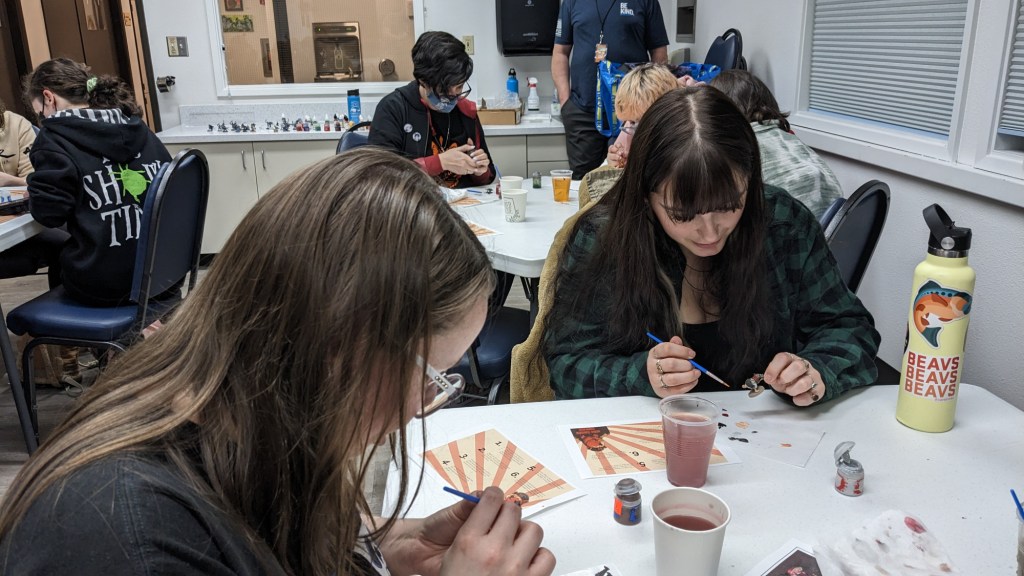
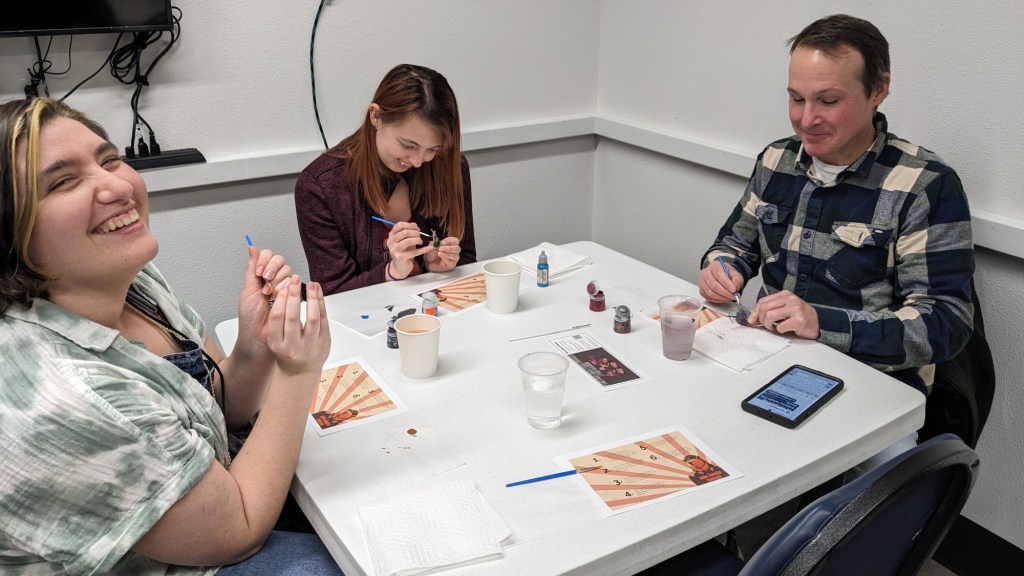
We ended up structuring the workshop as two back-to-back hour-long sessions. They were designed as drop-in events, where someone could sit down, grab a paintbrush and a free mini (generously printed by my buddy John) and try their hand at painting. I provided all materials – paints, brushes, minis, palette paper, water cups, as well as a little tip sheet.
I had 25 seats packed into a little side room at the convention, and I’m pleased to report that my sessions were “sold out,” all seats occupied by painters of varying experience levels. Most were novices, but a few had advanced skills. All were welcome!
Last year I tried to inject an instructional element to the painting workshop – offering step by step lessons to some participants, while others just jumped right in and started slinging paint. This year, I skipped the detailed curriculum in favor of a more open, come as you are type of experience.
Jim and Rian from my local game group dropped in as well, and they really helped out with setup and teardown, as well as providing that “veteran perspective” when new painters had a question. Here’s Jim (right) and I (left) toward the end of the evening, celebrating a fun event that hopefully kindled some hobby flames for these new painters.
As I prepared my workshop for 2023, I went through the annual ritual of clearing and resetting my kanban board. In doing so, I once again reflected on how helpful and nifty this minimalist tool has proven to be over the ~5 years I’ve been using it.
At its heart, a kanban board is a super simple way of visualizing a workflow or process. That’s it – all the rest, the breathless blog posts and TED talks and online courses on how to maximize your kanban – is probably just ASMR for process geeks. I prefer to embrace the simple, diamond-sharp core of the kanban board: help me see what I’m working on right now, what stage it’s at, and what’s coming up next.
As you can imagine, this approach works perfectly for painting and modeling. It’s already an inherently visual hobby, so a visual planning tool slots right into the mix. Several friends in my local game group are engineers of varying sorts, and they introduced me to the concept of a kanban board a few years ago.
Here’s a look at my current kanban board. Literally it’s a piece of paper with 4 columns, each with a label suggesting successive steps in the miniature painting process.
Each project, large or small, gets a sticky note. If it doesn’t have a sticky note, it’s not on my radar and probably won’t get done. As projects move forward, you simply move the sticky note to the next colum, showing progress toward completion. The columns also suggest the tasks required for that step in the process, which helps me match up my desired hobbying effort from day to day. If I’m in the mood to do some painting, I probably won’t pick up by dwarf ram riders, because as you can see in the photo above, they’re still in the “needs assembly” phase. On the flip side, if I decide I want those ram riders in a game 3 weeks from now, I can see that I’ll need to dedicate some effort to moving them along to completion.
This approach also aligns with my current hobby interests. I’m no longer painting entire armies in a single go – those days are behind me. Nowadays I’m more likely to tackle a small group of models from a Kickstarter, or a batch of long-delayed reinforcements for one of my existing armies. So my kanban board projects are almost always small morsels, relatively easy to pick up and work on, with a clear end point that allows me to finish them up and move on to something else.
Anyway, this approach really oils my gears in a weird, lizard-brain sort of way. I’m really not a terribly organized person – I sort of thrive amidst low-level chaos – but this simple sheet of paper helps a lot. I’ll probably redo the labels one of these days, because I literally came up with them in about 5 minutes when sketching this out in Word.
My favorite part of using my kanban board is the “complete” column. I know you’re probably supposed to remove finished projects shortly after they graduate to the “complete” column, but over the last few years I’ve kept them there for the entire year, slowly accumulating sticky notes like a stack of dried butterflies, giving me a deep sense of satisfaction as my hobby achievements pile up slowly over the year.
I’d like to hear from you, gentle reader. How do you organize your projects? What tools help keep you on task, while also leaving room for the creativity that is so essential to our hobby?
Miniatures purists, take note – this post will give you fits. You have been warned!
Late last year, as our group began grumbling and muttering about some sort of grimdark Inq28-style skirmish campaign in 2023, I started putting the wheels on my latest warband. As a longtime Chaos player, I’ve always wanted to build a small collection of miniatures representing an insane, techno-heretical cult of the Machine God. In 40k, these guys would be called Dark Mechanicus.
But I didn’t want to just say “Adeptus Mechanicus, but bad guys.” I also wanted to blend religious zeal and biomechanical horror and see what comes out of that stew. I wanted to aim for a collection of miniatures that looked like the frantic pencil sketches that filled the margins of the old Rogue Trader rulebook.
The results were The Seekers of the Fractal Schematic. I wanted to give them an evocative and mysterious name that hints at some of the narrative territory I’d like to explore in our upcoming game. What is the Fractal Schematic, and why are they seeking it? Let’s find out together, etc. I’d say about half of these models already existed in my collection, and the other half I’ve painted up to match their brethren over the last few weeks.
In true Comrade’s Wargames fashion, there are at least 5 different manufacturers represented in this photo. Shall we name them? Obviously we have the Asphyxious figure from Warmachine’s Cryx faction. He’s a standout grimdark model that perfectly represents my image of what a fallen Mechanicus heretek might look like – swollen with power, bereft of humanity, just a few tattered scraps of flesh held together by a fearsome mechanical frame, eyes burning with vengeance. Of course, he’s got a new name. Now this figure is known as Rho-Terak, the Enslaver of Logic, leader of the Seekers of the Fractal Schematic.
There are two other Cryx models in the mix up there… a biomechanical serpent coiled atop a heap of scrap, and a stooped, withered chap hefting a ramshackle banner made of clinking vials or censers. In my headcanon, he’s the second-in-command, the executive officer, so to speak.
From there, we have two GW models – an old metal Chaos cultist and a metal Necromunda Redemptionist hefting an autorifle over his head. In the foreground we have a hunchbacked mutant from Mega Minis (which is a great source of Rogue Trader-inspired models). The little Roomba from hell is a terrifying monstrosity known as The Flesh Engine, and he’s a kitbash using pieces from Star Frontiers (!) and a head from Pig Iron Productions. The blood-spattered cyborg on the far right is from ThunderChild Miniatures (painted by sculptor Jaycee and gifted to me after I won a contest, what!).
I speedpainted up a few more generic cultist models to bolster the ranks a little bit. Every cult needs some fearless cannon fodder to sell their souls in a blaze of glory, right? Contrast paints did a lot of work here.
In the image below, the guy on the left with the pistol and axe is converted from a Frostgrave soldier model. (Oops, forgot to paint his base rim.) The guy on the right with the flamethrower is a monopose model from Ramshackle Games.
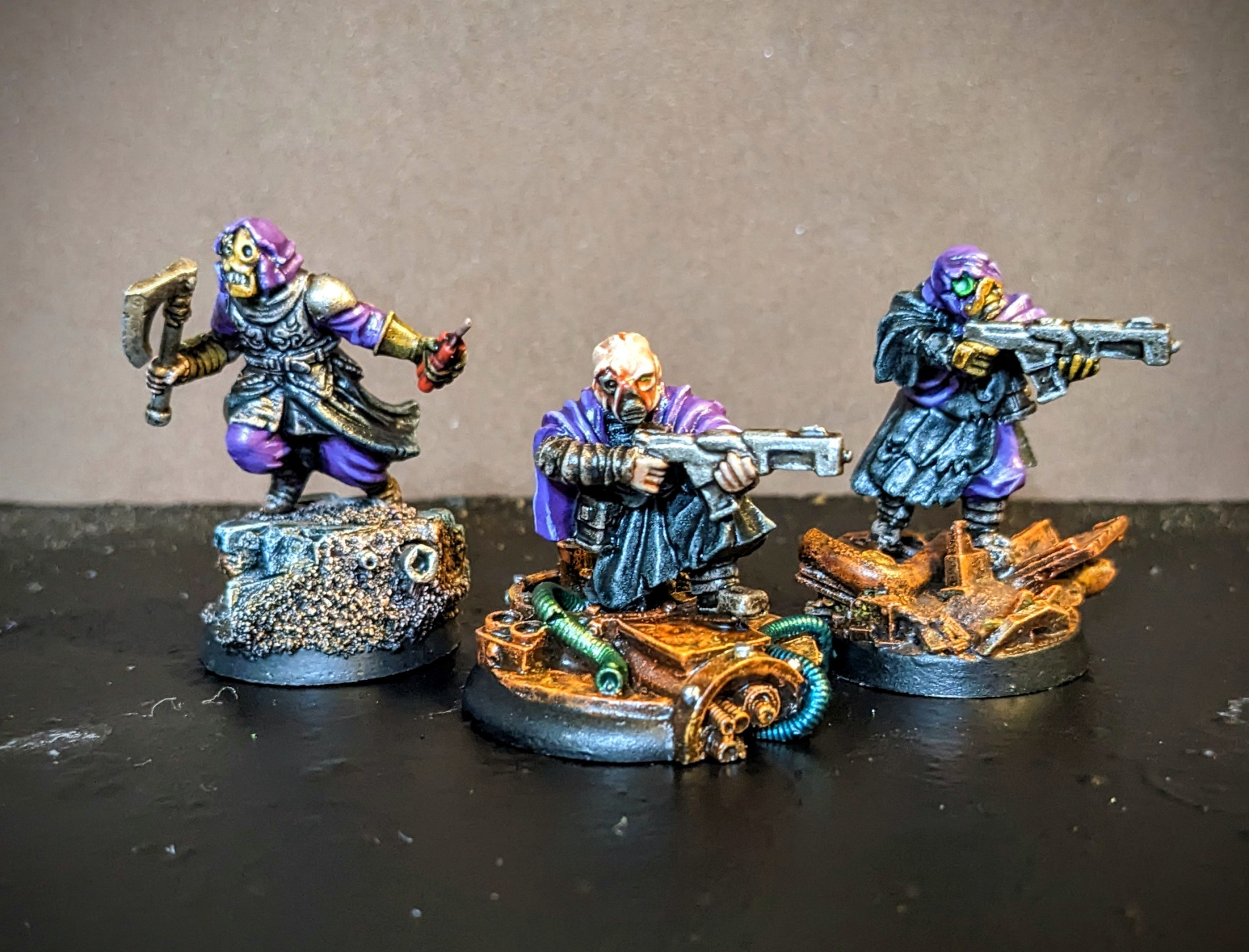
You can never have too many cultists! In the photo below, the guy on the far left with the axe and cluster of dynamite is another conversion from the Frostgrave soldier sprue. That kit is very flexible! All it takes is a couple sci-fi bits to drag a medieval-inspired model into the grim darkness of the 41st millenium.
The other two guys with assault rifles are from Pig Iron Productions, from their excellent Kolony Ferals range. I’ve got dozens of Kolony Ferals in my collection and they are some of my very favorite scrappy scavenger/cultist type models. Lots of gas masks, rebreathers, and creepy machinery poking out of necrotic flesh.
The two bruisers with clubs and shields in the photo below are from the Dark Age miniatures game. This is a super niche skirmish game based on Brom’s creepy fantasy/sci-fi art. Imagine that, a minis game inspired entirely by the work of one artist?! But here we are, and the models themselves a quite nice. These guys are from the Skarrd faction, and they’ve got a scrappy wastelands vibe with lots of twisted metal and weird cybernetics, not to mention assless chaps and exposed buttcheeks, and it all fits really well with my warband.
I absolutely love the challenge of combining miniature from many different manufacturers and sculptors to create a cohesive warband with a shared aesthetic. Nothing tickles me more than picking a figure like ol’ Asphyxious from Warmachine, giving him a new name and dropping him into a warband alongside a half dozen or more other distinct models from different makers. My goal as a painter and hobbyist is to create either a visual look or a narrative hook that ties all these models together and helps tell the stories that are swirling around in my head.
I’ll continue to build on the Seekers of the Fractal Schematic. My goal is to make each model fairly unique, so this won’t be a warband that I can use in games that require multiple squads of dudes, like Warhammer 40k. It will be, however, a great choice for skirmish games focused on individual models and small units. Stay tuned for more!
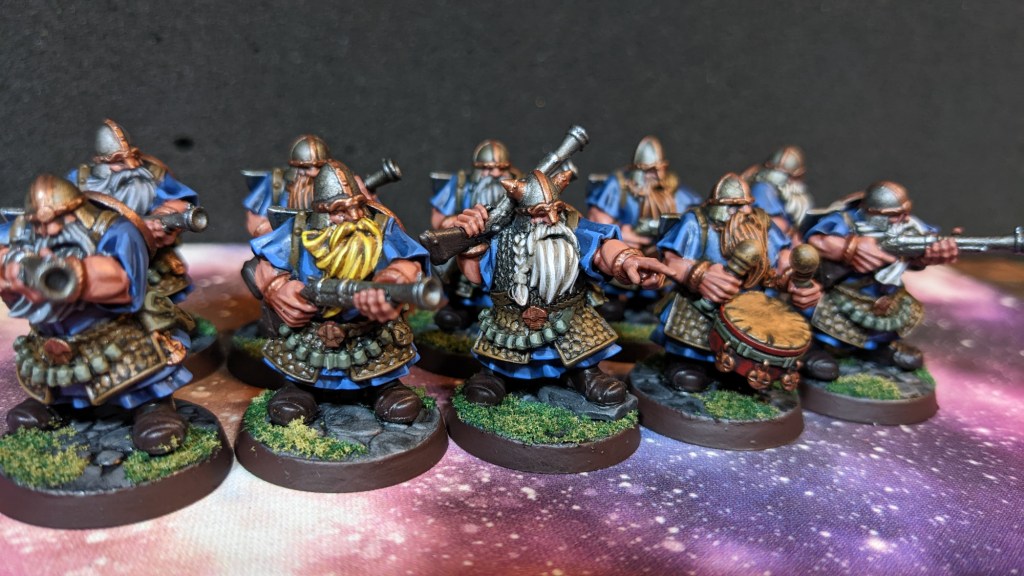
Last month I completed my first unit of 100% printed miniatures! Up until this point I’ve dabbled here and there in painting 3D printed models — several of the guys in my local game group have printers that are humming non-stop to churn out beautiful resin awesomeness — but this was the first time I set about painting an entire 3D-printed unit.
The models came from Highlands Miniatures, courtesy of BartyB’s fiery forge (actually a Phrozen Sonic Mini 4K). The sculpts are simple and unadorned, which I really like — I’m not a big fan of dwarf models that are covered in fiddly bits related to a specific setting or mythos. Guess that’s why I don’t have a lot of use for GW’s three disparate dwarf lines (the Dispossessed, Kharadron Overlords, and Fyreslayers).
These guys are simple, somber, task-oriented dwarf warriors, and I love it. I ended up painting these guys on my lunch break at work, which led to lots of fun conversations with my coworkers as they repeatedly stumbled across my little hobby setup in the breakroom.
These guys were painted in the sky-blue livery of King Nicodemus II, the Anvil of Dawn, which marks them as part of his personal house guard. These models will bulk out the ranged combat capability of the Expedition to Hearthspire, aka my large dwarf army. The army is composed of models from many different sources, which is almost a hobby unto itself — how many oddball miniatures can I paint up and add to my hodgpodge force?!
Be sure to take a look at the dwarves I painted up earlier this year in my Summer Painting Roundup! I’m hoping to get all of these guys onto the table later this year for our winter fantasy apocalypse game!