I absolutely adore Tabletop World’s crisp resin buildings. They’re well worth the price, even with shipping from Europe to the USA. I painted up a couple smaller cottages a couple years ago, but in late 2022 I embarked on my largest project yet – the epic Mansion building!
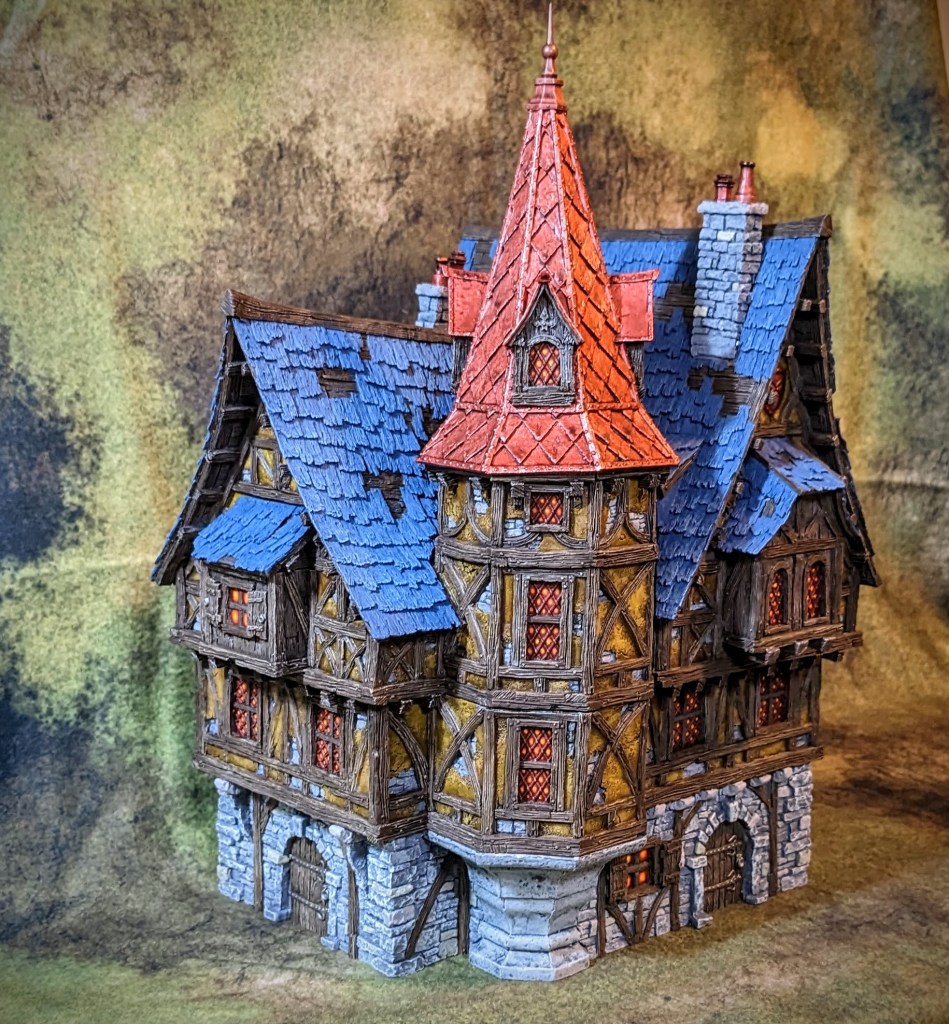
I’ll cut to the chase and show you the final completed model in all it’s four-story glory.
TTW terrain pieces are fully detailed inside and out, and the casting is absolutely superb – I’m talking machine-shop precise. The 7 or 8 pieces that make up this kit fit together with incredible precision, and no flash anywhere to speak of.
I started with a simple gray basecoat, which was to form the foundation for the stonework that defines the base of the building (and peeks through the wattle & daub of the upper levels). I picked out a few stones in off-gray colors to create some variety, then drybrushed the entire piece in progressively lighter shades of gray. This created a decent undercoat for the rest of the colors.
The timbers became dark brown after two coats of raw umber. I really like raw umber for terrain, as it gives a brown hue with a touch of green that is transparent, allowing the gray drybrushed highlights to show through.
The windows on my other TTW buildings always draw the eye when they’re on the table, so I wanted to recreate that effect here. I’m going for a warm effect that suggests rooms lit by candles, braziers, sconces, and fireplaces. If you could peek in these windows, you’d see bawdy feasts and ribaldry on display. It’s a fun effect, looks good from a distance, and it’s quite unlike how most people paint windows.
Here’s that completed pic again. It’s hard to see in this photo, but the upper turret is painted copper, not orange. The roof of the turret is festooned with rivets, which to me suggests metal of some sort. Copper it is! Maybe in a few years I’ll go back and add in some patina and verdigris.
Now you might be wondering: blue wood shingles for the roof? Sure, why not? It’s a fantasy setting, so anything goes. The blue pleased me when I was looking at different colors, so I went with it.
So that brings my total collection of TTW buildings to three (3)! But I’m not done yet – my buddy Lawrence, who is even more of a fiend for these pieces than I am, has been busy scooping up lots of TTW terrain off ebay and miniswap, and he’s offered me a duplicate blacksmith’s cottage to paint up. So look for that later this year, once I’ve rebuilt my stamina for these gigantic terrain projects!
I recently completed a terrain piece that I’ve had built in my head for a year or two. It’s a mining outpost, possibly abandoned, definitely run-down but still representing a tasty pile of loot for an adventuring party.
I originally conceived of this as a terrain tile for Frostgrave table that my group put together back in 2021. It was built on a 12×12 inch square vinyl floor tile, reinforced with foamcore and hardened with like a zillion layers of glue and sand and grout.
Atop that study foundation, I added some carved foam chunks to represent strip-mined areas that had been carved out of the landscape. In the flat interior basin I added a bunch of nifty bits from Mantic’s Abandoned Mine Terrain Crate, which was full of great details that every mine should have — stuff like tools and barrels and mine carts and crystal formations.
I glued most of the fiddly bits down to make this tile easier to transport and use, but I kept a few as individual pieces for creative terrain placement.
The rest of our Frostgrave table is built atop 2-inch foam sheets, so this terrain piece will actually appear to be “below grade” when it is placed alongside the built-up tiles. The tops of the carved foam chunks should be just about even with the “ground level” of the other terrain tiles. Nice!
The paint scheme is actually the same dusty badlands color palette that we selected for our Nightwatch board. I think it’ll work alongside the dark gray colors of our Frostgrave table. It should also fit in decently with my existing fantasy terrain collection, too. I think this piece will see some action in a game of Nightwatch later this month – stay tuned for more!
Hullo dear reader! I’m back after an uncharacteristic pause on this here blog. It’s been a busy summer without a lot of time for gaming, I’m afraid. But now that the days are getting shorter and the autumn winds are picking up, I’m once again finding some time to chuck some dice and play with toy soldiers.
This month, my local game group had expected undertake an expedition to Olympia, Washington, to attend Enfilade, the annual game convention from the Northwest Historical Miniatures Gaming Society. Alas, the rise of the delta variant this summer convinced us to skip the convention. We had hoped to host a game or two, and it seemed a shame to let all of that prep work go to waste, and thus Majesticon was born!
For our inaugural event, we planned a modest weekend of games, with plenty of breaks in between to attend to other obligations. Four players participated, with a few more dropping by to hang out periodically through the weekend. John graciously hosted our games in his converted garage “War Room.”
Game 1 – Into the Haunted Woods
Saturday morning was the first session, and John had planned a two-part mini-campaign of Nightwatch, the monster hunting skirmish game from Patrick Todoroff (creator of Zona Alfa). In Nightwatch, players create warriors, rangers, alchemists, and wizards who band together to defeat evil denizens of the darkness. It is a narrative co-op game, which I’ve really come to appreciate in this era of meta-heavy, combo-centric games that reward absolute beatdowns of the opposing player.
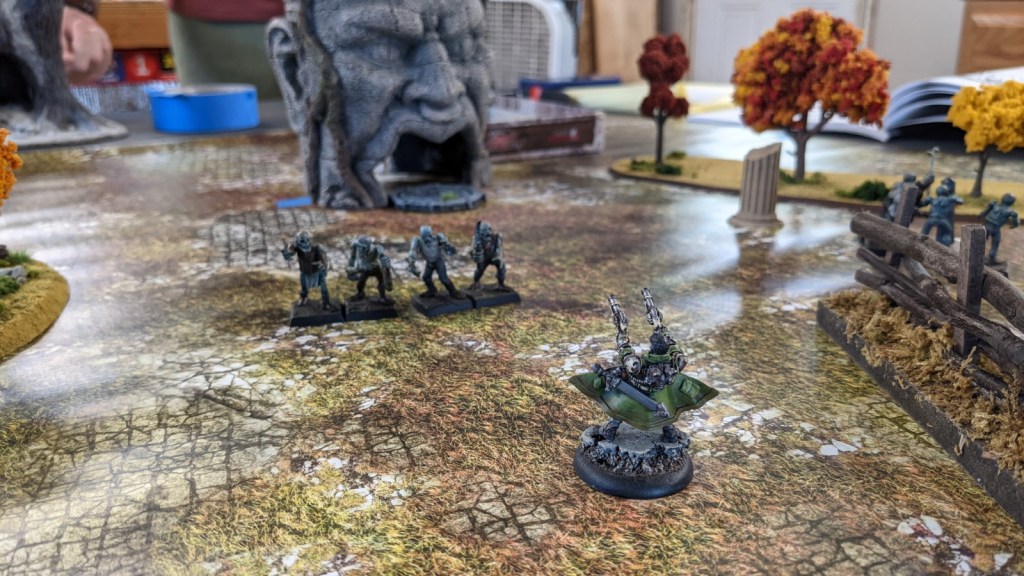
The first session took place in a spooky forest, shown in the photo above. The players were tasked with journeying through this forest, dealing with any randomly occurring monsters, and sanctifying the three stone cairns placed on the tabletop.
Each player had one figure for this introductory game — not a lot, but good for a tutorial game as we learned the ropes.
The bad guys began to arrive almost immediately. Nightwatch uses a series of random tables to generate progressively more dangerous waves of enemies. The rulebook doesn’t describe them in specifics, but instead just characterizes their threat level and behavior … it’s up to you to find a suitable miniature from your collection. Is this mob of vermin a group of giant spiders, or bloodthirsty imps? This ensures that Nightwatch games can features a wide variety of monsters and assorted bad guys.
The baddies spawned from one of four portals placed around the periphery of the battlefield at the start of the game. Here they come!
For fun and cinematic glory, we decreed that each “vermin” unit would be represented by TWO (2) zombie models, to better represent the palpable fear felt by the characters as they journeyed through the haunted wood.
The bad guys did a good job of harassing the players as they explored the forest and sanctified the cairns. We got a good sense of the game mechanics, which equipped us well for game two!
Game 2 – Defend the Church!
After a quick break, we set up the battlefield for game two. Having reached their destination, the hunters had to defend a stone church against seemingly endless waves of foul demons and hellspawn. This session featured a much more dangerous array of enemies!
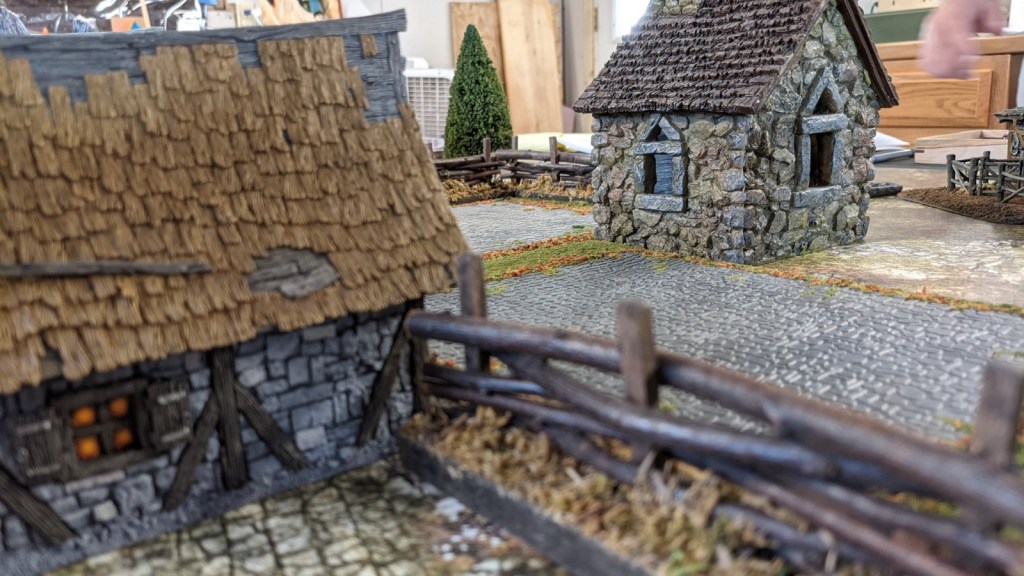
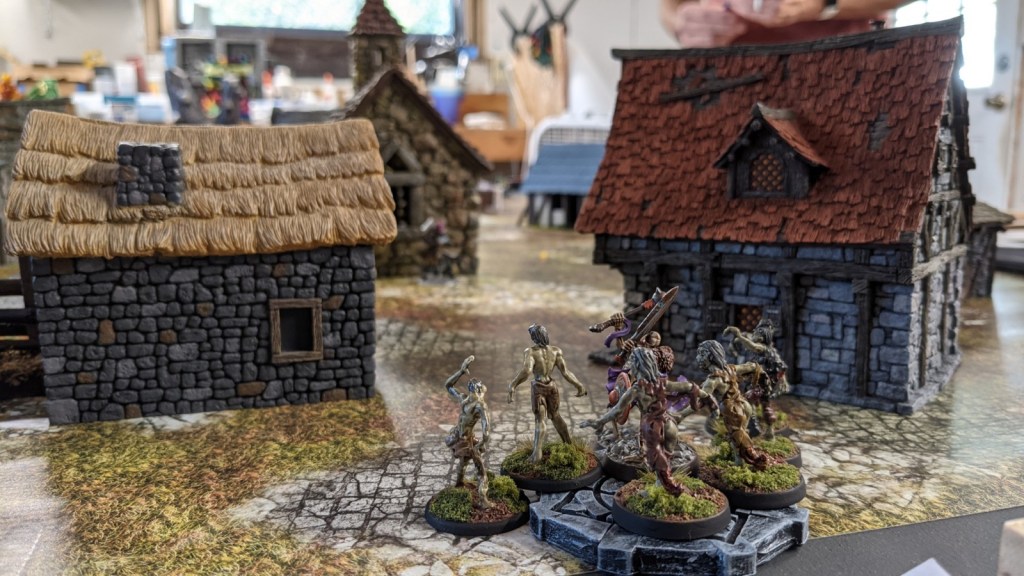
We were tickled pink to have a chance to build a tabletop battlefield featuring our collection of gorgeous hand-painted medieval village terrain. Much of what you see in these pictures comes from Tabletop World. This doesn’t even include Lawrence’s TTW collection — I’m convinced we could build an entire city with our shared batch of terrain!
One of the spawn points was located near an outhouse, and we were lucky that Vincent had a suitable array of models to represent the shambling horrors that poured forth from the foetid maw of the crapper. This was the catalyst for a number of toilet-themed jokes throughout the rest of the weekend. Don’t forget to wipe!
If game one was a walk in the park, game two was certainly a meatgrinder. The waves of enemies just kept coming! Each time a new group of bad guys spawned, John would roll randomly to see if they would 1) shamble toward the church and start attacking it or 2) come straight at the defenders! As the game picked up and the defenders began to get overwhelmed, the random rolls sent more and more monsters to attack the church.
Alas, despite our best efforts, the church was destroyed in an orgy of destruction and blasphemy. The defenders escaped with their lives, but just barely. A follow-up mission seems imminent, to reclaim the holy site from the terrible invaders.
All in all, Nightwatch was a blast to play. We agreed that the co-op mechanics provided a superb narrative framework. We all got big-time “Witcher” vibes from our two games.
Interlude – Lunch is Served!
What is a game convention without food? Luckily, John’s spouse served up a platter of delicious nachos, plus a carafe of hot coffee, to keep us fueled up and ready for more game action to come in the afternoon.
Game 3 – Goblin Slayer!
Our hunger sated, we gathered for another game in the afternoon. Vincent hosted the third session, a game of Open Combat set in the blood-drenched world of Goblin Slayer. Players each commanded a small 4-person team of warriors, and collectively we were tasked with defending a farm from relentless waves of goblins.
The game featured a wave mechanic where the groups of goblins, seemingly weak in their own, would return to the battlefield in their deployment area after being wiped out. There was no escape from the unstoppable green tide!
Through savage combat, magical mastery, and sheer force of will, the players gained the upper hand and managed to defeat several of the larger goblin champions in single combat. Slaying the big guys seemed to turn the tide in our favor, and the heroes prevailed in the scenario.
Open Combat was quick and easy to play, although we remarked that the rules struggled a bit with the big mobs of goblins. The game is definitely at its best when each player handles a small team of 5-10 figures.
All in all, day one of Majesticon was great fun! It’s been tough to get everyone together these days, so it was really nice to get some sustained game time (and hang out time!) with everybody.
I’ve been knocking out some disparate projects over the last month or two and wanted to share them with you.
First up is a pair of resin buildings from Tabletop World: the Cottage and Townhouse. I acquired these two models secondhand, which was perfect because ordering directly from TTW tends to come with steep shipping costs. (Well worth it, of course, since these models are absolutely terrific, but cheaper is always better…)
I’ve long admired TTW models. To me, they are examples of archetypal fantasy village terrain. They are realistic, but they also include design flourishes that suggest a hint of fairy tale whimsy. They’re equally at home on a historical Dark Ages scenario or a gothic Warhammer battlefield.
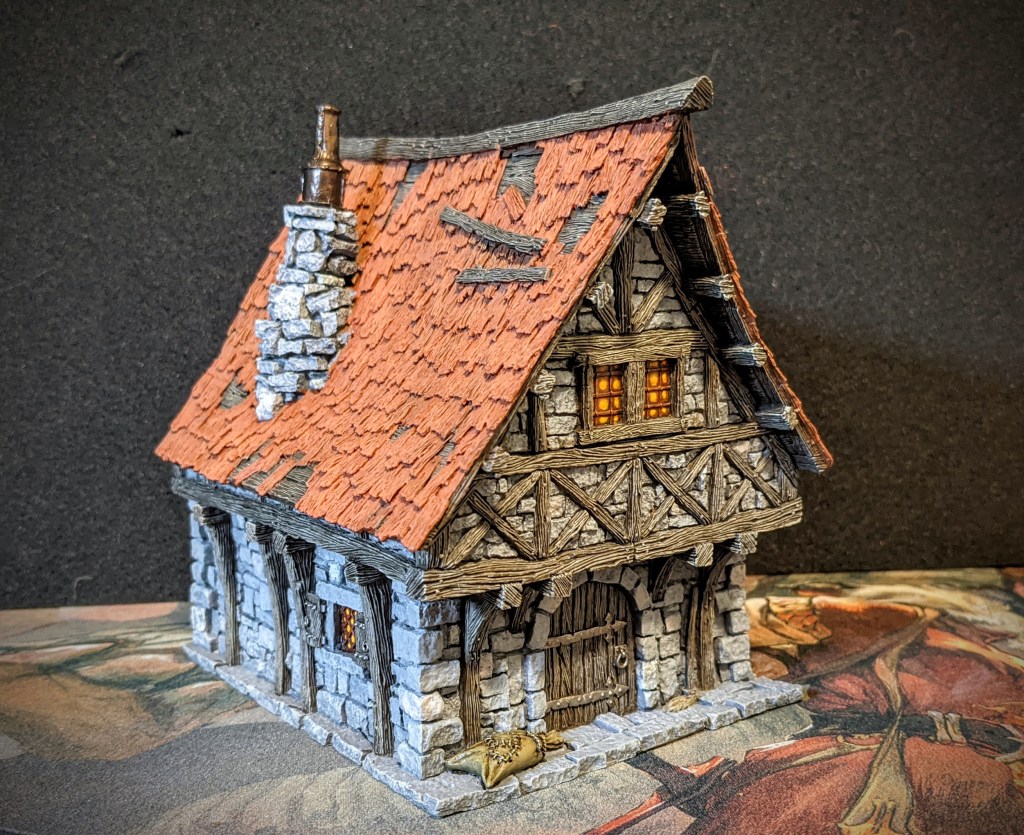
Here’s a look at the townhouse. It’s the bigger of the two models, with a removable roof and a fully detailed interior. I’ll have plenty of opportunities to use my dollhouse furniture dungeon scenery.
I’ll probably go in and sprinkle some flock on the stonework that serves as the base of these models. That way they’ll look a little bit more in situ alongside my existing fantasy terrain.
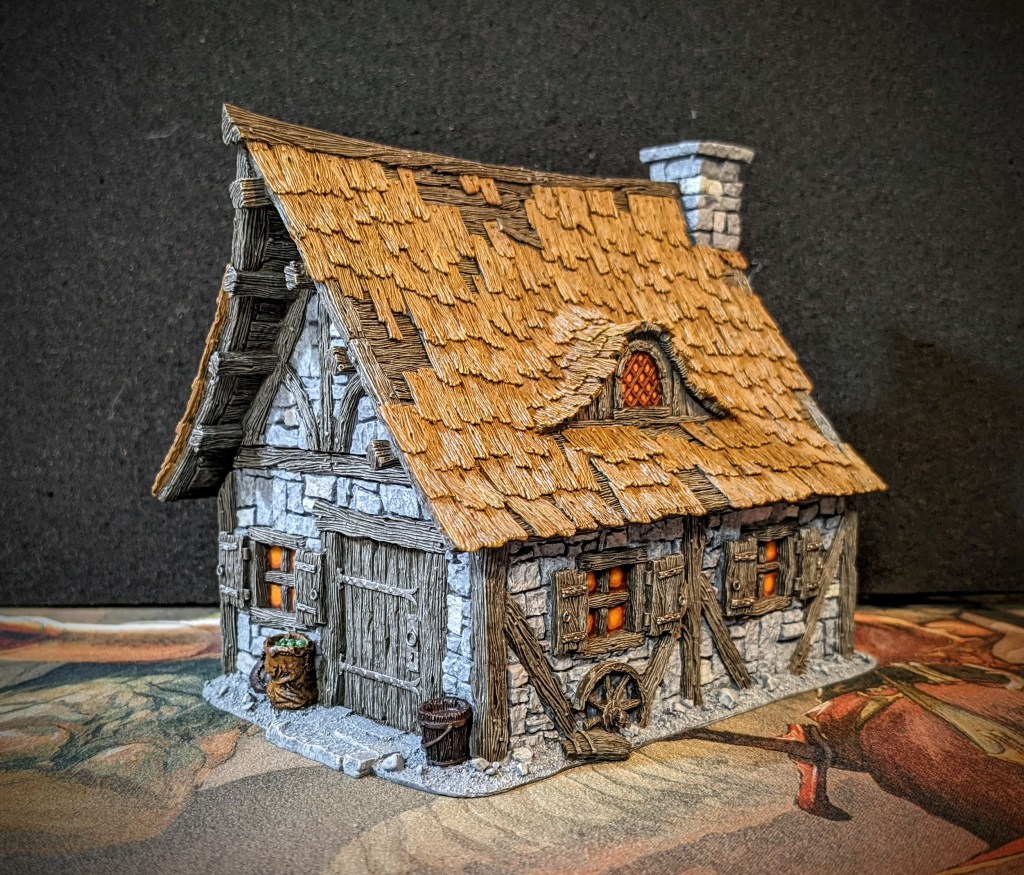
Here’s the cottage. It’s smaller, but no less charming! Imagine curling up in there with a hot cup of tea … or, more likely, barring the door and huddling in terror as the battle rages outside.
I’m absolutely chuffed with how these terrain pieces turned out. They’re going to be head-turners for sure whenever I can get them onto the battlefield.
The next batch of output is a group of 20 Northern Alliance Clansmen from Mantic. These are very decent, affordable miniatures suitable to represent barbarians from the frozen north. For me, they’ll serve as a core of levies for my nascent Chaos army (more to come on that later).
For these figures, I challenged myself to speedpaint the whole lot as quickly as possible. I used mostly inks and contrast paints over a light gray undercoat, without a whole lot of attention paid to individual details that I would normally paint separately (satchels, bandoliers, boots, belts, etc).
The result was a drab, muted paint scheme that really looks nice on the battlefield. I painted these guys in small batches to keep the slapdash painting method at least a little bit consistent. Here’s a look at a few of them.
Lots of grays and browns and tans and ochres. If you look closely, you can see plenty of details that would have warranted special attention if I was giving them a more traditional paintjob. But the goal here was to get them done quickly, and their presence on the battlefield will be as a big dirty mob of howling northmen.
Gosh, they look like they’d be right at home kicking down the door of a certain cottage.
I mentioned it earlier, but I’ve been sort of accidentally building an old-school inspired Chaos army over the last few months. I’ve been digging up various models and units and thinking about how they might all take to the battlefield together in games like Saga: Age of Magic, Dragon Rampant, or Oathmark. Here’s a sneak peek:
I’ll share more about this soon but I am really pleased at how things are coming together. Stay tuned!
My friend John, purveyor of fine postings at Barty B’s Command Crate, has put together a tremendous write-up about the origins and development of our modular Frostgrave table, which you may have read about in some recent posts. Do yourself a favor and click the link below to check out his expositions!
About a year ago my gaming group decided to collaborate on a terrain board to prepare for the release of Frostgrave 2nd Edition. After some back-and-forth in our Slack team, we agreed to build modular tiles using shared standards for certain key geometries and base coat colors.












 Comrade's Wargames