We’ve been playing Sword Weirdos here at Comrade’s Wargames, and it’s rapidly becoming our go-to ruleset for fantasy skirmish gaming. The game hits the sweet spot for complexity and flavor, and the size of a typical game (5-10 figures per player) seems perfect for our games.
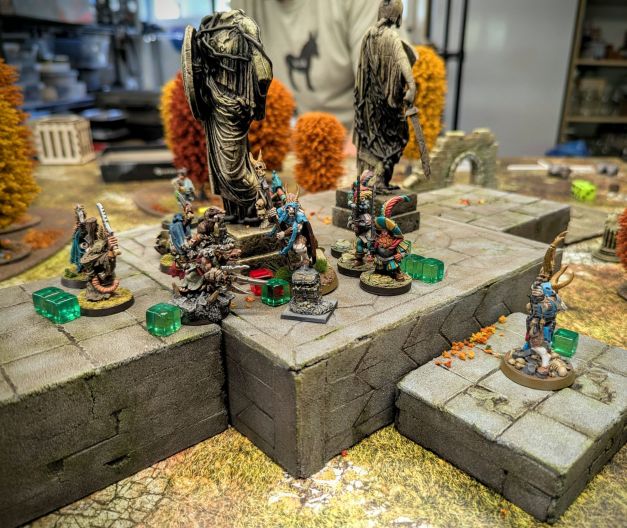
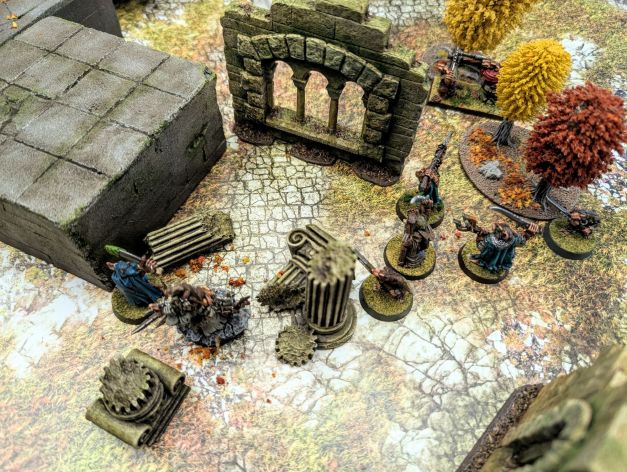
So I thought I’d share some thoughts and reflections on the game, interspersed with some pics from a recent three-player game. Sword Weirdos isn’t really intended for multiplayer games, particularly not a three-player game (which is always an odd size … one player always gets squeezed, in my opinion). But we’re a mature, high-functioning game group, easily able to adapt on the fly and make it work. And by that I mean … one player got squeezed.
We’ve played and enjoyed Space Weirdos, the sci-fi predecessor, and we immediately observed that Sword Weirdos took the complexity up an entire order of magnitude. Don’t get me wrong – it’s still a fast-playing game, easy to learn from the single rulebook. But it’s clear that creator Casey Garske intended to add a few more layers that don’t exist in the sci-fi original.
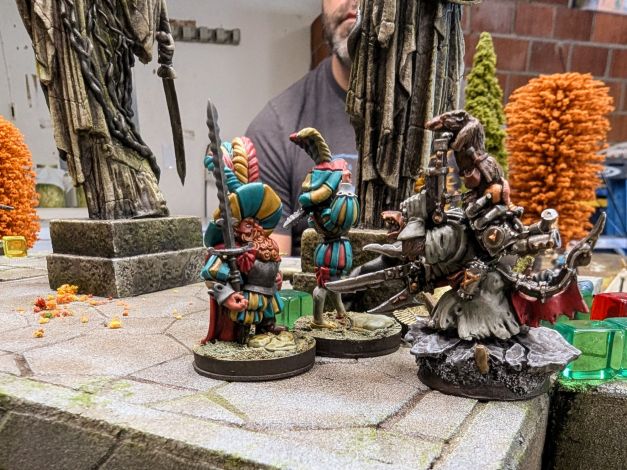
The new stuff that Sword Weirdos introduces seems to be intended to help players model the specific weaponry, equipment, and character styles that are represented on many different fantasy miniatures. This makes sense; after all, fantasy wargaming is a game of archetypes.
You start with warband traits, which give your team a little flavor at at the outset. Warband traits seem well balanced and fun. Many of them encourage you to pursue a particular type of build, like a bunch of scrappy weaklings, or a coven of warlocks summoning magical beasts. There’s something for everyone, for sure.
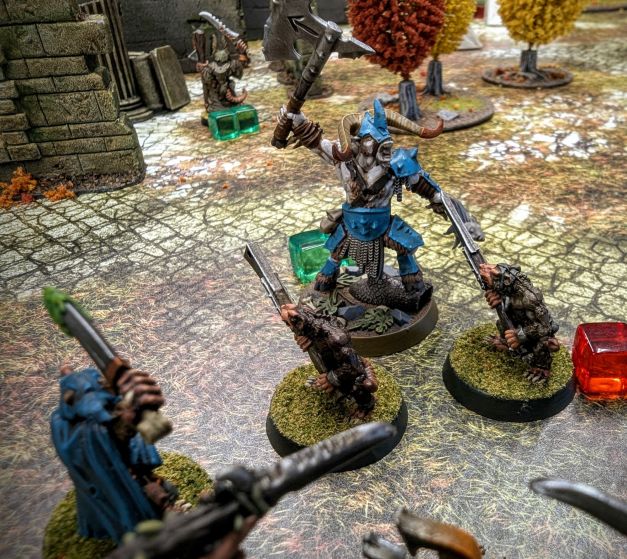
After that, you select a class for each model. The class should feel familiar for anyone who’s played classic roleplaying games or video games. All the hits are represented: archer, berzerker, fighter, etc., plus many more intriguing options.
Then we encounter one of the most satisfying mechanics in Sword Weirdos: weapons and maneuver points.
You purchase weapons for your model just like in a typical wargame. The list of options should look fairly familiar. Weapons come with a set of stats such as range and damage, but many also come with an ability that can be activated using maneuver points. Maneuver points are a small pool of resources granted to each player at the start of their turn.
They can be spent on a small handful of universal abilities that are available to all warbands, but the far more satisfying use for maneuver points is to activate the various nifty abilities on your model’s weapons and armor. Using riposte with your longsword or activating taunt with your gory trophy offers a whole layer of interesting decision-making, particularly because you are using a small pool of limited resources.
If you’ve played Space Weirdos, you’re probably familiar with Garske’s core mechanic – dice type shifts to represent bonuses and penalties, using the entire spectrum of polyhedral dice. It’s somewhat similar to the mechanics in Nightwatch, which is another game we’ve played and enjoyed over the years.
(Sidenote: If you want a particularly in-depth review of why this particular dice system is so brilliant, I invite you to dive into Mattias’s review of Space Weirdos over at Chicago Skirmish Wargames. He says it better than I ever could.)
Combat is similarly elegant. If you hit the opposing model, either in melee or ranged combat, it’s not a straight damage roll. Instead, you roll on on a table to see exactly what happens. The enemy model could be taken out of action (a satisfying result, for sure) but you could just as easily find yourself facing a surprise counter strike if the dice fall a certain way. It’s just the right amount of zany fun for a game this size.
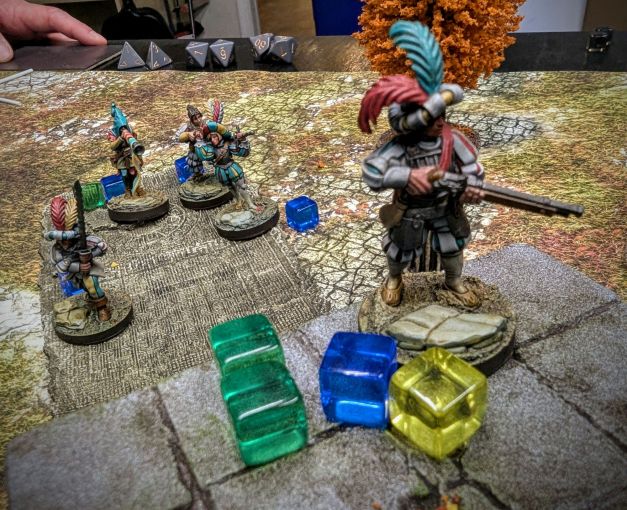
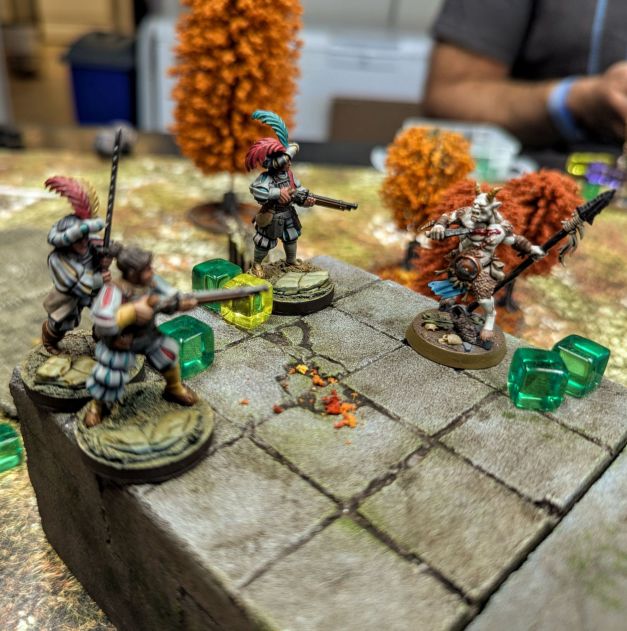
My only real quibble with Sword Weirdos is that the game requires (potentially) too many tokens and markers to denote various status effects for each model. The photo above is a good example.
Figures can take 1, 2, or 3 move actions per turn, and it’s important to note the total taken because that affects combat later in the turn. So the two green cubes represent two moves for the rifle-wielding lout in the photo above. The blue cube represents a buff emanating from the warband’s leader (you can see blue cubes on the rest of the team as well) and the yellow cube is a reload token, reminding us that this guy has already shot his load this turn and needs to spend an action to reload so he can shoot again.
The tokens all make sense, and they’re not overwhelming. I am HUGELY in favor of games that promote mobility (i.e. moving around the battlefield and not just standing still) and Sword Weirdos does that superbly. I just prefer less clutter on my battlefields. It’s more of an aesthetic thing, my personal taste. I think a solution might be to use printed unit cards (pleasantly created from either of the two useful warband builders available on the web) and place the tokens on the printed cards on the periphery of the battlefield, rather than adjacent to the models themselves.
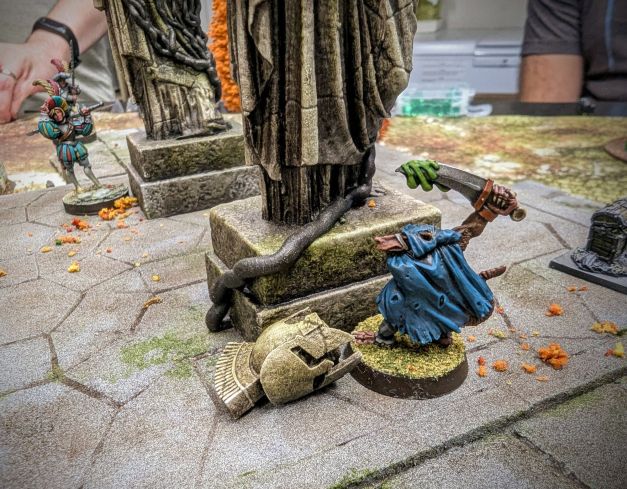
Anyway, these are minor issues that are hardly limited to Sword Weirdos. The game is smashing good fun and a great excuse to get your cool toys on the battlefield. The warband traits get your imagination crackling. The weapon abilities are incredibly fun and tactical. The whole system is ripe for house rules and/or future releases from the creator. We’ll play this one again soon!
 Comrade's Wargames
Fantastic looking minis. I love the addition of the classic Skaven Assassins!
LikeLike