Comrade's Wargames

Painting toy soldiers in Oregon

  • Home
  • Narrative Campaigns
    • The Cauldron: A Grimdark Sci-Fi Campaign
    • The Chronicles of Üthdyn: A Fantasy Tabletop Campaign Setting
    • Nightwatch: Beyond the Borderlands
    • Frostgrave: Mystery of the Night-Haunted City
  • About Comrade’s Wargames

Neglected Model Challenge: The Last Chaos Horseman

Posted by Comrade on June 26, 2019
Posted in: Posts. Tagged: fantasy, miniatures, painting, skirmish, warhammer, workshop. 8 Comments

Earlier this month I was browsing the awesome and inspiring list of blogs in my WordPress reader, as is my wont, when I came across Azazel’s June Community Painting Challenge. The theme was “Neglected Models,” which probably describes half or more of my backlog.

See, I play mostly skirmish-level games, which means I don’t usually need to paint up a full unit of anything. More often I’ll pick and choose figures from various sets to build my warbands. As a result, I’ve got lots of “leftover” miniatures bouncing around in various boxes and crates.

One in particular has been vexing me for nearly a decade: The Last Chaos Horseman. He’s so named because he’s the lone leftover from a set of Chaos Marauder Horsemen that I painted up back in 2010. As near as I can tell, the kit itself dates back to 2002. I’ve always liked these guys, because they’re not the heavily armored hunchbacks that came to define later iterations of the Warhammer Chaos line. They’ve got some character to them, with each figure being a bit unique, suggesting a cadre of individual, elite mounted warriors, rather than a wedge of anonymous armored cavalry.

The first four fellows were a blast to paint, and they’ve been in heavy rotation on the tabletop ever since then, playing the role of chaos marauders, roving brigands, or mounted barbarians in a variety of games as needed. I even developed a bit of backstory for them in this blog post (see “The Cursed Riders of Frostvale”).

The last horseman taunted me, though. For years I moved him from box to box, always vowing to work on him whenever I had a break in my schedule. Along the way I became a father, moved to across the country, built a new game group from scratch, started playing Warhammer 40,000 again, and … you get the idea.

Anyway, reading Azazel’s blog post about his June painting challenge got me inspired to drag out this lone horseman and finish him off.

Now, my painting style has changed (I’d say “matured”) since I painted up the first four guys in this unit. I deliberately tried to recall my earlier techniques in an attempt to make the last horseman fit in with his fellows. This was particularly important for the basing scheme, and I think I achieved a fairly decent approximation of my earlier work. Here’s the whole team.

My only regret is that I didn’t trim off the mold lines on the front section of the plastic horse. Oops! It’s not very visible at “gaming distance” (3 feet away), so we’re all good.

With that, this unit is complete! It only took me a decade. My extremely long term goal is to have a small generic chaos/barbarian warband for use in games like Open Combat and Frostgrave. With this lone horseman completed, I’m one step closer.

Dragon Rampant: Borderlands Burning

Posted by Comrade on June 10, 2019
Posted in: Posts. Tagged: campaign, club, dragon rampant, fantasy, game night, skirmish, uthdyn. 4 Comments

The crew got together earlier this month for another game of Dragon Rampant, which has quickly become our go-to game for fast-playing medium-sized fantasy games. The scope of the game is generally a bit bigger than a typical skirmish game, but smaller than Warhammer Fantasy (back when it existed). The flexible nature of Dragon Rampant really accommodates armies of all sizes, as we saw in this game.

This was to be Lawrence’s first game of Dragon Rampant, so we set up a scenario in our Üthdyn campaign setting that followed up on the outcome of a raid on a frontier village in the hinterlands of Glostmurk. The ratmen raiders, emboldened after pillaging the hamlet of Glodd, embarked on an orgy of looting and burning all along the borderlands of Glostmurk.

Desperate to halt their advance and bring the rats to battle in proper fashion, the Wealth of Begovic organized an alliance with a nearby brood of trolls and orcs, promising the savages first dibs on any tasty rat carcasses after the battle. That was good enough for the orcs and trolls, and they hefted their crude weapons and marched to war alongside the Begovic militia.

John was fielding his human warriors as the Begovic house guard, headed up by Lady Almira Begovic herself. His army included several newly painted units, including a somber squad of Oathmark infantry, and a crazed fighter wielding two maces, from RuneWars. It’s been awesome to see his army take shape as we’ve explored Dragon Rampant!

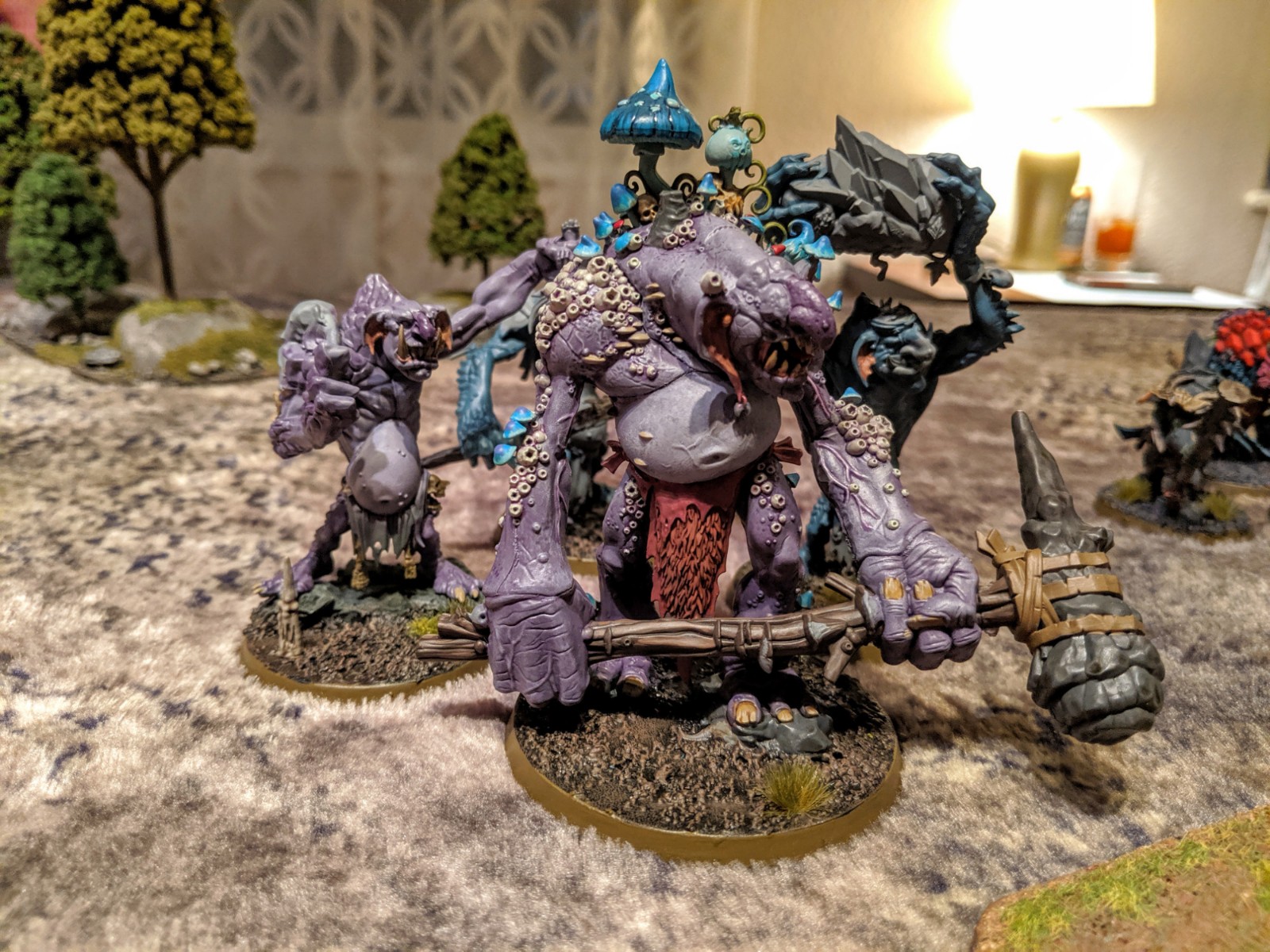
For his first game, Lawrence dropped a truly gorgeous collection of trolls and orcs onto the table. They were drawn from several different factions from Warhammer and/or Age of Sigmar, but they looked superb and totally cohesive on the table together.

Opposite them was an army comprised of basically every painted Skaven figure I owned. Ha! With both John and Lawrence teaming up to field 24 points each, it was up to me to scrape together 48 points of rats to oppose them. If you’ve been following the progress on my all-metal Skaven army, you know that it’s been my goal for a year or so to get a big army-sized pile of rats ready for battle. This is the moment I’ve been waiting for!

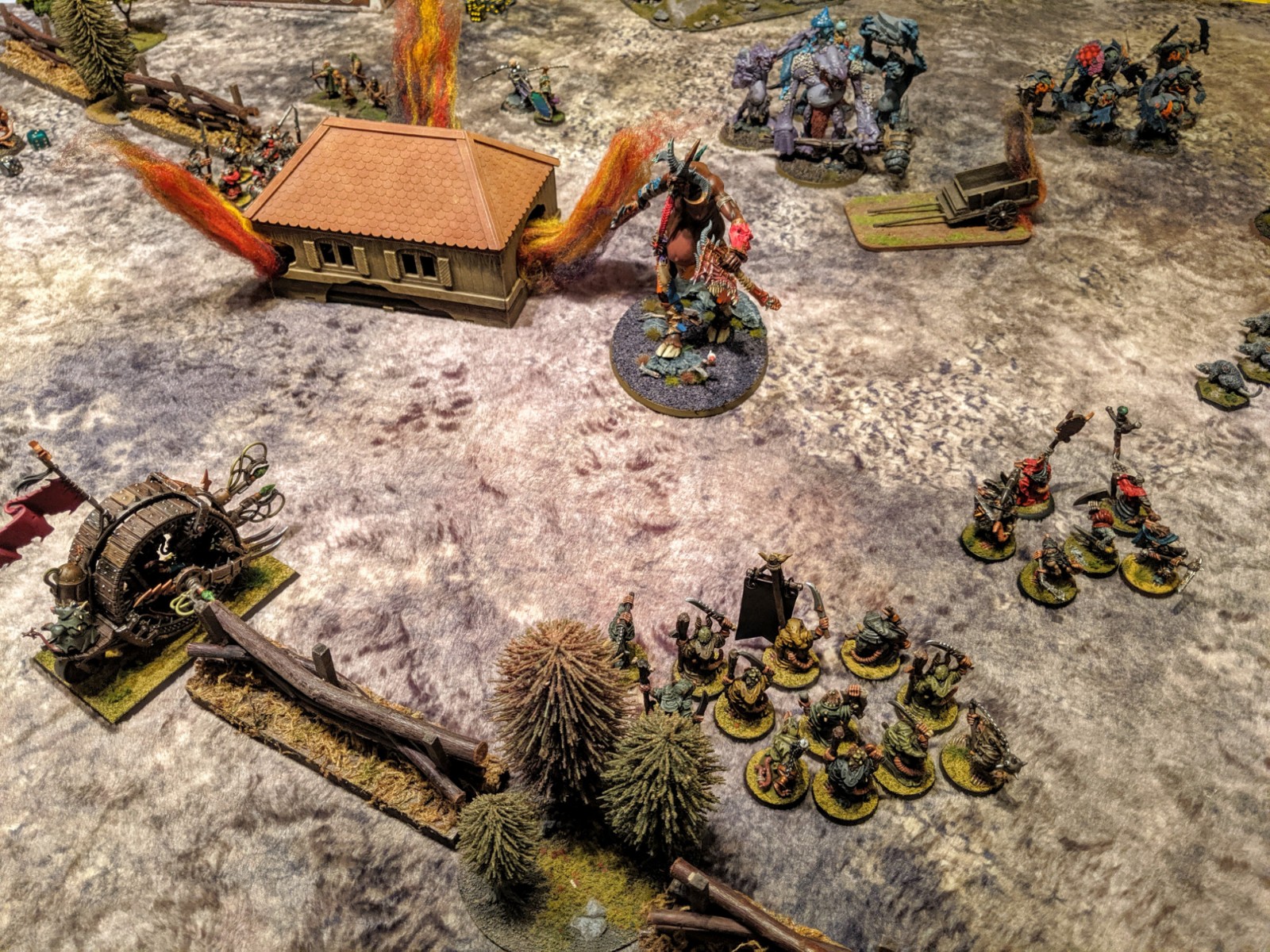
The battlefield represented any of the dozens of pitiful frontier locales that had born the brunt of the Skaven’s menacing attacks on Glostmurk. A flaming hut dominated the battlefield, surrounded by patches of forest in the otherwise trackless wilderness. The three opposing armies drew up their forces, shouted oaths and threats to enemies and allies alike, and then the battle got underway.

In the first couple of turns, both Lawrence and I got well acquainted with Dragon Rampant’s most angst-inducing mechanic — the botched activation roll. If at any time you attempt to issue an order and fail, your turn ends, right there on the spot. It’s an unforgiving mechanic, and it’s also tough to explain to people who are more used to playing Other Fantasy Wargames from a Particularly Large Publisher. In those games, your guys almost always behave as you expect, and you can move all your toys in a given turn. Dragon Rampant doesn’t care — if you fail, your turn is over.

Well, that happened. A few times, actually. Luckily, the hammer seemed to fall on both sides of the battlefield, and we soldiered on.

John had the most success in mobilizing his team, and as a result the Wealth of Begovic advanced mostly in good order toward a timber fence, where his archers took up position, guarded by a solid flank of spearmen.

The ratmen advanced in a much more haphazard fashion, with lots of starts and stops as my dice refused to cooperate. Ultimately I managed to get a decent sized force, consisting of a unit of heavy missiles (assorted rat-guns), a unit of greater warbeasts (rat ogres) and a unit of heavy foot (Stormvermin) to oppose the Begovic House Guard. You can see our maneuvering in the photo below.

Unseen in this photo, I had a unit of Skaven slaves (light foot) racing up the left flank. Light foot moves much faster than most other units in Dragon Rampant, so these guys were able to mobilize and get in position even when the rest of my army was draggin’ their tails.

Here they are in combat with a unit of Begovic spearmen (also light foot, actually). They did OK but I didn’t expect them to hold the entire flank on their own.

While John’s phalanxes closed ranks and prepared to weather the charge from the Rat Ogres, Lawrence’s orcs and trolls smashed into the rodent lines on the other flank. This action was led by his fearsome giant, who strode through the smoke and flame of the burning hut to utterly wreck the poor sad little rats who stood in his way. Check out this photo:

Wow! Truly, this was a beautiful game with breathtaking models and terrain. Only the best for you, dear reader!

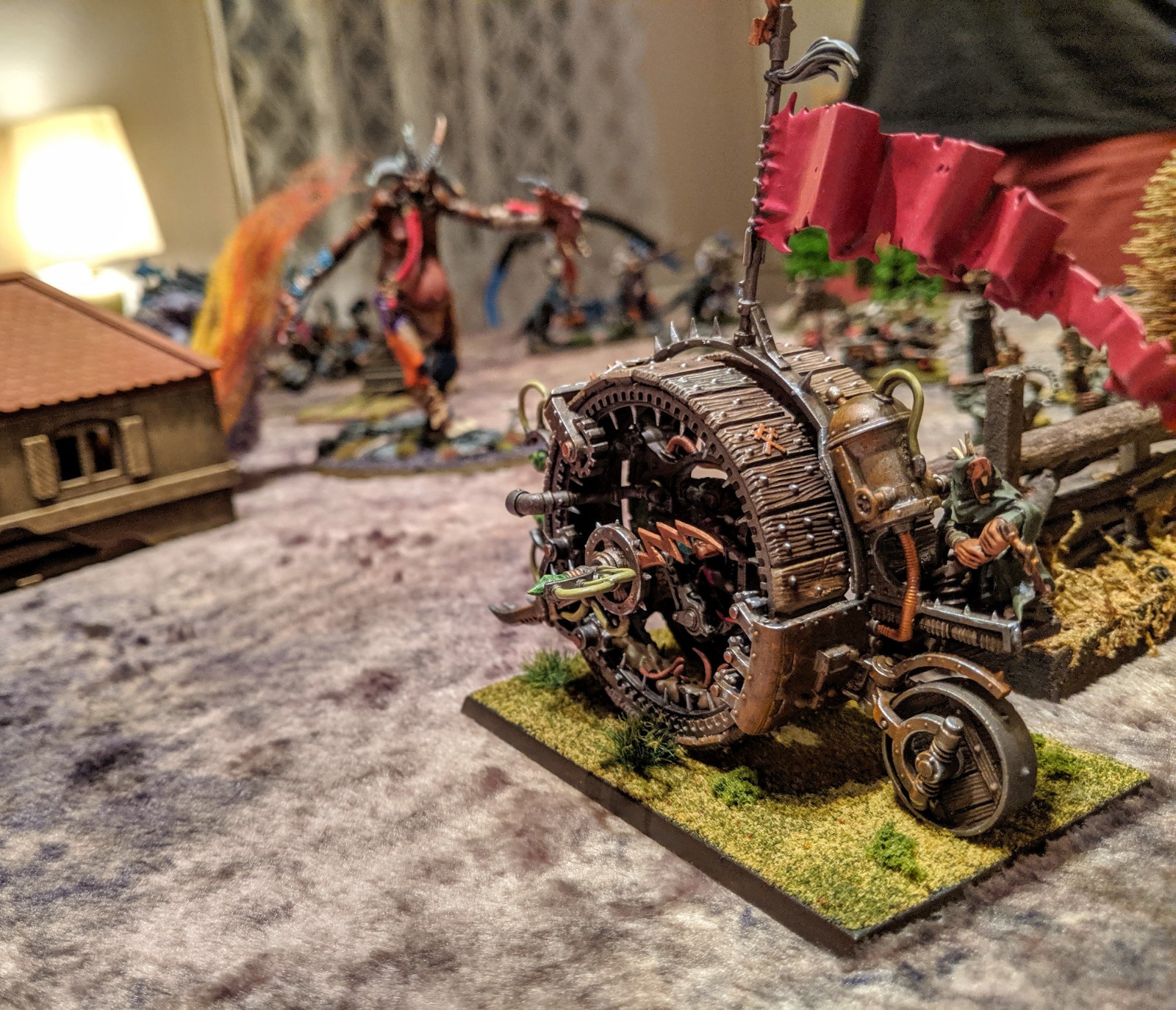
Anyway, Lawrence proceeded to trounce me on the right flank of the battlefield. A few factors went into this drubbing. First, I had inadvertently neutered the effectiveness of my Doomwheel by “upgrading” it to add a ranged attack and remove its wild charge special ability. In truth, wild charge was exactly what I needed in this game, because it would have allowed my Doomwheel to attempt a counter-charge when it was charged by that fearsome giant late in the game.

By trading off the wild charge for a cute-but-inadequate ranged combat attack, I had reduced the effectiveness of what should have been a hard-hitting shock unit (the Doomwheel). So it was carved up piecemeal, and I learned a good lesson about list-building.

I had higher expectations for my Plague Monks (bellicose foot, in the parlance of Dragon Rampant). After all, they had the counter-charge ability, as well as beefy combat stats. Alas, they failed their counter-charge roll on the turn when it would have mattered the most, and they were cut down like dogs (rats?) as they fled.

Overall, my rats did not perform well versus Lawrence’s trolls. But maybe that was for the best — after all, what better way to learn about a new game than by giving your opponent a thorough, merciless drubbing?!

I will claim credit for finally bringing down the giant, though, amid a flurry of blows by my elite foot (leader + bodyguard retinue). So there’s that!

At this point, the writing was on the wall for my ratmen. They had mustered for battle but failed to execute their battle plan (in true Skaven fashion). I learned a few things about list-building and the effectiveness of various units in this game.

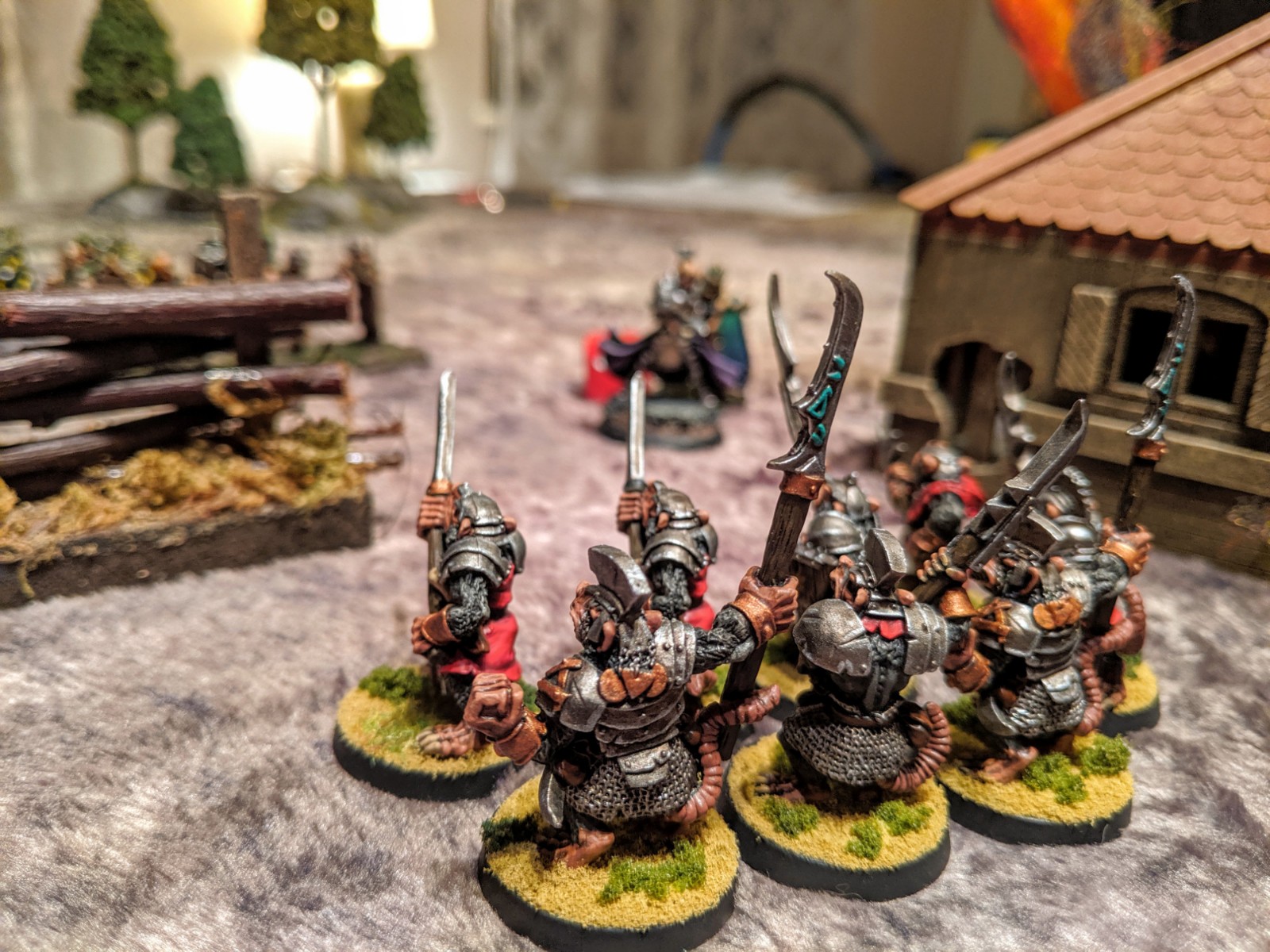
I addition, I must doff my cap to John’s very careful maneuvering and unit placement as he squared off with his Begovic House Guard. He was able to exploit the wild charge ability on units like my greater warbeasts. I tried to return the favor by goading Lady Almira into charging my Stormvermin (see below) but he was too smart for that. Arrgh! She escaped unscathed, which is an affront that must be rectified in future games.

So this mini-campaign rolls on, with the ratmen slinking away in defeat. It was great to see Lawrence’s army on the table, at long last!

So where will we go from here? I’m painting up some new units for future games, so maybe we’ll try a town raid, with lots of buildings and back alleys to spice things up. I’ve got a big collection of fantasy city terrain that I would dearly like to get onto the table for a big game. Stay tuned for more!

Open Combat: Under the Grey Mountains

Posted by Comrade on June 5, 2019
Posted in: Posts. Tagged: fantasy, narrative, open combat, skaven, skirmish. 6 Comments

Thankar lit a torch and edged closer to the doorway. The cavern entrance was hewn from the rough rock of the mountain face, but the ancient artisans had etched inscrutable runes around the perimeter of the opening. Thankar and his fellow warriors could only guess at the message as they stepped cautiously past the threshold and into the gathering dark. If the words were cautionary, they went unheeded.

The corridor sloped down, the flagstone pavers underfoot soon giving way to irregular pebbles and rocky outcroppings. Within minutes the warriors were enveloped in darkness, their way lit only by guttering torches gripped in steady hands.

Ahead lay their quarry: the vile, chittering Skaven raiders that had absconded with the halfling wizard Argus Nul after the massacre at the Stoic Arms. Thankar and his fellow warriors had tracked the foul ratmen to this underground lair, which offered their best chance at recovering Argus … or what remained of him.

Vincent and I had a chance to grab an empty table at Enfilade last month to play out the second game in our occasional fantasy mini-campaign set the Old World. In the first game, a warband of Skaven raiders swept down from the Grey Mountains to kidnap Argus Nul from his well-defended roost at the Stoic Arms Inn.

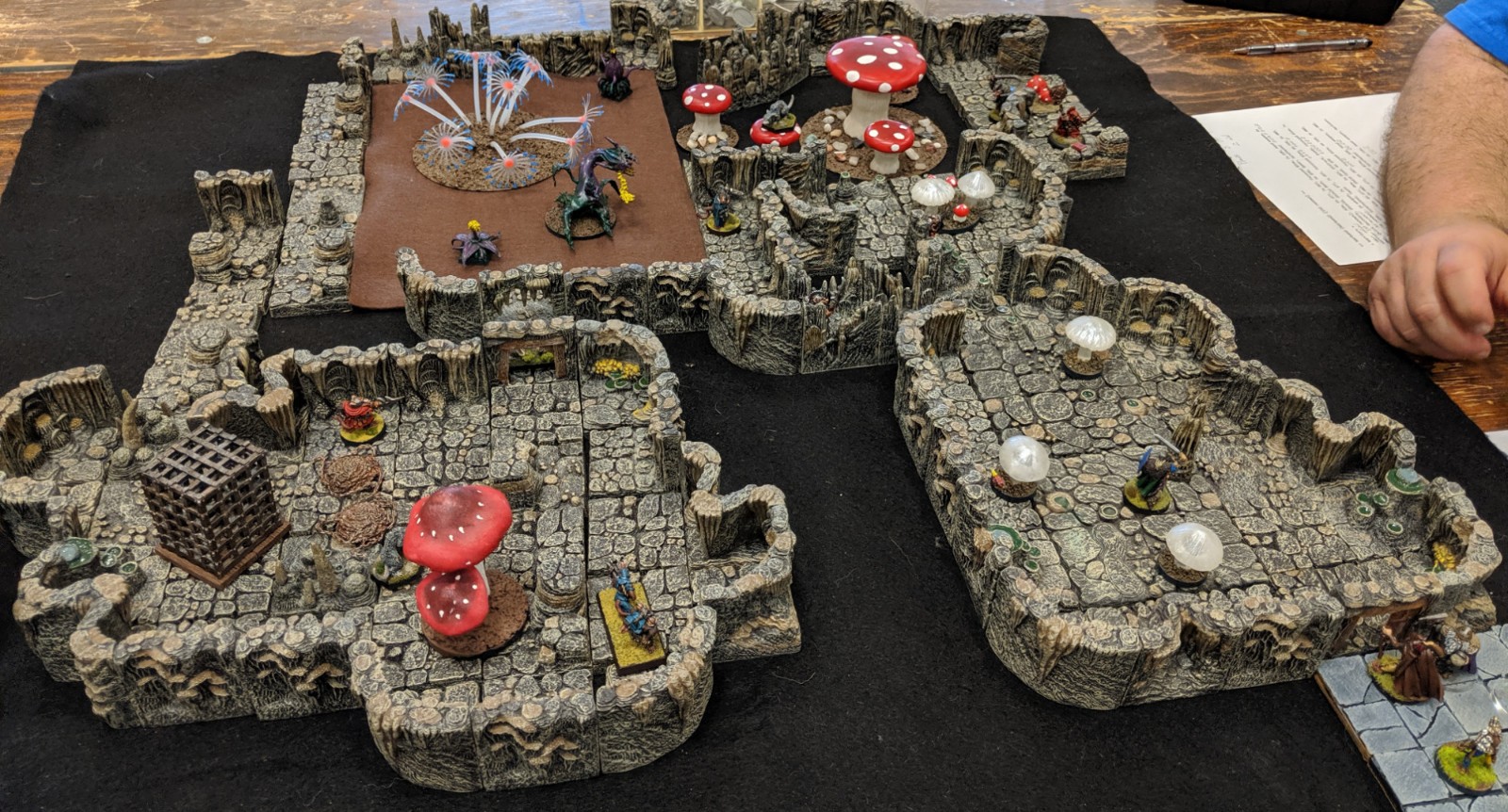
For this game, Nul’s gallant cadre tracked the ratmen’s spoor to the trackless caverns beneath the Grey Mountains, where our game begins. We’re using Open Combat, a fast-playing generic skirmish game that is great for games with 5 to 10 figures per side. Vincent brought his Dwarven Forge dungeon terrain to represent the benighted caves, plus some hungry fauna to populate the dank tunnels.

We played at Enfilade, a regional gaming convention hosted annually in Olympia by the Northwest Historical Miniatures Gaming Society. It was a busy day at the convention, and we were lucky to find an empty table on the perimeter of the gaming hall. I’m pleased to report that we had a steady stream of foot traffic coming over to check out our nifty terrain and miniatures, which was nice! It seems there’s always room for a good old-fashioned dungeon crawl, even at a historical miniatures convention.

The game began with Vincent’s warband creeping into the dungeon to face my ratmen defenders, which had been deployed throughout the maze-like passageways and chambers. My rats outnumbered his guys, but his figures were more powerful on an individual basis. It would be an interesting game…

The battle was joined in the antechamber, as the elf warrior Carroth True-Shot spotted Vrictus of the Gnarled Root (my Skaven warlock leader) darting amongst the mushrooms. In truth this was a bit of a feint, as I had hoped to lure more of Vincent’s figures into the mushroom forest so I could flank them with fighters hidden in a side tunnel.

Actually, this is exactly what happened … except the combat didn’t go my way, and my flanking maneuver turned into a slaughter.

As the dwarves pushed past the corpses of the slain ratmen, they came into range of Vironq’s Hand-Cranked Doom Machine (my ratling gun). The artillery piece lit up the darkness of the dungeon as it blazed away at the invaders, bleeding them for every step they took deeper into the Skaven lair.

The predatory plants lurking in the dungeon also contributed to the dwarves’ woes, gnashing at them with toothy foliage and barbed tendrils. For the plants, we decided they would attack any figure that came within 3 inches of them. And since Open Combat is a very mobile game, with lots of push-backs and repositioning of figures, this meant that Skaven and hero alike had some uncomfortable encounters with the hungry plants in the dungeon.

Alas, it was too little, too late. Even as the Skaven began to stabilize the situation in the mushroom forest (with Vrictus using his Intimidate psychological attack to great effect against a dwarven champion named Sphen Coldwind), a handful of dwarves had slipped past and were approaching the door to the dungeon jail where Argus Nul was imprisoned. The lone Skaven guard was getting increasingly anxious as the sounds of combat drew nearer to the jail.

Finally, having lost his nerve, the Skaven guard butchered poor Argus through the bars of his cage, then fled into the darkness.

The few remaining ratmen beat a hasty retreat. For their part, the heroes recovered Argus’s spellbook — offering some small measure of victory even as they mourned the loss of the wee little halfling wizard.

Once again Open Combat gave us a great game, with lots of drama and seesaw action moments. Dungeons are exceedingly dangerous environments for Open Combat, because so much of the game involves pushing and bashing your enemies into stuff. When you hit a wall or a piece of terrain or another model, you typically take additional damage. On a wide-open battlefield, that’s dangerous enough — you can imagine how brutal it becomes in a claustrophobic dungeon!

We’ll see where this mini-campaign goes from here. Maybe the next game will be a town assault, where the ratmen are are storming the city gates to plunder the burgermeisters’ holdings? That would be a good excuse to get some of my town buildings on the table, too. Stay tuned!

Enfilade 2019 Photos and Convention Report

Posted by Comrade on May 30, 2019
Posted in: Posts. Tagged: club, convention, dragon rampant, game night, hobby, miniatures, wargames. 1 Comment

I got a much-needed hobby reprieve last weekend, when Paul and I road-tripped up to Olympia for Enfilade, the flagship convention hosted annually by the Northwest Historical Miniatures Gaming Society.

I’m not a huge historical gamer, but I am a GAMER, and that means I’ll always clear my schedule for a good convention. Back in Chicago, the big annual HMGS convention was Little Wars, and I attended that as often as I could. Enfilade had been on my radar since I moved to the Pacific Northwest a few years ago, but this was the first year that my family schedule allowed me to attend.

I played in one scheduled game (Bruce Smith’s award-winning Battle of El Obeid scenario, pictured above) and dropped in on a few more. I’ll sprinkle photos of the tabletop battlefields in throughout this article.

Enfilade was held in the Hotel RL in Olympia, located in a semi-secluded office park with plenty of parking and a view of the Puget Sound. One thing the hotel DIDN’T have was a cash machine or ATM, and this was particularly problematic because the bring-and-buy flea market was cash only. It seems like a huge oversight that the convention organizers or the hotel operators didn’t contract with a portable ATM company to drop in a kiosk for the weekend or something. They would have made hundreds of dollars in fees alone.

The convention itself had the feel of a close-knit gaming club coming together for their annual reunion. You could tell that a lot of these guys and gals had been friends for years, decades even, and Enfilade represented a great opportunity to see old friends and make new ones.

As I mentioned earlier, I had the good fortune to end up in Bruce’s Battle of El Obeid game. This was a 15mm sci-fi mashup, kind of like Weird War II meets Mars Attacks. The players were different national factions (British, Ethiopians, Germans, etc.) competing to take and hold a small settlement in the titular city of El Obeid, Sudan. Each faction had recognizable WWII units, such as infantry and tanks, but they also had a variety of alien units, plus access to weird tech to round out their forces.

Here’s a look at the battlefield a few turns into the game.

The game was run with Xenos Rampant, which is a sci-fi fan supplement inspired by the popular Dragon Rampant ruleset, along with a few modifications by Bruce (of course).

I later learned that Bruce is well known at Enfilade for hosting exciting and engaging games, so I’ll chalk it up to dumb luck that I had the presence of mind to register for the Battle of El Obeid.

The game was great fun, with lots of nifty little details (like the alien airship that floated menacingly over the table, zapping units at random). Bruce incorporated random encounters and RPG-style elements, as players were encouraged to explore the wasteland surrounding the village to see if they could recover any lost tech or helpful resources. (Most often, though, they just found monsters. Lots and lots of monsters.)

The conclusion was up in the air until the final turn of the game. The Allied powers had succeeded in seizing the center of the village, but they had done so at terrible cost, losing most of their armor and flank support in the process. We joked that the village would become our graveyard as the Axis powers closed in and eliminated us. Hah!

Thanks to Bruce for running such a fun game. I got to know a few of the other players in his local group, who either played in the game with us or drifted over to watch and offer somber assessments of the state of the battle.

Beyond that, Enfilade had many of the games I’ve come to associate with HMGS — epic Napoleonic battalion-level clashes, Revolutionary War forest skirmishes, and Zulu batttles. Peep these pics to see more of the action.


I dropped some cash on a few must-have items from the flea market. Thanks also to Mike and Rob for letting me pick over their loot to grab a few figures for my various projects.

I’ll admit that I’ve been spoiled in the past by having a plethora of great game conventions in my backyard. Back when I lived in Chicago, I had Little Wars, Adepticon, Winter Wars, and of course, the granddaddy of them all, GEN CON, all within an easy few hours’ drive. Enfilade is a solid offering and I can definitely see myself coming back next year.

In fact, Paul and I were talking on the drive home about running a game next year. We’re not big historical gamers, but it seemed there was plenty of appetite among the attendees for a sci-fi or fantasy offering. And there’s nothing like a convention game to get you motivated! Stay tuned for more.

Trying Out Laserblade for Ultra Fast Sci-Fi Skirmish

Posted by Comrade on May 23, 2019
Posted in: Posts. Tagged: club, game night, miniatures, sci-fi, skirmish, warbands. 2 Comments

Skirmish level gaming is a mainstay for us here at Comrade’s Wargames. I got my start with Song of Blades & Heroes many years ago, and have since explored many different rule sets, from established game companies to up-and-coming creators.

We notched another one on the list last week with a couple games of Laserblade, an ultra fast-playing sci-fi skirmish ruleset that encourages you to use any figures you want to play out games in whatever milieu floats your starship. And when I say this is a rules-lite system, I mean it — I actually think Laserblade might be an order of magnitude simpler than Song of Blades & Heroes, and that’s really saying something.

Laserblade is intentionally setting-agnostic, but it seems designed to replicate any manner of popular cinematic sci-fi games, or darker iterations of sci-fi such as Warhammer 40k. Each figure is a distinct character with just two stats, representing close combat and ranged combat. There are no separate equipment lists — your two combat scores represent not just your fighting prowess, but also any weapons, equipment, magical auras, raccoon sidekicks, and so on.

From there, you can add in a special ability or two from a limited list that encapsulates most of what you’d expect to see — abilities like brawler, commander, marksman, etc. They’re self explanatory. I’m a big fan of games that use super simple stat lines backed up by flavorful special abilities. Soldiers only — no tanks, vehicles, walkers, or oversized demons here.

John and I tried out this game on a random weeknight, and we were quickly able to knock together two opposing teams for a game set in our home brew setting: an alternate future where the Earth is a toxic garbage heap over which orbital mega corporations clash to extract the last few morsels of resources from its devastated surface. We each ended up with 6 or 7 guys per side. I’ll sprinkle in a few photos from our game while I continue this review.

My absolute favorite Laserblade mechanic is how it deals with ranges. It uses a single range band — called, appropriately, “range” — for moving, shooting ranges, and other effects. Range is exactly 8 inches, and the game encourages players to make custom movement sticks rather than fiddle with tape measures.

Shooting within range (8 inches) incurs no penalty. Shooting at multiple ranges (say, 3x range, which would be up to 24 inches) incurs progressive penalties.

The range mechanic encourages players to close in with each other to avoid penalties and get the best modifiers on the tabletop. This means the game plays best on a fairly small tabletop. The rulebook suggests 4×4 feet, but we played on 3×3 feet with 8 or 10 pieces of terrain and it worked fine.

Playing up close also looks great, as you can see from these photos. Games like Warhammer 40k pretend that they’re all about close combat, but often long ranged shooting is where you want to be. With Laserblade, the action happens up close, whether it’s shooting or close combat.

The activation system is also inspired. Each turn, you roll randomly to see how many figures you can activate. You can never activate more than 3 dudes at a time, so for typical games you’re leaving half (or more) of your team inactive in a given turn, and only activating one or two figures. This forces a lot of tense decision making, particularly in the late game when figures are close together threatening multiple devastating attacks.

But make no mistake, this is an extraordinarily simple game to play. Players seeking a lot of “crunch” will not find much to work with in Laserblade. But it’s a great option on busy weeknights, when mental energy isn’t in great supply and we just want to get some toy soldiers on the table.

John had some thoughts about the game here:

Laserblade allows me to get models on the table when I otherwise wouldn’t. I most often play tabletop games in the margins of a busy adult life. So it was with our most recent games, sandwiched into a Wednesday night between full workdays, after the kids were settled into bed. By the time we played, I had spent most of my attention budget for the day.
Luckily, we played Laserblade that night. Laserblade offers few details to keep track of and few decisions to make in the course of a game, all focused on one fundamental activity: positioning and maneuvering your troops for greatest advantage. This laser focus allowed games that surprised me how satisfying they were, while freeing me from needing to remember variations in things like weapon types, troop profiles, and so forth. Though neither of us had ever completed a game of Laserblade before, Patrick and I only needed to refer to the rulebook maybe twice. We got two games in, one exciting narrow victory per player, with time and energy to spare. I got to bed by ten!

The game is published by Echidna Games. It is a spartan offering, just 35 pages, with barely any formatting and just a handful of unspectacular photos as illustration. But you know what — that’s totally fine, because after one or two games, you literally won’t need to look at the rulebook ever again (except when you build your team for the next game).

And lastly (as is common with these ultra rules-lite games) Laserblade seems perfect for tinkering. If you like crafting house rules and custom scenarios and modifying games to suit your homebrew  setting, this one has a lot of meat on the bone.

The verdict: try out LaserBlade if you want a fast-playing tabletop experience that is unlike most mainstream sci-fi games out there. It’s also a great option if you want to focus on pouring your creative energy into world building and custom rules, rather than reading volumes and volumes of published material.


Posts navigation

← Older Entries
Newer Entries →
  • Recent Posts

    • Cold Data and Fiery Logic: The Dark Mechanicum
    • Building a Grimdark Battle Board
    • Hobgoblin: More Thoughts and Musings
    • Grimdark Future: The Scouring of Hundvolst
    • Shadow War: Armageddon Battle Report & Review
  • Follow Comrade's Wargames on WordPress.com
  • Tags

    28mm 40k army battle report caluphel campaign chaos club death guard dragon rampant dwarves fantasy game night grimdark hobby miniatures narrative nurgle painting post-apoc project saga sci-fi skaven skirmish terrain warbands wargames warhammer workshop
  • Archives

    • February 2026 (1)
    • January 2026 (1)
    • November 2025 (1)
    • October 2025 (2)
    • September 2025 (1)
    • October 2023 (2)
    • September 2023 (1)
    • August 2023 (2)
    • July 2023 (3)
    • June 2023 (3)
    • May 2023 (4)
    • April 2023 (2)
    • March 2023 (5)
    • February 2023 (2)
    • January 2023 (2)
    • December 2022 (1)
    • November 2022 (1)
    • October 2022 (4)
    • August 2022 (2)
    • July 2022 (1)
    • June 2022 (2)
    • May 2022 (5)
    • March 2022 (1)
    • February 2022 (1)
    • January 2022 (3)
    • December 2021 (1)
    • November 2021 (2)
    • October 2021 (1)
    • September 2021 (2)
    • July 2021 (1)
    • June 2021 (1)
    • May 2021 (2)
    • March 2021 (3)
    • February 2021 (1)
    • January 2021 (3)
    • December 2020 (1)
    • October 2020 (1)
    • September 2020 (2)
    • August 2020 (1)
    • July 2020 (1)
    • June 2020 (1)
    • May 2020 (1)
    • April 2020 (1)
    • March 2020 (1)
    • February 2020 (2)
    • January 2020 (3)
    • December 2019 (5)
    • November 2019 (1)
    • October 2019 (1)
    • September 2019 (2)
    • August 2019 (2)
    • July 2019 (4)
    • June 2019 (3)
    • May 2019 (3)
    • April 2019 (1)
    • March 2019 (1)
    • February 2019 (2)
    • December 2018 (3)
    • November 2018 (3)
    • October 2018 (5)
    • September 2018 (5)
    • August 2018 (5)
    • July 2018 (5)
    • June 2018 (2)
    • May 2018 (1)
    • April 2018 (3)
    • March 2018 (1)
    • February 2018 (1)
    • January 2018 (1)
    • December 2017 (1)
    • November 2017 (5)
    • October 2017 (1)
    • September 2017 (2)
    • August 2017 (4)
    • July 2017 (4)
    • June 2017 (3)
    • May 2017 (4)
    • April 2017 (3)
    • March 2017 (7)
    • February 2017 (6)
    • January 2017 (2)
    • December 2016 (5)
    • November 2016 (2)
    • October 2016 (3)
    • September 2016 (4)
    • August 2016 (5)
    • July 2016 (6)
    • June 2016 (8)
    • May 2016 (2)
Create a website or blog at WordPress.com
Comrade's Wargames
Create a website or blog at WordPress.com
  • Subscribe Subscribed
    • Comrade's Wargames
    • Join 153 other subscribers
    • Already have a WordPress.com account? Log in now.
    • Comrade's Wargames
    • Subscribe Subscribed
    • Sign up
    • Log in
    • Report this content
    • View site in Reader
    • Manage subscriptions
    • Collapse this bar
 

Loading Comments...