Comrade's Wargames

Painting toy soldiers in Oregon

  • Home
  • Narrative Campaigns
    • The Cauldron: A Grimdark Sci-Fi Campaign
    • The Chronicles of Üthdyn: A Fantasy Tabletop Campaign Setting
    • Nightwatch: Beyond the Borderlands
    • Frostgrave: Mystery of the Night-Haunted City
  • About Comrade’s Wargames

Fully Painted: More Vintage Plague Marines

Posted by Comrade on February 13, 2017
Posted in: Posts. Tagged: 40k, chaos, citadel, miniatures, painting, project, sci-fi, vintage, warhammer. Leave a comment

I’m continuing to work my way through the handful of vintage metal Plague Marines I acquired last summer. I’m also combining torsos, weapons and other bits to create a few much-needed support pieces for my Nurgle followers, too, as evidenced by this lot, featuring a missile launcher, a battle standard bearer, and a vintage squad leader.

wp-1487044482819.jpg

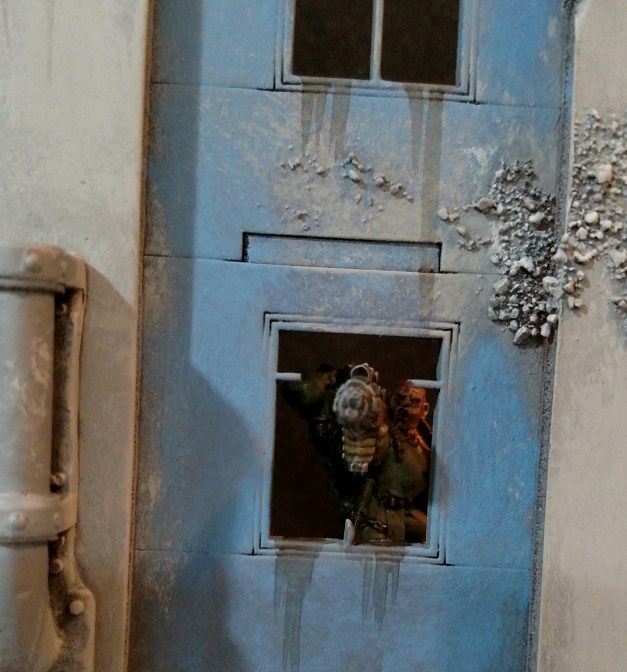
The squad leader is mostly stock, although I gave him a gnarly barbed maul. This particular figure has fascinated me for literally decades. I remember seeing him in the pages of White Dwarf and remarking on his ancient plasma pistol. With its scope and wood panel decorations, this was the figure that helped my teenage self understand what was meant by the term “master-crafted weapon.”

wp-1487044617104.jpg

wp-1487044532302.jpg

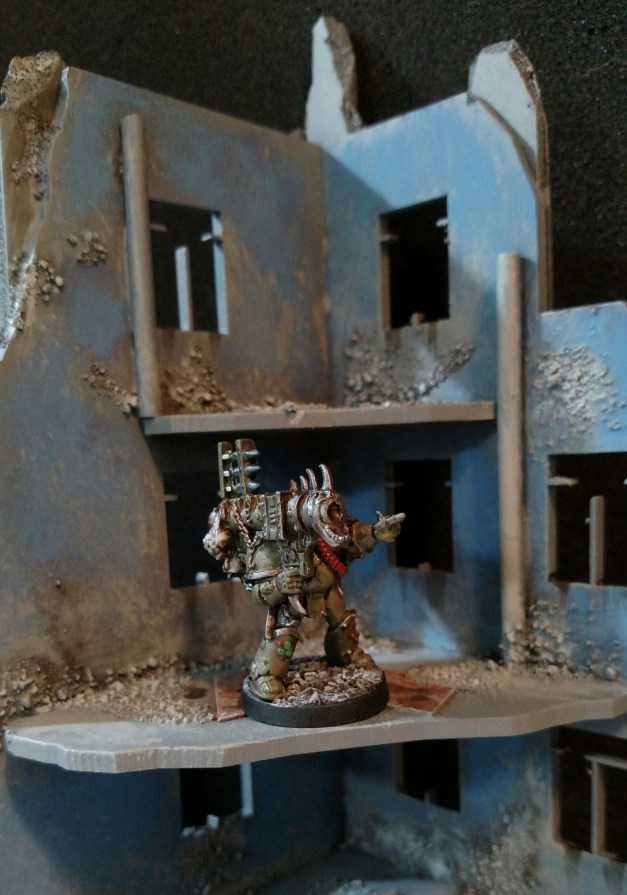
The  Plague Marine with the missile launcher was a bit of a kitbash … I had a spare metal missile launcher arm that I pinned to a Plague Marine torso that was helpfully standing stock upright. The addition of a pointing arm brought the whole figure together.

wp-1487044590427.jpg

And lastly, this standard bearer figure is very obviously not a vintage Plague Marine sculpt. But hey, beggars can’t be choosers, and the newer Nurgle icon piece fit perfectly atop this guy’s upraised pole. Give him a quick and dirty paintjob and presto — he’s a Plague Marine now!

wp-1487044564035.jpg

This lot brings my total number of painted Plague Marines to eight — definitely enough to field a versatile squad for One Page 40k (or Grimdark Future, I should say, since it got renamed just a few days ago).

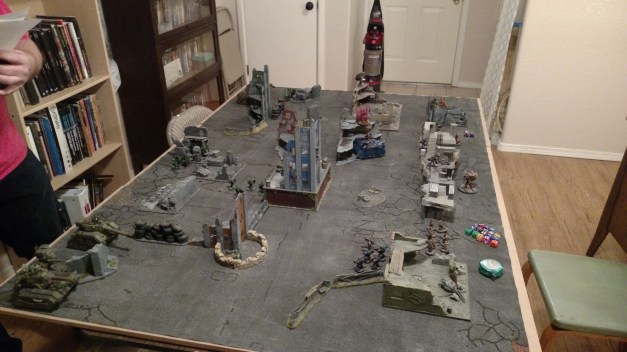
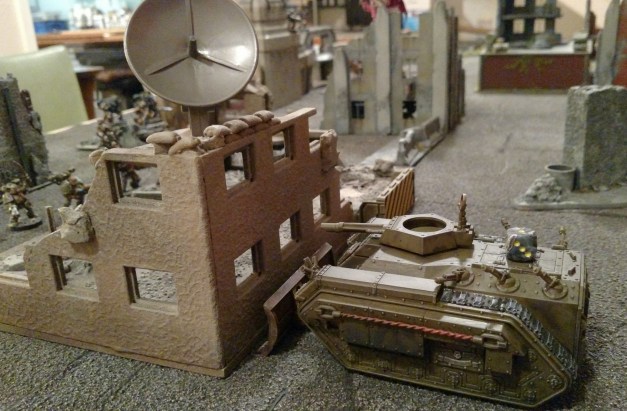
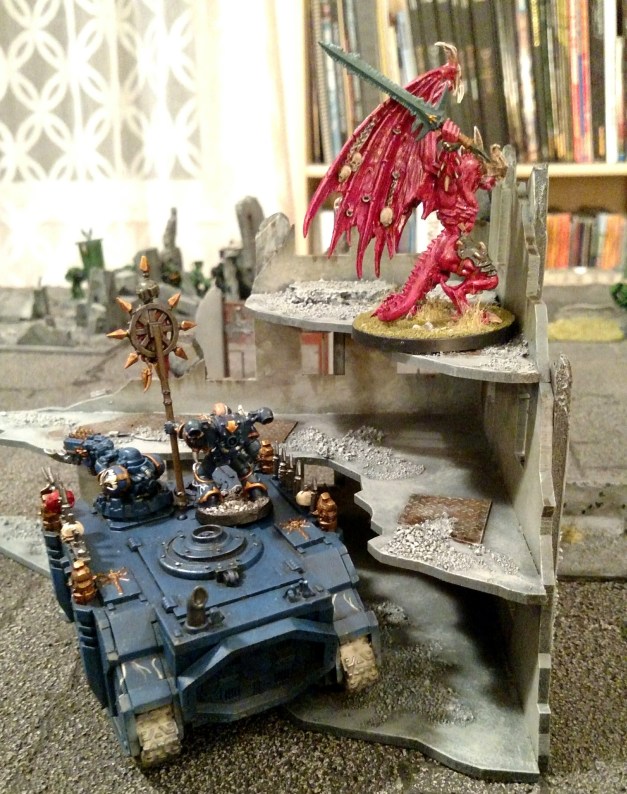
You’ve probably also noticed some nifty new terrain in the background of this post. I dipped my toe into the world of laser-cut MDF terrain and so far I’m liking what I’ve been able to do with some fairly simple kits!

I’m expecting to get all of this stuff onto the battlefield later this month, so stay tuned!

Caluphel: Notes on the Reemergence

Posted by Comrade on February 5, 2017
Posted in: Posts. Tagged: 40k, caluphel, campaign, project, sci-fi. 1 Comment

daedalus-stargate-wallpaper-1

Memorex
To: Prelate Chrydriik Guillurus, Macrotechnia Technographica Determinus
From: SubCadre Commander Uriel Vare
Re: Caluphel Reemergence Hyper Strategy, Research Directory
Date: 2 150 941.M41

Sir.

Per your Directive, I am attaching the first documents on Caluphel Prime. As you are aware, the Caluphel system was originally settled ~ 570.M27 during the so called Dark Age of Technology. With the records relocated during the Unification Wars 800.M30, it was concluded that the Caluphel System had become lost in space, time and warp during the intervening period.

With the recent re-discovery of Caluphel and the landing of Imperial forces, certain documents pertaining to the settlement and abandonment/loss of Caluphel have become available to us. These documents and records are a mixture of official report filings from various tech-priests (ne:scientists) of the Expeditionary Force as well as Personal Logs and transmission recordings. In my subsequent reports, I will submit these various documents in rough chronological order, rather than by topic/sacred order. Additional technical data for each can be found on Web.rMTD.x12v465 in your personal terminal node.

In the Emperor’s name.

Vare

*-*-*-*-*-*-*

System Report, 0.0.0, 2735 estimated.

Exogeologist Janen Peh Lyn

Jack,

How are you? I hope you are well and this transmission reaches you safely. When the Expeditionary Force left Iscandar Station, you were about to propose to Xi – I hope she said yes. Tell her that if it doesn’t work out, she’s welcome to visit me on Caluphel once we have running water. Jesting! I should give my official report here as well.

Captain Hayes and his navigator made a safe Insertion to the calculated Mandeville Point of Caluphel. My understanding was that the Emergence point was off by well over 72k, considered an outlier of the jump calculation models. No official statement by the Command, other than this contingency had been accounted for, the fleet was not in any danger and we were now moving into orbit above Caluphel.

Still, I’ve never heard of a jump going this wrong. Hopefully this is the last of our bad luck. I know, I know, there isn’t such a thing as luck. . . just low probability events.

The Caluphel System matches probe data perfectly. Five planets and asteroid belt in orbit around a binary red-white dwarf pair.

  • Prime: Chthonian planet in close orbit to the twin suns. Tidal locked. No moons.
  • Asteroid Belt
  • Secundus: Gas Giant. 5 moons, 1 likely inhabitable.
  • Tertius: Mini-Neptune, frozen ocean. 2 moons, both with volcanic activity
  • Quartus: Major planet, terrestrial.
  • Quintus: Centaur planet (minor)

The red-white dwarf pair is interesting, as is the tidal-locked nature of Caluphel Prime. The leading theory is that the red dwarf star is the forming agent for this system and that the planets formed along with the condensation and fusion ignition of that sun. In this theory, a rogue white dwarf star entered the system at some point and was captured by the red into a binary. This theory makes sense due to the extreme age difference between the red and white dwarfs; white dwarfs are simply red or yellow stars that have burned through their gaseous fuel but do not have the mass to supernova. However, given the moderate temperature of this white dwarf (3270k), it is one of the oldest stars in the universe. Meanwhile, the red star is only a few billion years old; fairly young.

In any case, with this theory, the newly formed red-white binary would have had sufficient mass to draw in and tidally lock the chthonian prime planet at a distance of 0.23 Au. Normally, this would be close enough to burn off all atmosphere and life on the planet, but the extreme age of the white dwarf must have limited the impact of that event, albeit confining the remaining life to a ringed habitable zone.

Fortunately for the remaining life, the addition of the white dwarf substantially increased the light radiation from the suns, from a narrow IR band previously to full-spectrum light with a UV peak. As is apparent from long-range photos, the green of photosynthesis is present.

The Asteroid Belt is a mystery at this point. I have my sensors directed at Prime for the moment, but am interested to determine the age of the Belt. When did it form and when is the predicted re-coalescence? So many mysteries, actually. I can’t wait.

I’m attaching a data dump from my system scans and orbital mass readings. Should be enough to get your charts updated and models running.

Give my best to Xi!

Janen

Transmission ends.

*-*-*-*-*-*-*

This bit of electrifying fluff was submitted by Paul, one of my friends and co-conspirators on the Caluphel project. We’ve been bouncing ideas around for a few weeks, and Paul was particularly interested to start developing the backstory of this lost colony. Check back soon for more!

Caluphel Beckons … Will You Answer?

Posted by Comrade on February 3, 2017
Posted in: Posts. Tagged: 40k, caluphel, campaign, project, sci-fi. Leave a comment

goodwp-com_18371

I’m trying something new here. I’ve started sketching out a 40k narrative campaign setting with some of the guys from my local game group. The idea is to add a little narrative layer on top of our games, to give them a little character and flair. I can’t help it … I’m a narrative gamer at heart. I like to name my little painted mans, and I try to come up with little backstories for the games I play.

The first step for me was to come up with a suitably moody setting … how about a lost colony planet that has been newly rediscovered? Yeah, that’s good. But we need to 40k-ify it by cranking everything up to 11. Enter Caluphel Prime, the largest planet in the system of the same name. It had been lost for centuries, but now factions from all over the galaxy are converging on the planet once again, in search of something.

Caluphel beckons … will you answer?

Stay tuned for more.

Confessions of an Impatient Painter

Posted by Comrade on February 1, 2017
Posted in: Posts. 2 Comments

This is a post that’s been percolating around in my head for a long time. I’m not a particularly skilled painter, but I like to think that what I lack in technique, I make up for in volume. Over the last 10 years I’ve painted many hundreds of miniatures, constructed tables full of scratchbuilt terrain, hosted dozens of games and generally done my best to create a fantastic and immersive tabletop experience for myself and the players I’ve interacted with.

img_20150907_190407919.jpg

That might sound like a humblebrag, but it’s really intended to show that you, too, can achieve all of those things. I’m here to tell you how.

Let’s start with painting. I am, as the title denotes, an impatient painter. I rarely paint large-scale models or centerpiece figures. I speed through almost everything, because I’m always in search of that perfect, fleeting moment, when I put down my paint brush and declare that a figure is *done*. Not perfect, just done. Here are a few tips that have helped me reach this goal, more often than not, over the years.

img_0737

1. Prime in black

I prime virtually everything, from figures to vehicles to terrain, in black. Now, that certainly has an impact on my painting — certain paints require a little more attention to cover properly over black, and my brightest colors aren’t quite as bright — but it’s also allowed me to develop an incredibly reliable set of techniques.

In particular, I prime most of my figures these days using black gesso, applied with an old craft paintbrush. Using brush-on gesso, I find that I have a lot more control over the priming. It doesn’t take a whole lot of additional time, and I manage to avoid the fumes associated with spray paint (although I do still use spray paints for certain projects). And trust me: gesso creates a truly wonderful surface upon which to paint.

2. Use a limited palette

I know plenty of players who own hundreds of paints from a variety of hobby companies, and who agonize over the correct techniques for blending, shading, washing and drybrushing. I am not one of those people. I’ve been known to paint entire armies and warbands using just four or five colors — intentionally limiting my palette in favor of speed and uniformity. Again, the goal here is volume. Your fantastic  paint scheme means nothing if all you’ve got to show for it is a really nice test model.

These Warhammer Skaven dudes, for example, were painted with just a few colors — gray/white for the fur, red for the cloak (plus a dark wash), plus a few highlights. They won’t win any awards, but they are perfectly serviceable on the battlefield. And I’ve got a dozen more just like them, ready for action at a moment’s notice for D&D, Song of Blades & Heroes, Frostgrave, or whatever.

img_20161025_210747.jpg

Now, that’s not to say I don’t like effective paint schemes. To the contrary — I love a paint job that pops! But I’ve found that you can achieve that with a limited palette in most cases. And it allows you to explore a more complex palette of colors for appropriately awesome, large-scale miniatures or vehicles.

3. Use the dip

This will be heresy to some. But my painting output shot through the roof when I discovered the “magic dip.” Some people shell out $35 for ArmyPainter Quickshades, but I’ve gotten comparable results at one-third of the price using Minwax Polyshades polyurethane stain. In essence, the dip combines a dark pigment wash along with a tough, protective outer layer that gives instant results to even the most basic paint jobs. It’s most effective with earth tones — browns, tans, ochres, brick reds, etc. Here’s a Reaper guy I painted up and finished off with Minwax Polyshades Tudor Satin.

wp-1485969411348.jpg

There’s definitely a learning curve to using the dip, so rather than trying to explain it myself, I’ll just link you to a fantastic tutorial that my friend Karl put together. Read it and be enlightened.

I can’t overstate the impact that the dip has had on my painting. Simply put, using the dip is like using an airbrush — it so thoroughly changes your painting method that it’s hard to imagine a time before you used it.

4. Don’t get bored painting armies

One of the Facebook groups I’m a member of is One Hour A Night, which is dedicated to motivating people to finish their voluminous hobby backlogs. It’s a great group, very focused on positivity. As you can imagine, a lot of the members are trying to paint large armies for games like Warhammer 40,000. Many of them have deadlines looming (“Gotta get three colors on these Tau by Friday for a big tournament!” is a common refrain). Over the years, I’ve neatly sidestepped this issue by avoiding army-sized games (defined here as any game requiring 60+ figures per side) in favor of smaller warband-sized games (a few dozen figures per side, plus a vehicle or two). (Sidenote: Remember when 40k was essentially a skirmish-sized game? Me too, haha.)

img_20160719_213554.jpg

Even this past summer, when I was painting up my Night Lords army, I made sure to tackle it in bits and pieces, with breaks in between to build terrain or paint up weird, oddball figures. Like this creepy guy, which I’ve nicknamed The Flesh Engine.

img_20160719_214232.jpg

What purpose does he serve? He’s not a unit, per se, in the 40k rules, so why did I waste time and energy on painting him? The answer, of course, is because it pleased me to do so. Not everything has to be about producing for your chosen army.

I’ve also set a personal goal of always having at least one new model to unveil at each game event I’m attending. So even if I’m hosting another game of One Page 40k featuring my heavy infantry army (which I’ve owned and enjoyed since at least 2010), I’ll try to paint up a new squad leader or a medic or a heavy weapon trooper just so I’ve got something new to show off. Small deadlines with discrete, measurable goals that you can be proud of are very important.

5. Start a miniatures blog

The blogosphere is calling … will you answer? Seriously, I derive tons of enjoyment and engagement from posting random words and photos here. I’m under no delusions about my meager readership — and I worked in digital publishing for a time, so I know just how much content it takes to build a reliable audience. I doff my cap to folks who have thriving audiences but I don’t think I’ll ever be prolific enough to join their rarified ranks.

Having a blog, though, is something of a digital business card that I can produce whenever I bump into like-minded folks on Facebook or web forums. It certainly helped build the membership of my previous game club, Chicago Skirmish Wargames.

But mostly I do my blog stuff for me, because I enjoy cultivating this little piece of the web. It gives me one more thing to get excited about when I settle in to spend my hour each night on hobby related stuff.

What’s your favorite shortcut or time saver? Leave a comment and let me know. Thanks for reading!

New Paint for Old Plague Marines

Posted by Comrade on January 22, 2017
Posted in: Posts. Tagged: 40k, army, chaos, miniatures, painting, project, sci-fi. 4 Comments

When I started my little 40k project last summer, I resolved to seek out and acquire some of the fantastic old metal figures that energized my imagination when I was younger.

At the top of the list were the old metal Plague Marines released in the mid-90s. These guys really fired my imagination — I mean, what other sci-fi milieu has evil space marines whose armor and flesh has been corrupted by centuries of sorcerous rot and demon-spawned decay? And now their pus-bloated, maggot-infested bodies are inured to pain and suffering, making them the ideal shock troops to lead an invasion on some hapless frontier colony world??


afflicted

Yeah. Plague Marines, man. Dig that.

There are newer plastic Plague Marine figures out there, but I wanted the older vintage metal sculpts released in the mid-90s. So I spent the summer scouring ebay and managed to scoop up a small handful of metal figures. They were poorly painted and missing arms and weapons, so they spent some time soaking in paint stripper until I pulled them out this month for some long-awaited brushwork. Here are the first five completed figures.

wp-1485120023583.jpg

The guy with the plasma gun was part of a two-pack of metal Plague Marine figures armed with special weapons. I can honestly say that I’ve never seen the figures before, so I’m guessing they’re somewhat rare.

Here’s another look at the champion. Love this figure.

wp-1485119933258.jpg

The other figure from the two-pack is the guy with the flamethrower below.

wp-1485119889028.jpg

If you think the bloated, fleshy, glistening fuel tank underneath his weapon looks a lot like a gigantic diseased scrotum … well, you’re not the only one.

And lastly we have two basic Plague Marines. For years these were the stock sculpts that players would use as the starting point for their Nurgle-themed armies. I’ve seen some truly fantastic conversions using these basic troopers, but for my purposes I wanted to stick to my roots, so they got some nifty weapon upgrades, new shoulder pads, but little else.

wp-1485120002659.jpg

Here’s another look at those same two troopers.

wp-1485119851321.jpg

Painting these guys up was a joy. The default Death Guard color palette lends itself really well to my fast-and-dirty painting style, and the obligatory Minwax dip at the end really ties the figures together quite well. I loved the opportunity to try out different paint techniques on the various boils, sores, open wounds and odd fleshy bits on these guys.

As an added bonus, the backdrop for these photos is a small ruined terrain piece that I finished up recently. It’s just chunks of cork board along with a few plastic bits, covered in sand and gravel and given a rough and messy paint job. It came out really well I think!

I’ve got five more of these guys on my workbench, including a couple more famous sculpts, so stay tuned!

Posts navigation

← Older Entries
Newer Entries →
  • Recent Posts

    • Building a Grimdark Battle Board
    • Hobgoblin: More Thoughts and Musings
    • Grimdark Future: The Scouring of Hundvolst
    • Shadow War: Armageddon Battle Report & Review
    • The Expedition Soldiers On
  • Follow Comrade's Wargames on WordPress.com
  • Tags

    28mm 40k army battle report caluphel campaign chaos club death guard dragon rampant dwarves fantasy game night grimdark hobby miniatures narrative nurgle painting post-apoc project saga sci-fi skaven skirmish terrain warbands wargames warhammer workshop
  • Archives

    • January 2026 (1)
    • November 2025 (1)
    • October 2025 (2)
    • September 2025 (1)
    • October 2023 (2)
    • September 2023 (1)
    • August 2023 (2)
    • July 2023 (3)
    • June 2023 (3)
    • May 2023 (4)
    • April 2023 (2)
    • March 2023 (5)
    • February 2023 (2)
    • January 2023 (2)
    • December 2022 (1)
    • November 2022 (1)
    • October 2022 (4)
    • August 2022 (2)
    • July 2022 (1)
    • June 2022 (2)
    • May 2022 (5)
    • March 2022 (1)
    • February 2022 (1)
    • January 2022 (3)
    • December 2021 (1)
    • November 2021 (2)
    • October 2021 (1)
    • September 2021 (2)
    • July 2021 (1)
    • June 2021 (1)
    • May 2021 (2)
    • March 2021 (3)
    • February 2021 (1)
    • January 2021 (3)
    • December 2020 (1)
    • October 2020 (1)
    • September 2020 (2)
    • August 2020 (1)
    • July 2020 (1)
    • June 2020 (1)
    • May 2020 (1)
    • April 2020 (1)
    • March 2020 (1)
    • February 2020 (2)
    • January 2020 (3)
    • December 2019 (5)
    • November 2019 (1)
    • October 2019 (1)
    • September 2019 (2)
    • August 2019 (2)
    • July 2019 (4)
    • June 2019 (3)
    • May 2019 (3)
    • April 2019 (1)
    • March 2019 (1)
    • February 2019 (2)
    • December 2018 (3)
    • November 2018 (3)
    • October 2018 (5)
    • September 2018 (5)
    • August 2018 (5)
    • July 2018 (5)
    • June 2018 (2)
    • May 2018 (1)
    • April 2018 (3)
    • March 2018 (1)
    • February 2018 (1)
    • January 2018 (1)
    • December 2017 (1)
    • November 2017 (5)
    • October 2017 (1)
    • September 2017 (2)
    • August 2017 (4)
    • July 2017 (4)
    • June 2017 (3)
    • May 2017 (4)
    • April 2017 (3)
    • March 2017 (7)
    • February 2017 (6)
    • January 2017 (2)
    • December 2016 (5)
    • November 2016 (2)
    • October 2016 (3)
    • September 2016 (4)
    • August 2016 (5)
    • July 2016 (6)
    • June 2016 (8)
    • May 2016 (2)
Create a website or blog at WordPress.com
Comrade's Wargames
Create a website or blog at WordPress.com
  • Subscribe Subscribed
    • Comrade's Wargames
    • Join 154 other subscribers
    • Already have a WordPress.com account? Log in now.
    • Comrade's Wargames
    • Subscribe Subscribed
    • Sign up
    • Log in
    • Report this content
    • View site in Reader
    • Manage subscriptions
    • Collapse this bar
 

Loading Comments...