Hark, gentle reader! Do you hear that? The grinding of massive gears hints at some foundational updates to Comrade’s Wargames. Specifically, I have created a new section on ye olde blog to collect the various narrative campaigns that I have taken part in recently. These campaign chapters have heretofore been sprinkled throughout my blog as individual posts, spanning months if not years. The new page attempts to list them all in rough chronological order for ease of reading.
The page itself is creatively named “Narrative Campaigns” and it is linked in the menu bar on the front page of this blog.
The page, in turn, displays links to three additional pages showcasing the backstory and a listing of battle reports from three recent narrative campaigns. They are:
In keeping with tradition here at Comrade’s Wargames, these narrative campaigns feature beautifully painted miniatures from me and my buddies, alongside visually stunning terrain and a compelling tabletop narrative. I’ll continue to update these pages as we play additional games for them. Grab a cup of your favorite beverage and dig in!
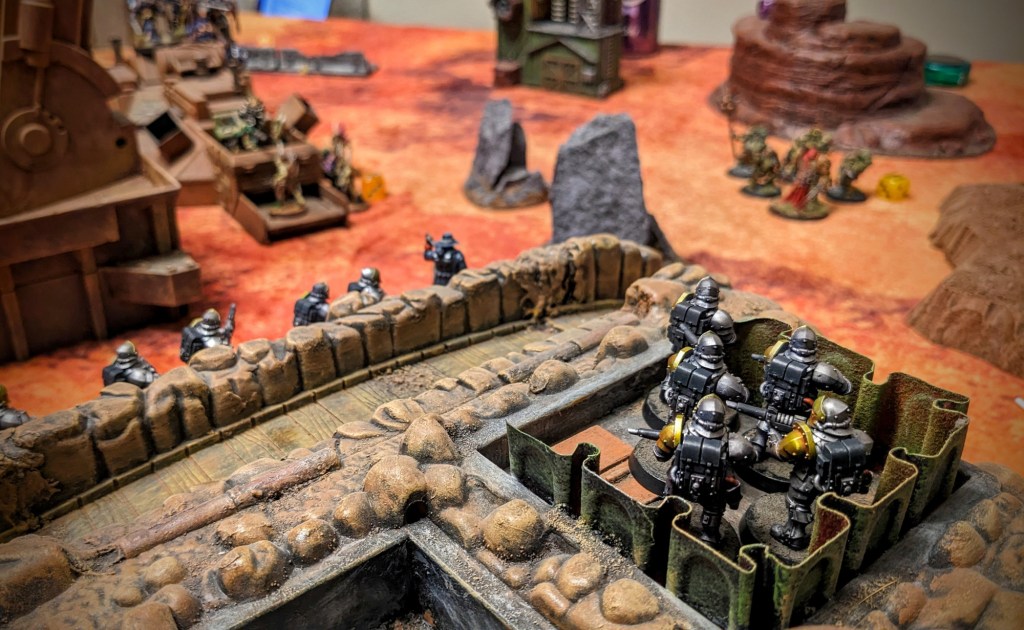
Last month I hosted two sci-fi skirmish games, and despite using two different game systems, we were able to tease out a bit of a narrative through-line to connect them together. Both games were set on Drusichtor, the third moon of Gamma Euphorion Prime in the Juventius Sub-Sector.
Drusichtor is a heavy industrial moon focused on mining and resource extraction. While Gamma Euphorion Prime grapples with a nascent genestealer cult infestation that is rocking the political underpinnings of the fragile ruling class, miners on Drusichtor made a terrifying discovery that suggested just how long the genestealers had been plotting to undermine the planet…
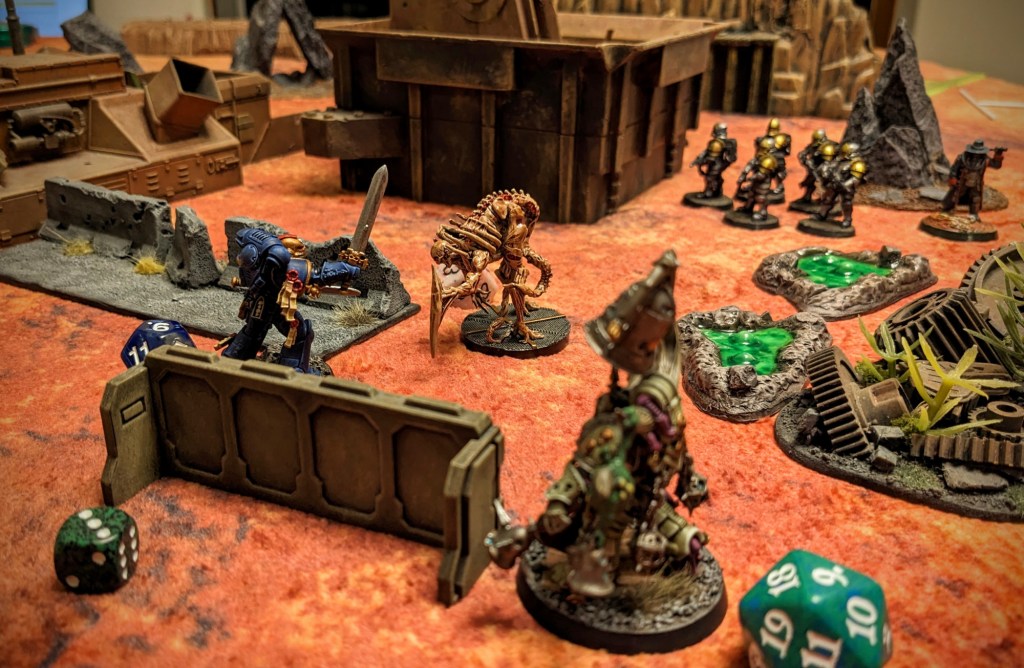
For the first game, we tried out Rogue Hammer, the new grimdark sci-fi ruleset from Nordic Weasel Games. It was a learning game, so we started small and coached each other through the rules. The game was set in the Pits of Volceradon, a vast and crumbling strip-mining operation that sprawls across the surface of Drusichtor. The warbands were competing to reach a hapless miner who had been infected by … something … that he picked up during his forays deep below the moon’s surface. You can see the miner staggering around near some bubbling pools of green toxic waste. Yum!
The game featured an Inquisitorial kill team, alongside a platoon of Ultramarines, racing to secure the miner before the pox-ridden warriors of the Death Guard could spirit him away and conduct a vivisection to figure out what happened to him.
Rogue Hammer was fun, but it definitely felt like a game that needs some additional material before it’s a truly playable Rogue Trader heartbreaker clone. For example: Many of the unit and character upgrades were specifically focused on fighting vehicles, yet you won’t really be using vehicles unless you’re playing a large game of Rogue Hammer. So for the skirmish sized games that we typically play, most of the anti-vehicle upgrades are useless and a waste of points. Meanwhile, factions like Chaos Space Marines – which have arguably been part of the lore since Rogue Trader – were conspicuously absent from the barebones army lists provided in the rulebook. I had to run my Death Guard using the Eldar (excuse me, Space Pirates) list.
In fairness to Nordic Weasel, I believe his intent is to manage Rogue Hammer like a “living rulebook,” with fairly frequent releases and rules tweaks to deliver exactly the sort of content I was missing.
Anyway, our Rogue Hammer game wrapped up with a shocking conclusion, when the poor miner underwent a sudden and violent transformation – the “final form” of his mysterious infection?
The blood-spattered xenomorph creature lurched toward the nearest target, claws akimbo. It was a deadly dance, but Danie’s Primaris Captain was up to the task!
The grisly outcome led directly to game two, which took place a few weeks later. In this game, the action moved to the nearby mining settlement of Ghorston’s Spur, where another specimen had been captured and stashed in one of the hovels. This game featured two teams of factions fighting to locate and secure the specimen – Dark Mechanicus and Chaos Cultists vs. Sisters of Battle and Orks (temporarily pacified, perhaps, to serve as useful cannon fodder for the Adeptus Sororitas? That was what we convinced ourselves, anyway).
For this game, we used Grimdark Future Firefight, an old favorite around here that we return to time and time again.
I had prepped a little scenario with rules for exploring the little ramshackle outbuildings. You weren’t sure exactly what you’d find when you went a-knocking on those doors!
Shooting is fairly potent in Grimdark Future Firefight, and we lamented the unfortunate lack of cover for Lawrence’s Chaos Cultists. They got chewed to pieces by deadly accurate fire from Rian’s newly painted Sister of Battle. Oops!
I didn’t have it much better … my Dark Mechanicus warband, The Seekers of the Fractal Schematic, were uncomfortably close to the menacing Orks at the start of the game.
Jim’s Orks were on top of me by the second turn, which made it pretty hard to explore the outbuildings to find the specimen.
Eventually (through trial and error) we determined which of the squalid dwellings held the specimen, and all of the factions promptly made a beeline for it. Covering fire was laid down by the Sisters of Battle as the Orks rampaged unchecked through the industrial settlement. Rho-Terak, the Enslaver of Logic (leader of my Dark Mechanicus warband) sustained superficial damage to his mostly-metal body during this chaotic scramble.
In game terms, he went out of action, but of course he didn’t die. He’s just … recuperating, back at base. Shouldn’t have been standing there, guy!
The final clash came when Vethidian the Supernumerary, second-in-command of my Dark Mechanicus warband, met the Sisters of Battle Canoness at the front door of the target hut. His sad little withered body was no match for the Canoness’s power sword!
So the Sister of Battle made off with the alien specimen! Doubtless the Imperium’s best xenobiologists will gather important intel from its carcass. The Dark Mechanicum will lick their wounds and regroup for another assault!
Grimdark Future gave a quick and decisive game, as always. There are a number of mechanics in this game that serve to hasten the inevitable conclusion of a skirmish clash. It’s never fun to see your cool models go down, but it’s important to remember that the game’s gotta end at some point.
It was pleasant to write up these two short game reports and stitch them together into a coherent narrative flow. I’m really enjoying the development of Drusichtor as a theater of operations in the larger Gamma Euphorion narrative campaign. There’s plenty here to fight over, and we haven’t even delved into the soot-encrusted Volceradon Furnace Tunnels…stay tuned for more!
Miniatures purists, take note – this post will give you fits. You have been warned!
Late last year, as our group began grumbling and muttering about some sort of grimdark Inq28-style skirmish campaign in 2023, I started putting the wheels on my latest warband. As a longtime Chaos player, I’ve always wanted to build a small collection of miniatures representing an insane, techno-heretical cult of the Machine God. In 40k, these guys would be called Dark Mechanicus.
But I didn’t want to just say “Adeptus Mechanicus, but bad guys.” I also wanted to blend religious zeal and biomechanical horror and see what comes out of that stew. I wanted to aim for a collection of miniatures that looked like the frantic pencil sketches that filled the margins of the old Rogue Trader rulebook.
The results were The Seekers of the Fractal Schematic. I wanted to give them an evocative and mysterious name that hints at some of the narrative territory I’d like to explore in our upcoming game. What is the Fractal Schematic, and why are they seeking it? Let’s find out together, etc. I’d say about half of these models already existed in my collection, and the other half I’ve painted up to match their brethren over the last few weeks.
In true Comrade’s Wargames fashion, there are at least 5 different manufacturers represented in this photo. Shall we name them? Obviously we have the Asphyxious figure from Warmachine’s Cryx faction. He’s a standout grimdark model that perfectly represents my image of what a fallen Mechanicus heretek might look like – swollen with power, bereft of humanity, just a few tattered scraps of flesh held together by a fearsome mechanical frame, eyes burning with vengeance. Of course, he’s got a new name. Now this figure is known as Rho-Terak, the Enslaver of Logic, leader of the Seekers of the Fractal Schematic.
There are two other Cryx models in the mix up there… a biomechanical serpent coiled atop a heap of scrap, and a stooped, withered chap hefting a ramshackle banner made of clinking vials or censers. In my headcanon, he’s the second-in-command, the executive officer, so to speak.
From there, we have two GW models – an old metal Chaos cultist and a metal Necromunda Redemptionist hefting an autorifle over his head. In the foreground we have a hunchbacked mutant from Mega Minis (which is a great source of Rogue Trader-inspired models). The little Roomba from hell is a terrifying monstrosity known as The Flesh Engine, and he’s a kitbash using pieces from Star Frontiers (!) and a head from Pig Iron Productions. The blood-spattered cyborg on the far right is from ThunderChild Miniatures (painted by sculptor Jaycee and gifted to me after I won a contest, what!).
I speedpainted up a few more generic cultist models to bolster the ranks a little bit. Every cult needs some fearless cannon fodder to sell their souls in a blaze of glory, right? Contrast paints did a lot of work here.
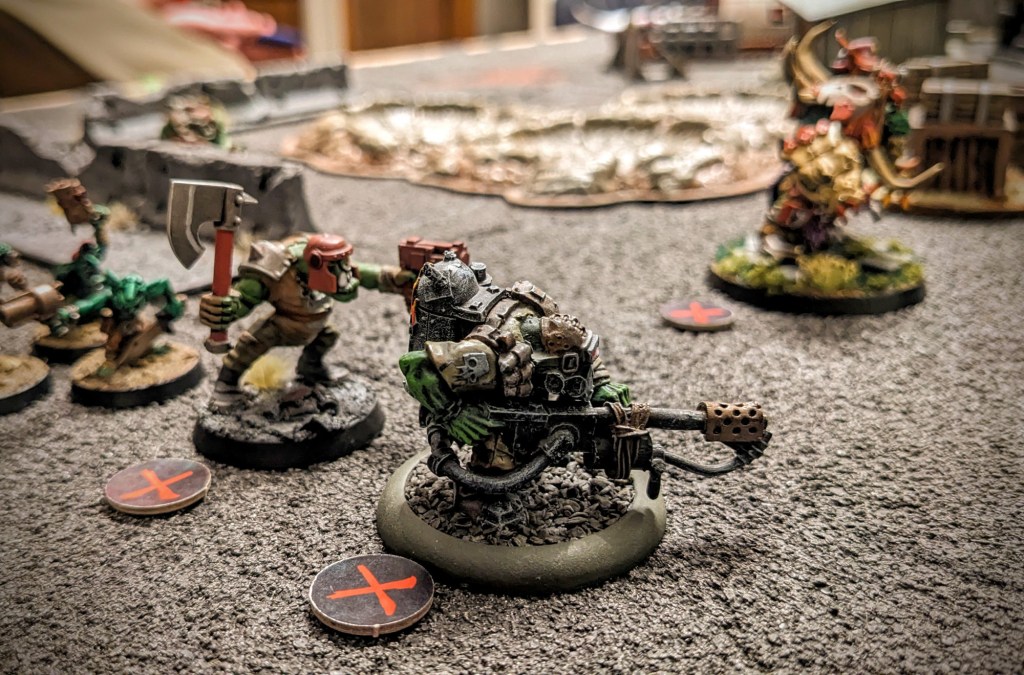
In the image below, the guy on the left with the pistol and axe is converted from a Frostgrave soldier model. (Oops, forgot to paint his base rim.) The guy on the right with the flamethrower is a monopose model from Ramshackle Games.
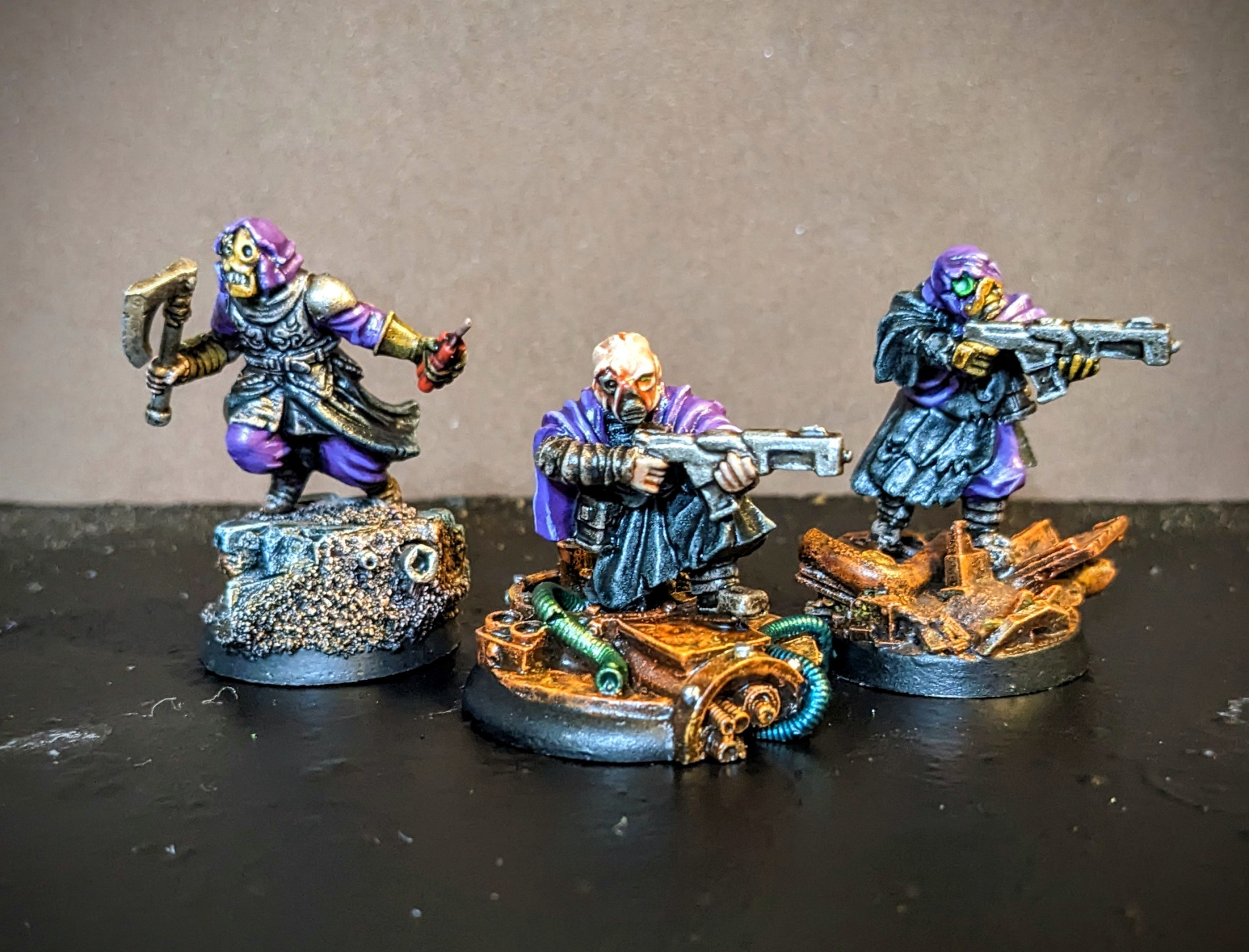
You can never have too many cultists! In the photo below, the guy on the far left with the axe and cluster of dynamite is another conversion from the Frostgrave soldier sprue. That kit is very flexible! All it takes is a couple sci-fi bits to drag a medieval-inspired model into the grim darkness of the 41st millenium.
The other two guys with assault rifles are from Pig Iron Productions, from their excellent Kolony Ferals range. I’ve got dozens of Kolony Ferals in my collection and they are some of my very favorite scrappy scavenger/cultist type models. Lots of gas masks, rebreathers, and creepy machinery poking out of necrotic flesh.
The two bruisers with clubs and shields in the photo below are from the Dark Age miniatures game. This is a super niche skirmish game based on Brom’s creepy fantasy/sci-fi art. Imagine that, a minis game inspired entirely by the work of one artist?! But here we are, and the models themselves a quite nice. These guys are from the Skarrd faction, and they’ve got a scrappy wastelands vibe with lots of twisted metal and weird cybernetics, not to mention assless chaps and exposed buttcheeks, and it all fits really well with my warband.
I absolutely love the challenge of combining miniature from many different manufacturers and sculptors to create a cohesive warband with a shared aesthetic. Nothing tickles me more than picking a figure like ol’ Asphyxious from Warmachine, giving him a new name and dropping him into a warband alongside a half dozen or more other distinct models from different makers. My goal as a painter and hobbyist is to create either a visual look or a narrative hook that ties all these models together and helps tell the stories that are swirling around in my head.
I’ll continue to build on the Seekers of the Fractal Schematic. My goal is to make each model fairly unique, so this won’t be a warband that I can use in games that require multiple squads of dudes, like Warhammer 40k. It will be, however, a great choice for skirmish games focused on individual models and small units. Stay tuned for more!
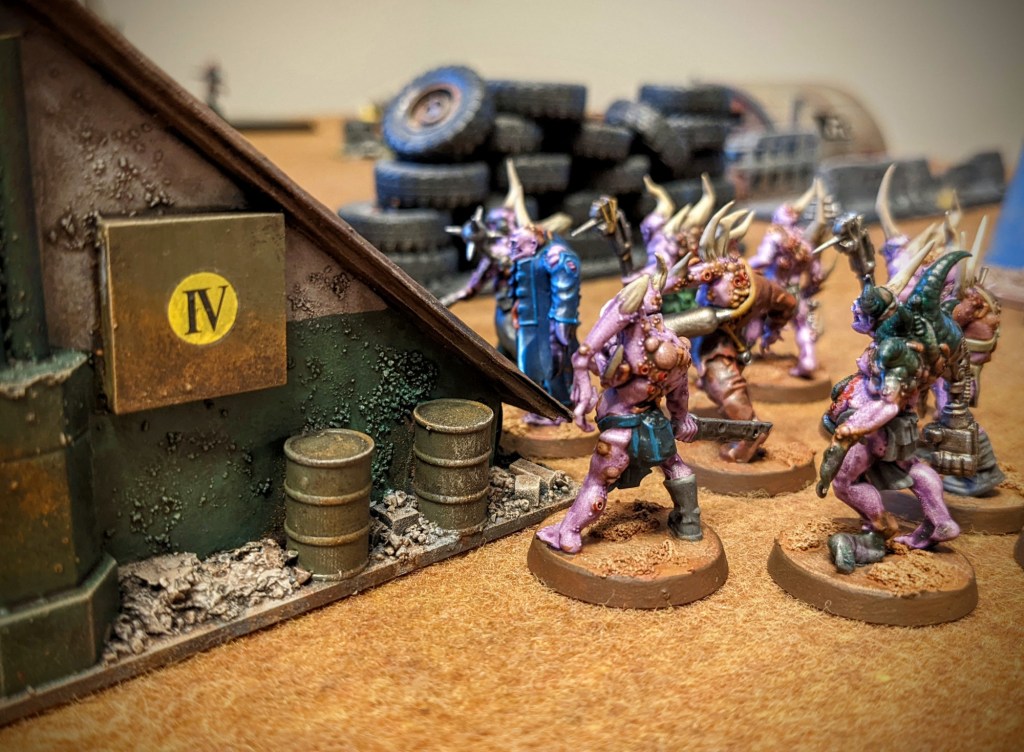
An iridescent drizzle of acid rain hissed off the crumbled machinery at the chem station. Nearby, a small knot of poxwalkers was unfazed by the caustic precipitation; the mindless zombies simply stood sentry and awaited orders, even as their flesh slowly melted away under the relentless rain.
The squad of Plague Marines overseeing the zombies showed more agency, surveilling the perimeter of the chem station and keeping an eye out for interlopers. The Maggot Magnates legion was visiting the shrine world of Pestus Maximus for a specific purpose, and they would not dither any longer than necessary on the accursed planet.
Suddenly, the vox crackled with a whispered warning, and the unmistakable roar of engines drifted in from beyond the perimeter.
John and I got together towards the end of summer for another game of Grimdark Future. John was trying out a list built around a specific expensive, high-powered model (an Imperial assassin) and so we set up a game focused on delivering the assassin to wipe out a high-value target — my Death Guard Lord of Contagion, Brasque Krakmarrow, aka the Grave-Wurm of Endymion-Delta and the Gift-Giver of Vortulai Hive. A truly vile chud if there ever was one!
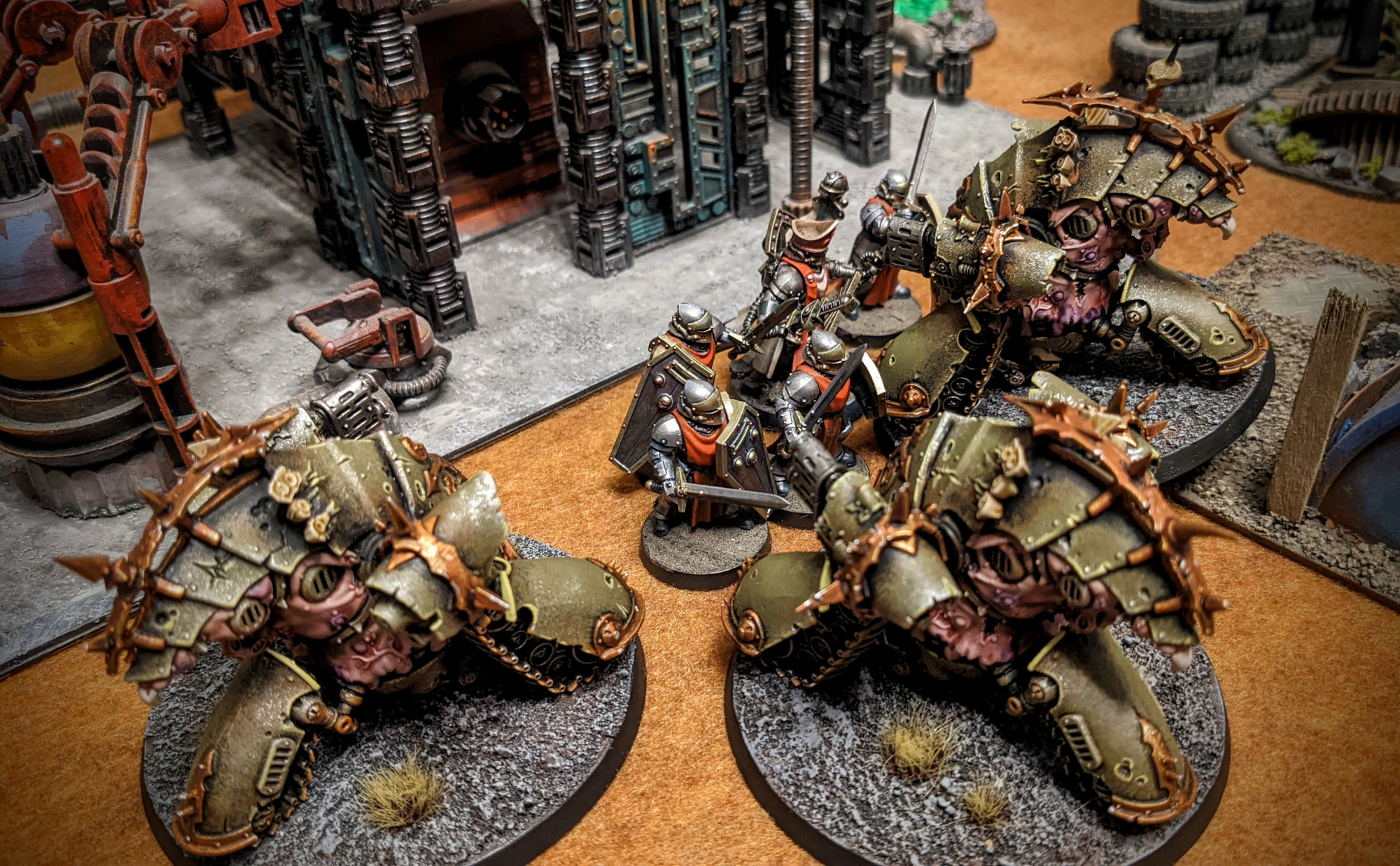
The game began with John’s Taurox transport motoring into the chem station, where it was met with a trio of Myphitic Blight-Haulers and a small mob of poxwalkers. Inside the transport was a well-equipped squad of inquisitorial acolytes led by a very capable inquisitor.
As the Death Guard moved in to engage the Taurox and its scrappy occupants, a smaller group of Imperial agents crept through the rubble near the chem station. The agents included a pair of acolytes escorting a psyker, who was carrying a teleport homing beacon that would be used to deploy “the asset” — the assassin!
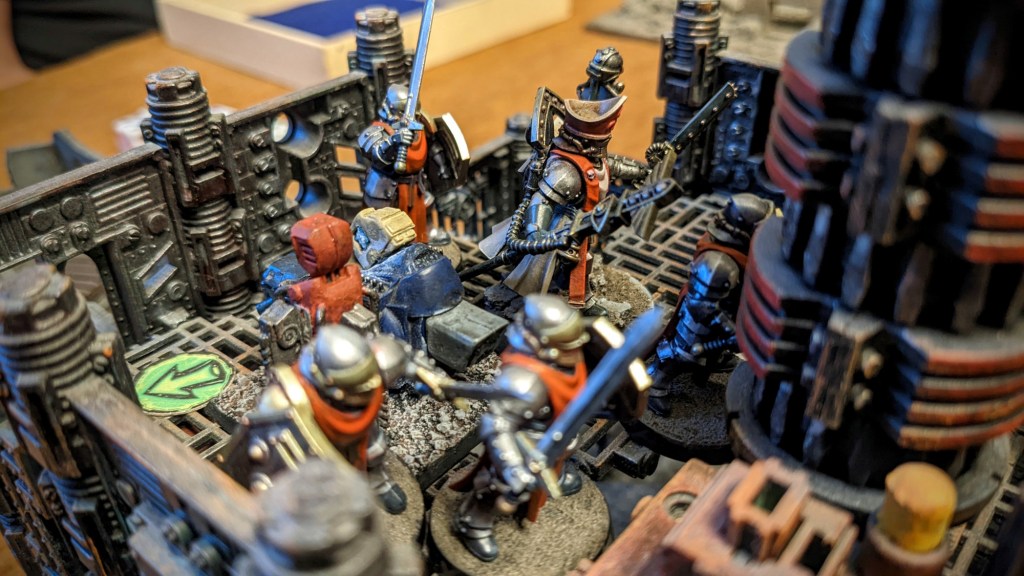
The inquisitor led his acolytes into the comparative safety of the chem station, where they would attempt to hack a data terminal while the Death Guard’s attention was focused by the imminent arrival of the assassin.
When the assassin arrived via the teleport homing beacon (anytime after turn 1, per the Grimdark Future rules) John was immediately presented with an agonizing decision: where to deploy his shiny new toy soldier?!?
Gentle reader, I cannot tell you how much time the two of us collectively spent trying to analyze and strategize the best possible placement of his assassin. Empires rose and fell, seas evaporated into dust, and still John was second guessing about where to put his little man.
Ultimately he plopped him down within easy charge range of my 5-man squad of Plague Marines, which had been camped near an objective for most of the game while they harassed the advancing Imperials with accurate heavy weapon fire.
Across the battlefield, the Death Guard army was doing an admirable job plugging the gaps in their defensive line. The three Myphitic Blight-Haulers motored up to the chem station and began pouring on the fire. This led to a head-smack moment for John as he realized his guys are armed with swords, not guns, and so he sent them clambering down from the chem station’s parapets so they could assault the Myphitic Blight-Haulers.
This proved to be a fairly indecisive battle that dragged on until the end of the game.
The psyker with the homing beacon, his life’s purpose complete now that he had called in the assassin strike, was dragged down and dismembered, along with his escort, by a staggering mob of poxwalkers. He will be remembered in the Tome of Heroes!
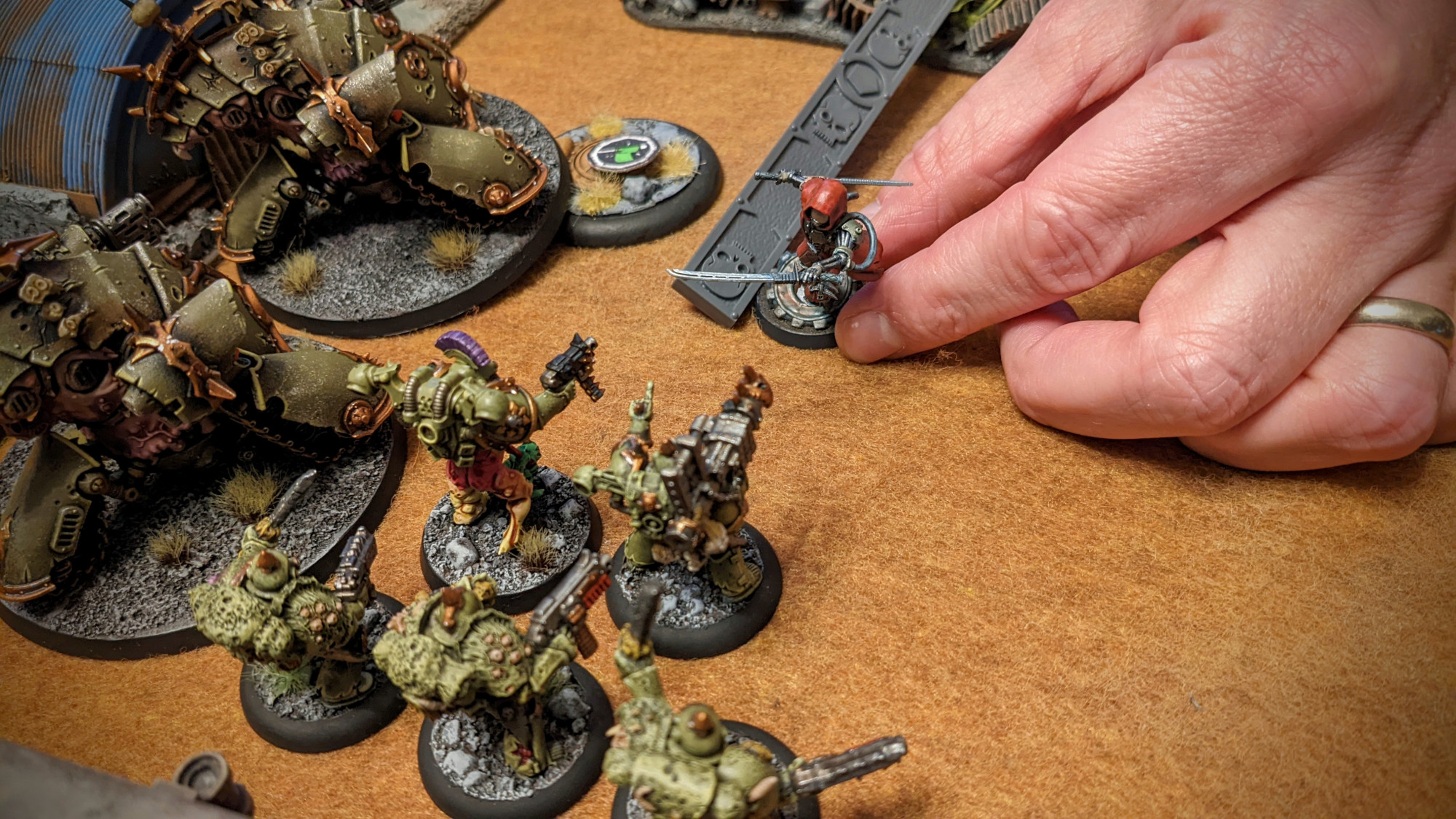
What’s left? Oh yeah, the assassin! Having dealt with the squad of Plague Marines, the red-robed killer pivoted toward his true target: the Lord of Contagion! This set up an epic clash of for the ages.
Lumbering behemoth versus spritely death machine! We traded blows for a turn before, stunningly, the Lord of Contagion hefted his might plague axe and cleaved the assassin in twain, casting side the ruined body and grinding the warrior’s entrails into the dust with his massive steel-shod boots.
It’s not an exaggeration to say that the assassin represented half of the entire points value of John’s army. Without that unit, he didn’t have much left to oppose me, and we agreed that the forces of Chaos had won the day.
And so John’s intensely focused army list had shattered like a glass torpedo on the rusted armor of my Chaos army. The Imperial landing party slunk off to lick its wounds. With any luck, they’ll be able to piece the assassin back together from the gore-slicked pieces that were recovered from the battlefield on Pestus Maximus. Stay tuned for more!
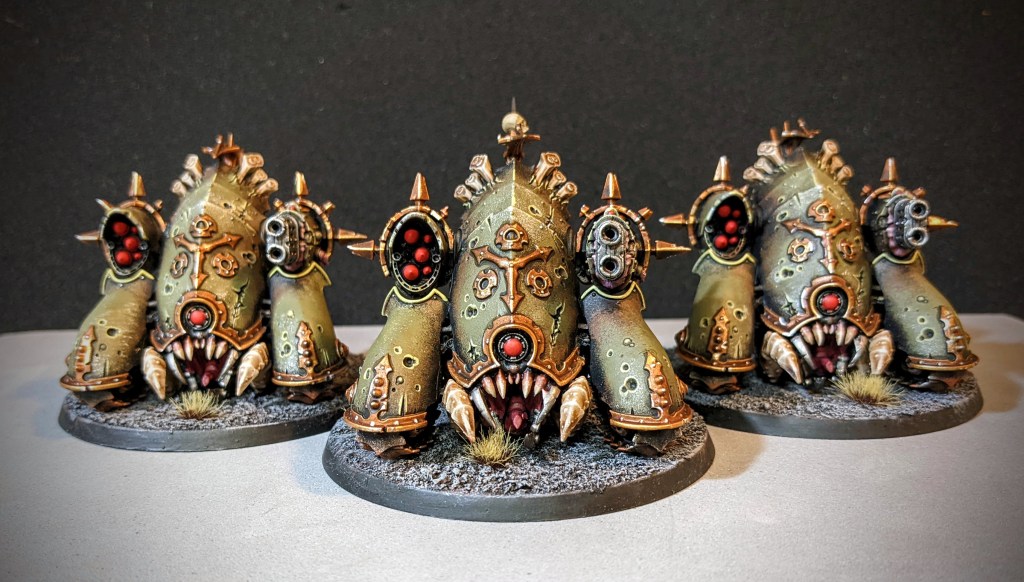
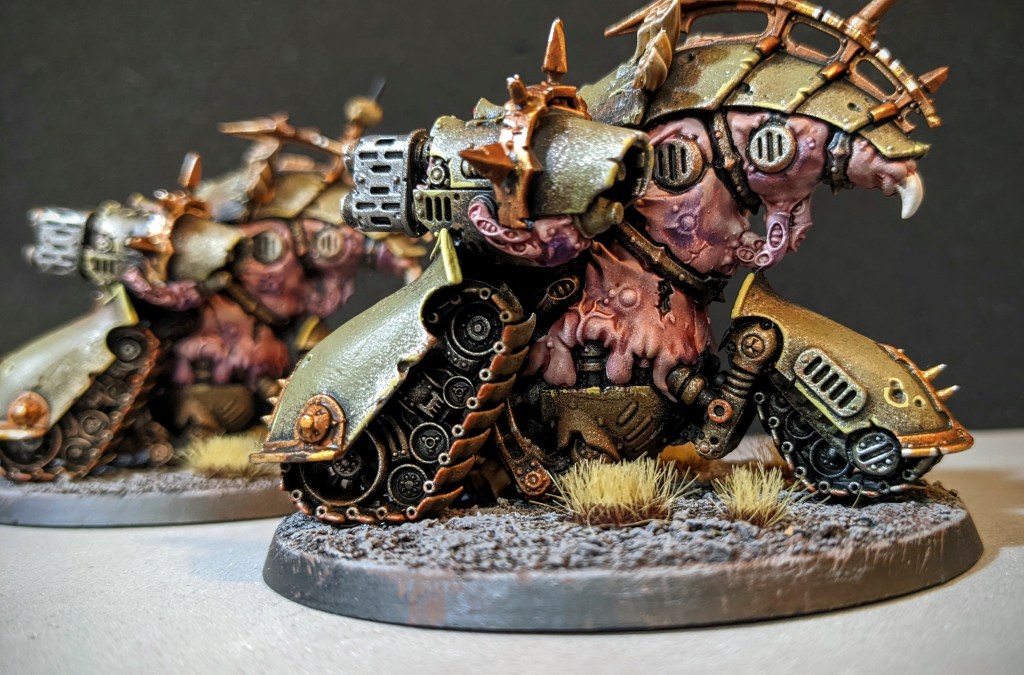
I recently completed painting my first “complete” 40k unit in quite some time – years, probably. These three Myphitic Blight Haulers will be reinforcements for my large Death Guard army, the Maggot Magnates.
They’re cute and fearsome models that epitomize the current Death Guard model lineup. I’ve always admired them, and so when I found a good price on a trio of these models (they can be fielded in a group of three, known as a “tri-lobe”) I knew the time for reinforcements had arrived.
I decided to try out a speedpainting technique on these models – specifically, this nifty tutorial that uses a simple sponge painting technique to quickly knock out the main armor colors.
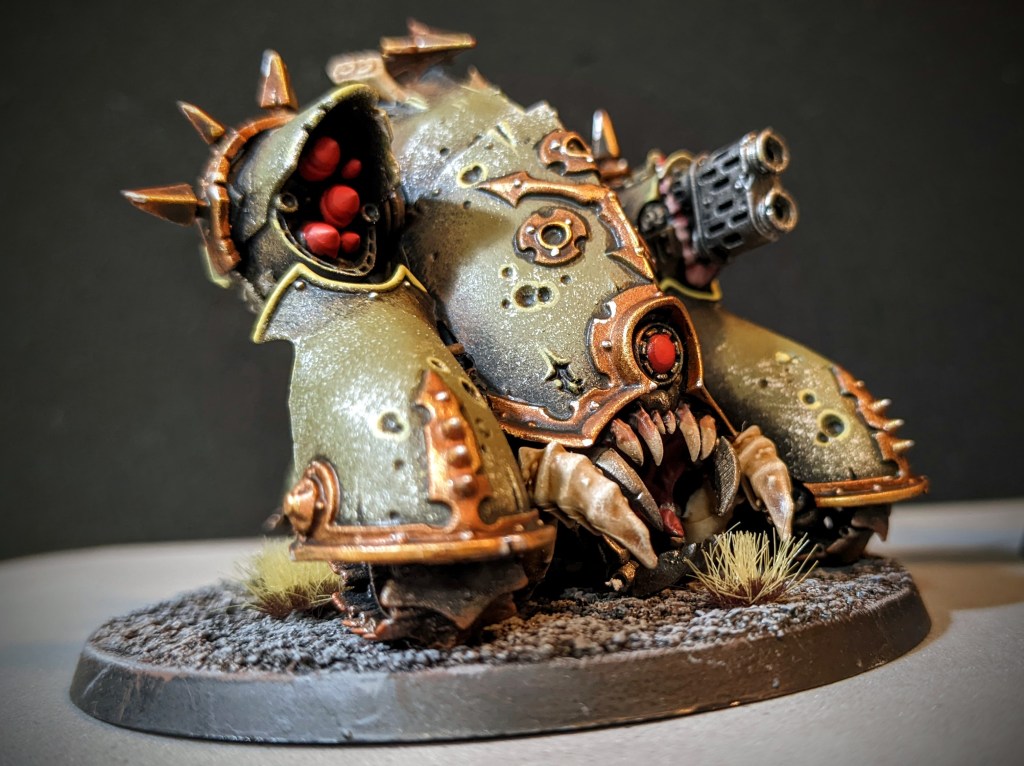
The technique starts with a black basecoat, followed by a rough sponging on of a basic brown color – I used a couple shades for some variety. The sponging continued with rusty orange, followed by olive drab green and various metallics to create a rough, textured armor appearance that is perfect for these Nurgle-blessed murder tricycles.
This was a speedpaint, so I tackled the swollen, oozing fleshy bits with a mixture of washes and drybrushing. I’d probably spend more time if these were display quality pieces, but faster technique gave decent results in relatively short order. A key mantra for Comrade’s Wargames is “more toys on the table” and I tried to keep that in mind when working on these models.
The final highlights were kept to a minimum … just the most high-impact details were picked out, the stuff that would catch your eye from 3 feet away on the tabletop.
All in all, I was impressed at the overall effect that this quick sponge painting tutorial provided. It was certainly fast! Once I got the armor done, I probably spent the equivalent of a few evenings adding in the final details and highlights. I also hauled them to work with me and painted a bit on my lunch breaks over the course of a week or two. Much of the time was spent waiting for the various washes to dry!
Definitely give this technique a try if you’ve got some small vehicle-sized models that could benefit from a rusty, dirty painting technique. Don’t be like me, though, and forget to paint the rims on your bases! I know what I’m doing tonight after dinner!















 Comrade's Wargames