Pull up a chair, dear reader, for a personal story from our local game group.
You may have read about our friend Paul, one of the founding members of our local game club (The Majestic Gamers). I met Paul shortly after moving to town about 7 years ago.
At that time, he was just starting out in 40k, and we got together for some games. Paul shared that he experienced periodic tremors in his hands, ranging from barely noticeable to more debilitating. In spite of this, he persevered with his newfound hobby and painted up three gorgeous 40k armies that have made regular appearances on Comrade’s Wargames over the years, as well as countless skirmish warbands for Warcry, Shadespire, and other games. Truly, it was an inspiring example of someone overcoming a physical impairment to achieve spectacular skill in a creative hobby.
Paul’s magnum opus is probably his Tyranids army, which featured heavily into our 40k narrative campaigns. Here’s a couple photos from our gigantic Apocalypse game back in 2018.
Last year, Paul let us know that his tremors had become more pronounced, and the doctors had diagnosed a more advanced condition. He begrudgingly acknowledged that his painting days were likely over.
Around this time, the new Leviathan boxed set came out, and the rest of us in the Majestic Gamers had a brilliant idea – we would acquire the box set, divvy up the Tyranid models, and paint them up to fit in with Paul’s existing Tyranid army! His army would get a huge boost and we’d all get a chance to splash some paint on those cool new bugs. Daniel handled the purchase and distribution of the Leviathan box – thank you, Daniel!! Splitting up the painting amongst 5 people meant we all got a manageable numbers of models to paint up.
Here, then, are the fruits of our labors, which were delivered to Paul earlier this month. HUGE thanks to Rian, John, Parker, and Lawrence for lending their artistic skill and expertise to this project, and to Daniel for purchasing the box and handling logistics.
(Tip: If you click on the first photo, you’ll launch a fullscreen gallery where you can flip through each photo in sequence.)
Keep in mind, that’s five different people offering their own personal interpretation of Paul’s paint scheme. I think we did pretty good, all things considered! Shout-out to John for printing up those crystal pieces that we all used on the bases – that really pulled everything together in a cohesive manner.
But Wait, There’s More!
The story doesn’t end here! When we presented Paul with his newly painted Tyranid reinforcements in August, he shared with us some wonderful and heartening news: he is planning to have a procedure done that will help control his symptoms and hopefully get back some quality of life.
Yes, we immediately cracked jokes about Paul becoming a literal cyborg. Ah, the miracles of modern medicine. The procedure is planned for next month (September). So don’t throw away those paintbrushes, Paul – this hobby isn’t done with you yet!
Last weekend John and I got together to try out Hobgoblin, the forthcoming miniatures wargame from Mike Hutchinson (creator of Gaslands). Hobgoblin aims to be a mass battle fantasy wargame that combines old school rank & flank maneuvering together with a handful of speedy, modern game concepts. The overall goal is a game that lets you use all of your cool fantasy miniatures, arranged in big blocks of troops reminiscent of classic Warhammer, but streamlined to the point where you can play a game to conclusion in a couple of hours.
It’s a tall order, for sure! “Rank & flank” is not at all synonymous with “fast playing,” in my humble opinion. So I was intrigued to see what Mike had in mind as I cracked open the early access PDF. Hobgoblin had a successful Kickstarter earlier this year to produce a nice hardcover version of the rules, and the early access rules have been distributed and updated for backers (such as me) to play around with until the final release comes along.
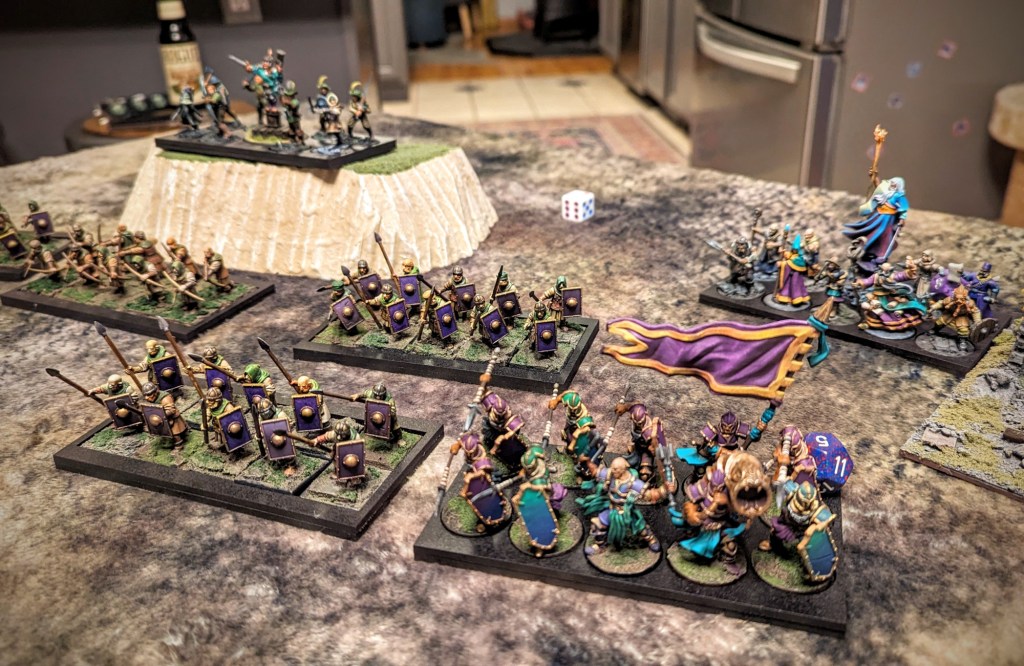
John’s House Begovic infantry marches to war!
From the outset, Hobgoblin has a lot of the signposts that appeal strongly to me as a non-commercial, primarily indie wargamer. Among them:
Use any miniatures you want.
No specialized army lists – both players build armies using the same list of common units, plus a couple dozen special keywords for flavor.
Your cool toy soldiers always get to fight back, even when they’re in the process of being wiped out.
Only complete units are removed as casualties, no individual model removal.
Only the overall size of the unit matters – the individual figures don’t matter, so you can go nuts creating unit fillers, mixing & matching figures from your collection, etc. A block of “heavy infantry” could be 10 spearmen in chainmail, or 3 steam golems, or 1 young dragon perched on a rocky outcropping on a scenic base.
Along those same lines, the overall sizes of the units are flexible enough to accommodate most bases and movement trays. A typical infantry unit, for example, can be 100mm – 200mm for its frontage, and anywhere from 40mm to 160mm deep. Anything that fits within that spectrum works.
Although there’s not a lot of lore present in the early access rules, it’s clear that there is a ton of lore lurking in the shadows, waiting to be foisted upon us whenever the complete rulebook is published. The tidbits that are present – a vast, subterranean world of endless caverns, bizarre ecosystems filling the sightless depths, bone-grinding magic that feels utterly alien – are absolutely delicious, and definitely leave you wanting more.
For our game, we decided to try a small game at 3,000 points per player. At that threshold, we were both able to bring 8 units. I pulled out my vintage all-metal Skaven army that I built a few years ago. (Well, almost all metal…I acknowledge that the plastic kits for the Doomwheel and Warp Lightning Cannon are fantastic and much easier to work with.)
John brought his ever-growing troop of sad sack humans led by a despised field commander and a cowardly wizard. (Yes, cowardly and despised are both keywords that you can select for your units. These are both negative keywords, so they actually give you more points back for your army when you select them!)
Rank upon rank of beautifully painted miniatures … tabletop wargaming at its finest!
We rolled randomly to determine our scenario and overall terrain setup using the fun battle generator available online. We ended up with some ruins, a couple hills, and two large impassable towers in the center of the table. These two towers would serve to channel our forces into the central killing field. This definitely accelerated the carnage but also prompted some mind-numbing unit movement as we edged our gigantic rectangles of troops around these impassable obstructions.
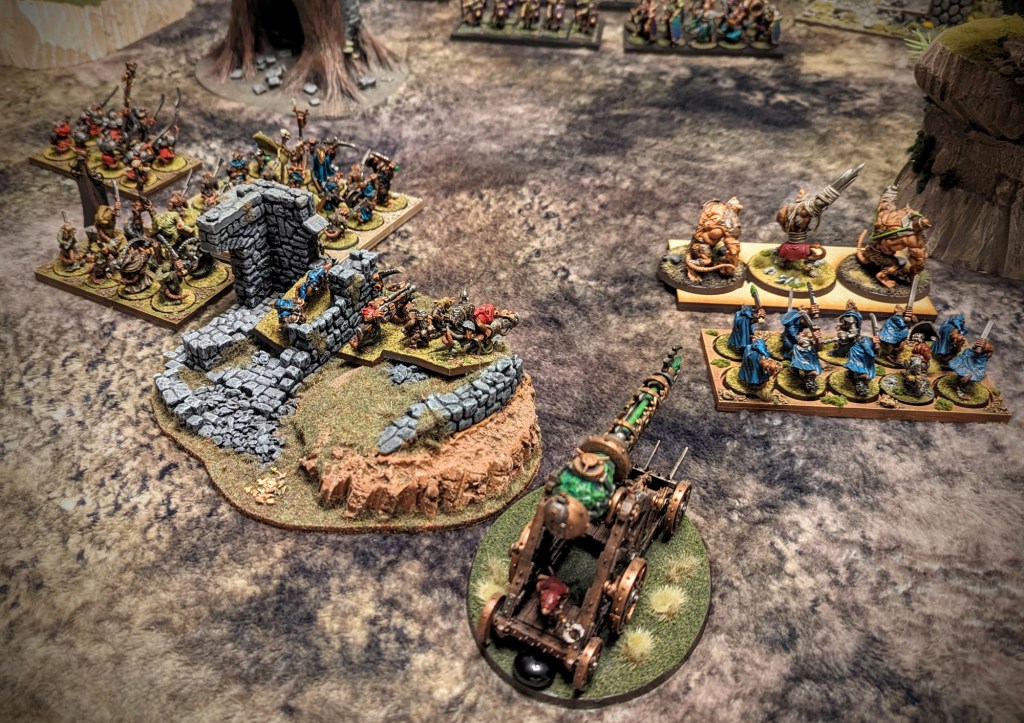
An early clash led to some mismatched expectations: the heavy cavalry successfully charged the Doomwheel, but the Doomwheel hit back and wiped out the horsemen!
Hobgoblin uses a modified IGOUGO turn sequence, where players alternate casting spells, shooting, and then moving their units. In general, both players are active and engaged throughout the turn; you’re never more than a few minutes away from having a decision to make for one of your units.
Magic spells cost mercury, which is a resource that gets replenished at the start of each turn. You can hoard it between turns to save up for big spells, and you can also use a mercury token to re-roll a single combat dice. Spells always happen – there’s no rolling to see if it’s successfully cast. If you can pay the cost in mercury, your spell is going to kick off. It’s a fun, old-school effect that has the effect of keeping a sense of inevitability about magic for much of the game. Spells happen. Deal with it.
Fortune cards provide each player with a small number of one-off effects and save-your-ass resources that come in handy throughout the game. A typical fortune card might heal a unit, or grant a bonus in your next combat, or let you reposition a unit prior to fighting. You start with 4 Fortune cards and receive 1 additional each turn.
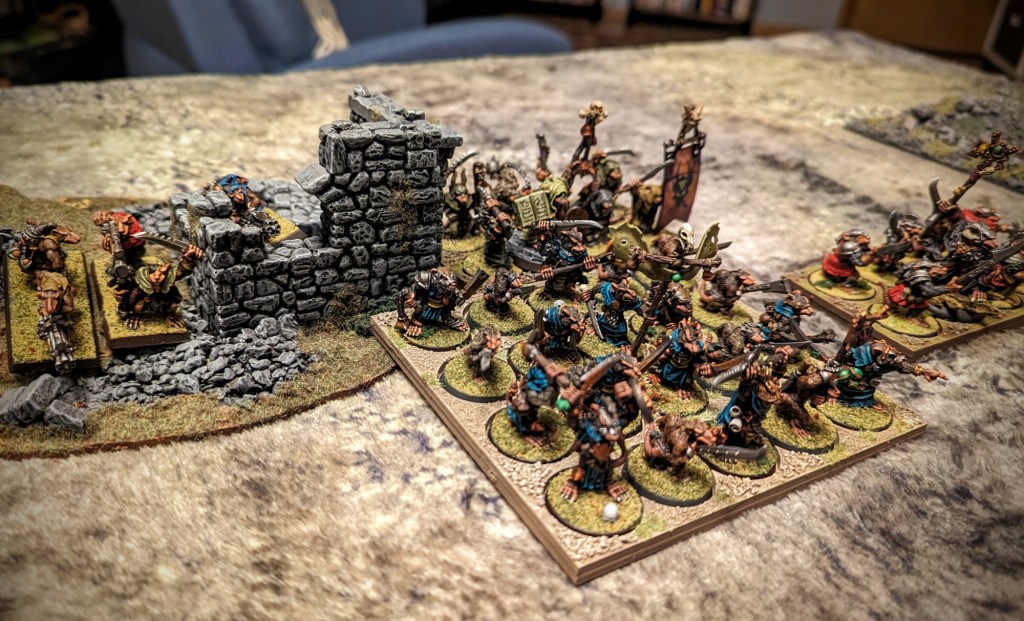
Ratmen shooters wielding clunky, hand-cranked weapons of doom!
Shooting is intentionally de-emphasized in Hobgoblin. Part of it is due to the lore – this game takes place in a sprawling underground grotto lit only by torches, watchfires, glowing runes, luminescent fungi, and other eldritch sources of illumination. In an environment like that, a unit of archers just isn’t going to make a big impact. From a mechanical standpoint, shooting can only ever inflict 50% casualties (measured in doom tokens) on a given unit. Shooting is very much designed to be a harassing mechanic that is employed from the flanks as the armies march toward each other for the massive, inevitable clash in the center.
And clash we did! There’s no innate benefit for charging into combat, so if you want to fight an opposing unit, it’s not essential that you be the first one to initiate the engagement.
My horde-sized block of light infantry attracted a lot of attention during the game. The large size made it difficult for me to maneuver additional units for support!
My horde-sized unit of light infantry was the single largest unit on the battlefield from a footprint standpoint, so it attracted a lot of attention as the game developed. As my Skaven horde began to get enveloped by enemy units, we encountered perhaps the most divisive aspect of Hobgoblin – the fussy wheeling and shuffling and repositioning that forms the heart of the rank & flank movement system.
Another look at the horde of light infantry. They’re being engaged by two of John’s units: a squad of heavy infantry (with the banner) and a squad of light infantry.
If you like rank & flank movement and lament its absence from many modern wargames, then you will appreciate when Hobgoblin is trying to recreate. For my part, I learned that I don’t miss rank & flank movement. LOL! I never played classic Warhammer and so I don’t have an innate affection for large squares of troops wheeling around the battlefield.
I particularly dislike the uber-awkward model placement that results from shuffling giant movement trays full of models in half-inch increments. I’m talking about trays of models perched on terrain with giant gaps underneath, or unit trays hanging off the edge of a sheer cliff because that’s how far you were able to move this turn, dammit! I very much subscribe to the “moving diorama” philosophy of wargaming, so aesthetics are important to me throughout a game. Hobgoblin lets this pendulum swing a bit too far in the direction of “gameplay over aesthetics” for my tastes. That’s really my one gripe about Hobgoblin.
Another example of engagement. The red-clad heavy infantry unit of ratmen is touching the opposing light infantry unit with just one corner, but that counts as engaged. No squaring up in Hobgoblin!
The combat resolution is extraordinarily satisfying – most units roll 10 dice and consult a chart to see their target number. Hits result in doom tokens, which accumulate throughout the turn but are only resolved at the end of the turn, after all units have had a chance to move and fight. Units that receive too much doom are defeated and remove from the battlefield – and their demise results in *more* doom for friendly units that witnessed the gruesome spectacle! Cascading doom situations really help push the game toward its inevitable, and gnarly, conclusion.
Fortune cards and mercury tokens provide a small measure of unpredictability – in our game, my giant Skaven horde had accumulated a whopping 26 doom tokens, more than enough to destroy it in the Doom Phase, but I had a Fortune card that allowed me to ignore the doom tokens for one crucial turn. As it turned out, this was enough to let the Skaven hold down the bulk of John’s units long enough to win the game.
John and I definitely miscalculated some of the rules interactions as we embarked on our inaugural game. And we learned a lot about the intended function of various units in the army lists. At the conclusion of our game, we both discussed ways we could have adjusted or fine-tuned our army lists to better reflect the sort of army that we wanted to bring to the battle.
All in all, Hobgoblin is a super solid addition to the pantheon of mass battle fantasy games. I’m not crazy about the rank & flank movement, for reasons that I’ve articulated a few paragraphs earlier. Frankly I’d love to see a skirmish sized game using the Hobgoblin game engine – limited list of units, doom tokens, fortune cards, all of it – and just eliminate the rank & flank stuff.
We’ll be playing this one again soon, so stay tuned for more!
Earlier this month we played out the latest installment in The Cauldron, our 40k narrative campaign. This session took place on Ardent Maxima, a hive city located on the other side of planet Gamma Euphorion Prime.
By contrast, Ardent Maxima is the epicenter of a vast textile operation. Stadium-sized looms spin gargantuan bolts of fabric for use in Imperial Guard uniforms or embroidered draperies or even sailcloth for maritime vessels. Seam-serfs, with help from stitcher-servitors, churn out untold millions of finished products each year. Most of the inhabitants of Ardent Maxima work to support these textile operations in one way or another, overseen by the benevolent enforcers of the Adeptus Sororitas.
Rebel activity from heretical cults recently hit a fever pitch in Ardent Maxima when the monument to St. Veridegora Deneia was blown up by insurrectionists. Even before the dust settled, the enemies of the Imperium were already making their moves to further despoil the site of the once-proud statuary. The Sisters of Battle summoned urgent assistance from a nearby expeditionary regiment of Imperial Guard, newly arrived from the Glouroth Sub-Sector.
This game pitted Daniel’s Genestealer Cult and Jim’s Orks against Rian’s Sisters of Battle alongside a combined Imperial Guard detachment commanded by me and John. It was a classic xeno-vs-Imperium matchup, amid the ruins of the blown up monument!
The forces of the Imperium mustered their soldiers and armor at the perimeter of the plaza where the statue to St. Deneia and stood until recently. Two walkers and a main battle tank anchored their line, along with the rarefied warriors of the Sisters of Battle.
You can see the blasted sandstone chunks of what had once been the statue to St. Veridegora Deneia in the background. Who would dare desecrate such a holy bastion?
Oh. These guys would.
And probably these guys, too.
With a guttural howl, the combined forces of the Orks and Genestealer Cults surged forward, eager to reach the Imperial lines and deliver vengeance upon the miserable curs of the Corpse-Emperor.
Thankfully, the Emperor protects and reloads.
The Imperial battle line let loose with a cracking volley of fire, ripping apart several of the xeno transport vehicles and spilling their inhabitants. Undeterred, the bad guys cinched up their belts and began the long slog to the three objectives scattered around the table.
In the photo above, you can see the first completed tile from Daniel’s Realm of Battle board. He acquired a full set (enough for a 6×4 table) from Mindtaker Miniatures earlier this summer. He brought his one completed tile to this game, and it fit in beautifully alongside the rest of our hive city terrain!
The big ol’ tank in that photo is from Pig Iron Productions. It is a gigantic chunk of solid resin that has been in my collection for many years. This tank featured heavily into some my early games with the Chicago Skirmish Wargames club, such as this one: Operation Scrub Down! Nice to get it back onto the table 12 years later.
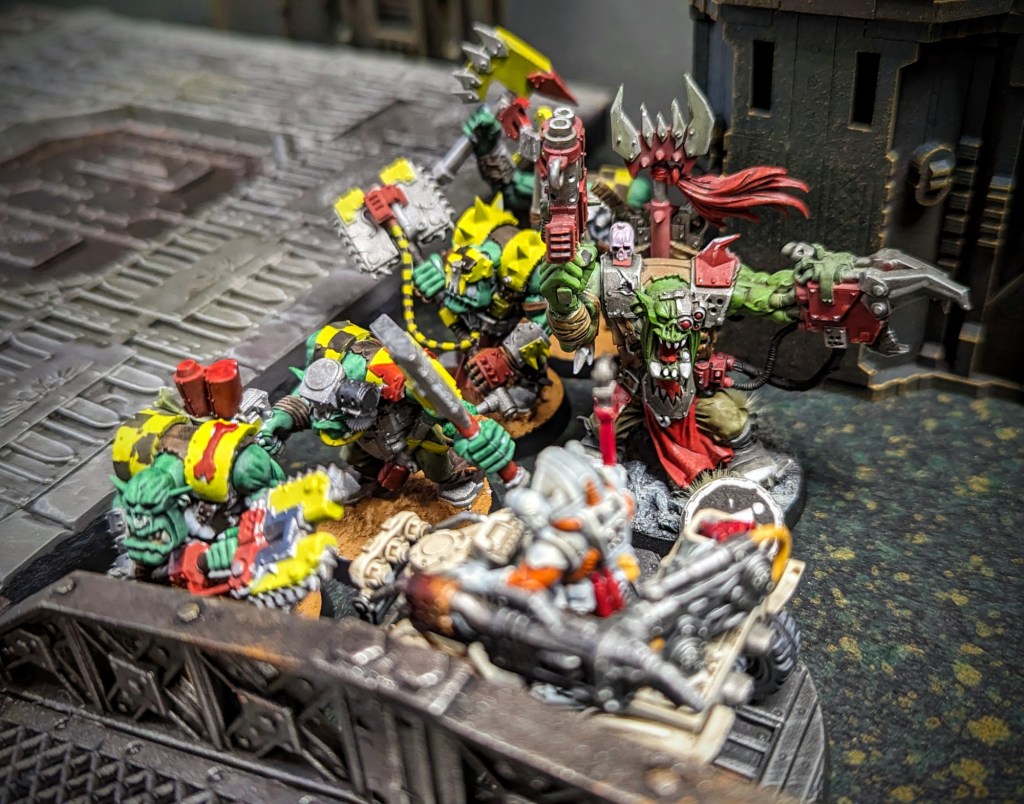
But anyway, back to the game. Big things were happening. A xeno transport truck motored up the flank and deposited a squad of greenskins right on top of one of the objectives.
As you can imagine, this transgression would not stand, man, and the Sisters of Battle were in a position to do something about it. Rian’s newly painted Penitent Engine stomped right into the fray and began hewing swathes of orks in twain with its massive buzz saws.
The stained glass windows on this MDF terrain looks absolutely fantastic! It was a fitting backdrop for this utter devastation that was visited upon the orks.
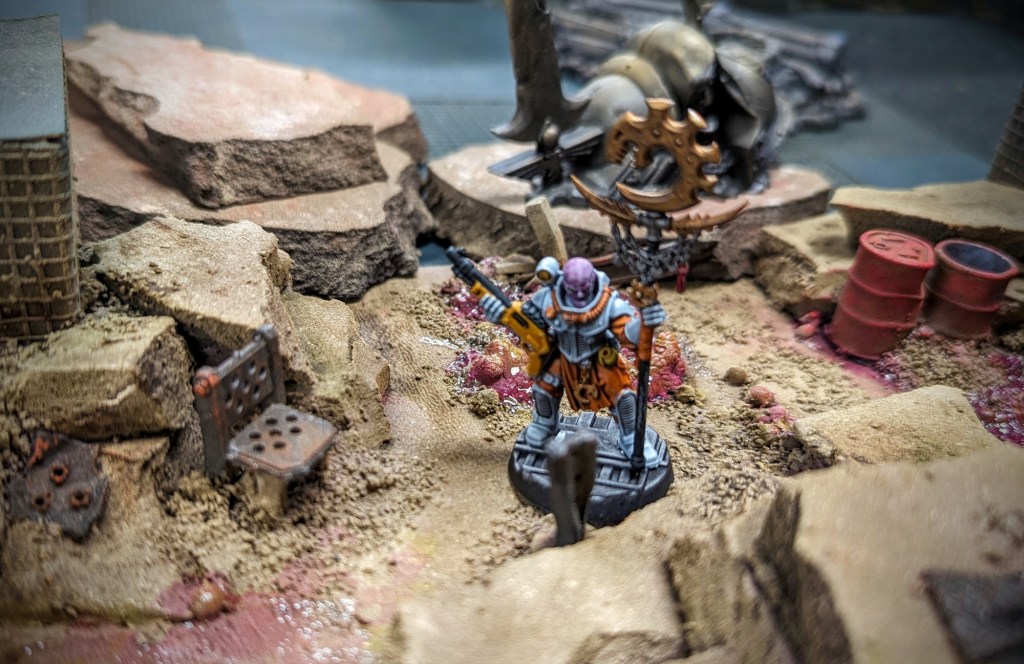
With the destruction of the ork mob on the flank, the xenos’ advance was seriously threatened. All eyes turned to the rubble-strewn plaza where a Genestealer leader had brazenly planted a flag amid the ruins of St. Deneia’s monument. What a shocking, ghastly display of debauchery!
At the time, it seemed like the appropriate response was for John to drive an APC up and open fire on the squirrely cultist with its autocannon. I think St. Deneia would agree, don’t you?
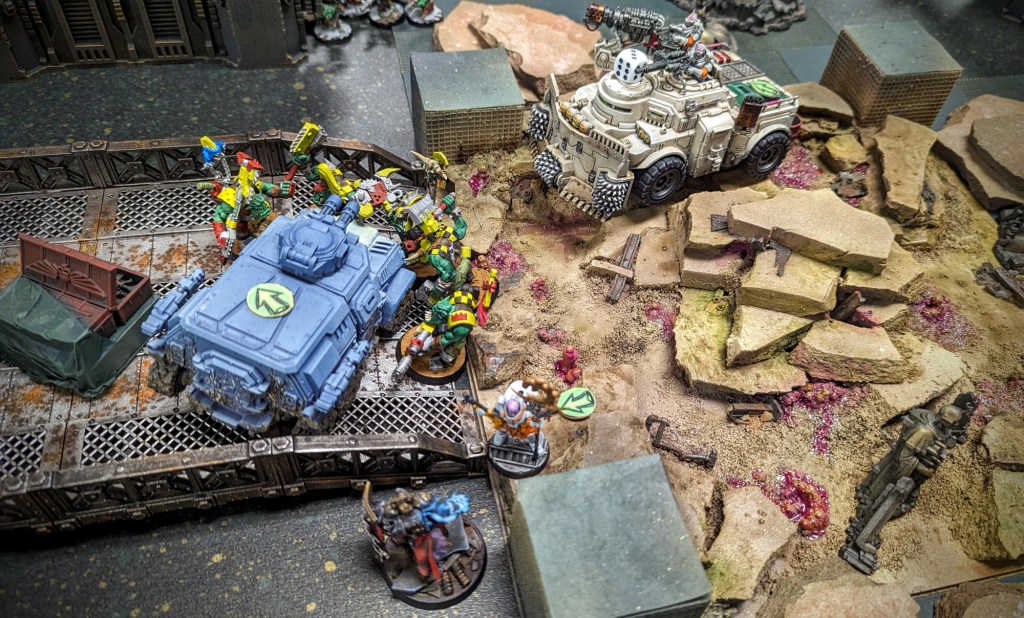
While the plaza was getting chewed to pieces by high caliber rounds, a different sort of confrontation was taking place near the Technobridge in the center of the table. A small kill team led by Inquisitor Ash was closing in on an elite ork warband led by Jim’s mighty warboss! If they could dislodge the warboss and defeat the quad-wheeler camped out on the objective, they could secure a vital area of the battlefield.
At this point, the tide of the battle turned. Warp lighting arced across the battlefield as the forces of Chaos arrived, no doubt drawn by the carnage and slaughter of the ongoing battle!
In game terms, the xeno team had a third player (Lawrence) who had brought two mighty demons to the game, and both arrived via the ambush special rule (similar to Deep Strike in 40k). So the initial cakewalk that the Imperial Guard experience was just an illusion! The bloodthirsty demons swooped in and began carving up the rear lines. Check out these photos of their arrival.
Doom had come to the plaza of St. Deneia!
The arrival of the two gigantic (and beautifully painted) demons caused a cold sweat to break out on the collective brows of the defenders of the Imperium. How could they carry on in the face of such abject evil? Trusting in their faith in the Emperor, the heroes mustered their courage and stuck to the game plan.
The plaza had become a killing field, as Orks and cultists swarmed in for the final clash. On the perimeter, heavy weapon teams and the remaining walkers poured fire into the advancing mobs of bad guys – even as the demons rampaged in the backfield. Would it be enough?
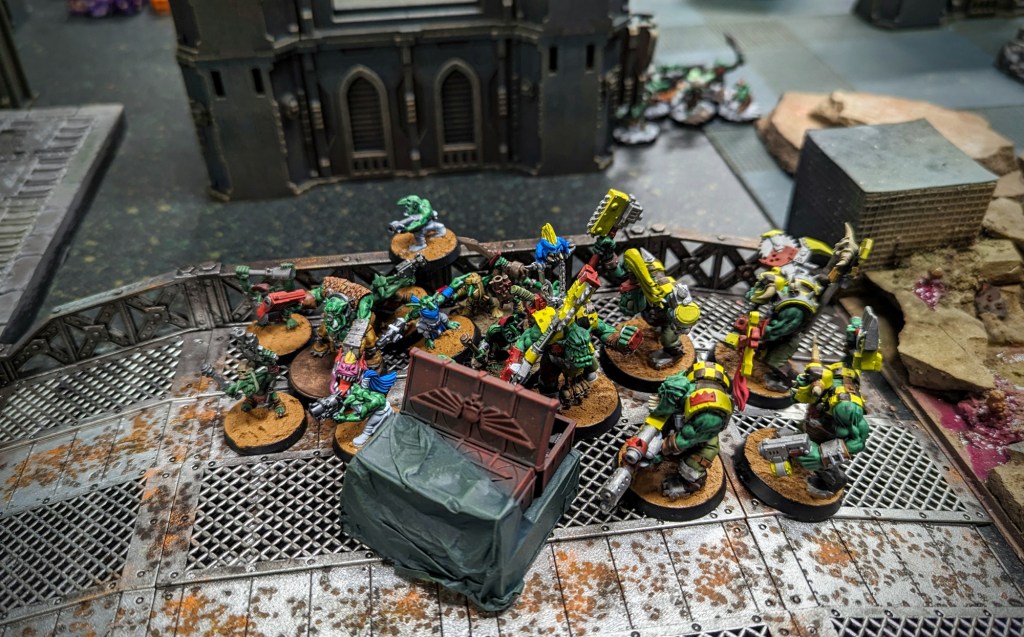
Eventually the orks consolidated their hold on the central objective. It seemed clear that the game would be decided here. Based on the photo below, it sure looks like the Orks have this one in the bag.
However, zoom out a bit and you can see what was awaiting them as we entered the final turn of the game. Legions of steely-eyed Guardsmen, backed up by tanks and walkers, ready to pour on the fire and do their duty to the Emperor!
The two demons, for all their might, didn’t have enough offensive power to thwart the Imperial Guard’s game plan. The defenders of the Imperium succeeded in purging the filth from the plaza of St. Deneia, notching one important victory in the battle for Ardent Maxima.
This was a large and tremendously satisfying game of Grimdark Future. We had 3,000 points per side, divided up amongst the players on the two teams. This game marked the first outing for several newly painted miniatures, as well as a triumphant return for some, ah, legacy models from my collection.
Here’s another milestone for me – last month, I officially took part in a curated art gallery at my local community center! This was a gallery for folks who are affiliated with the center; I teach miniatures painting classes there, so I was eligible to participate.
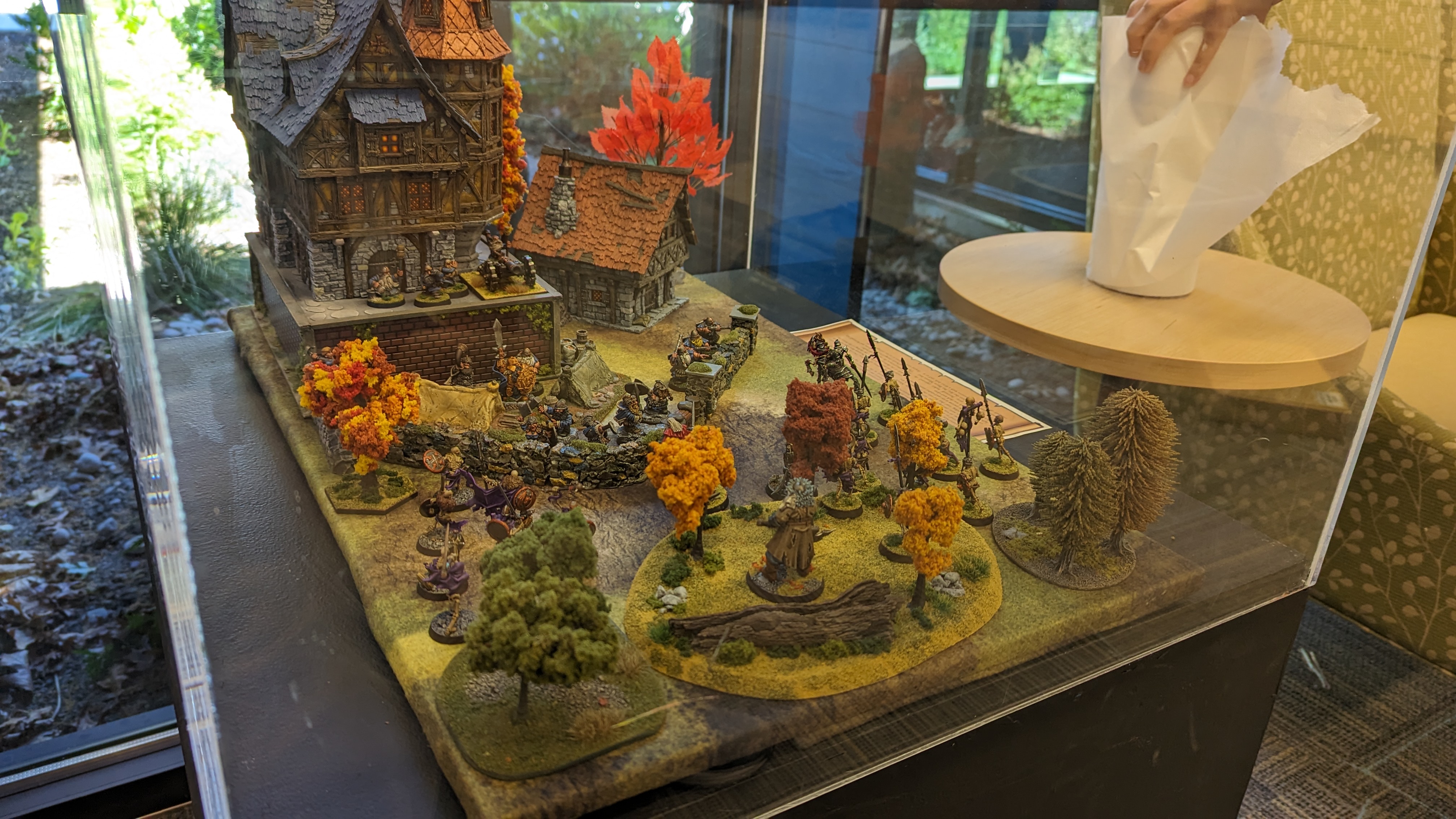
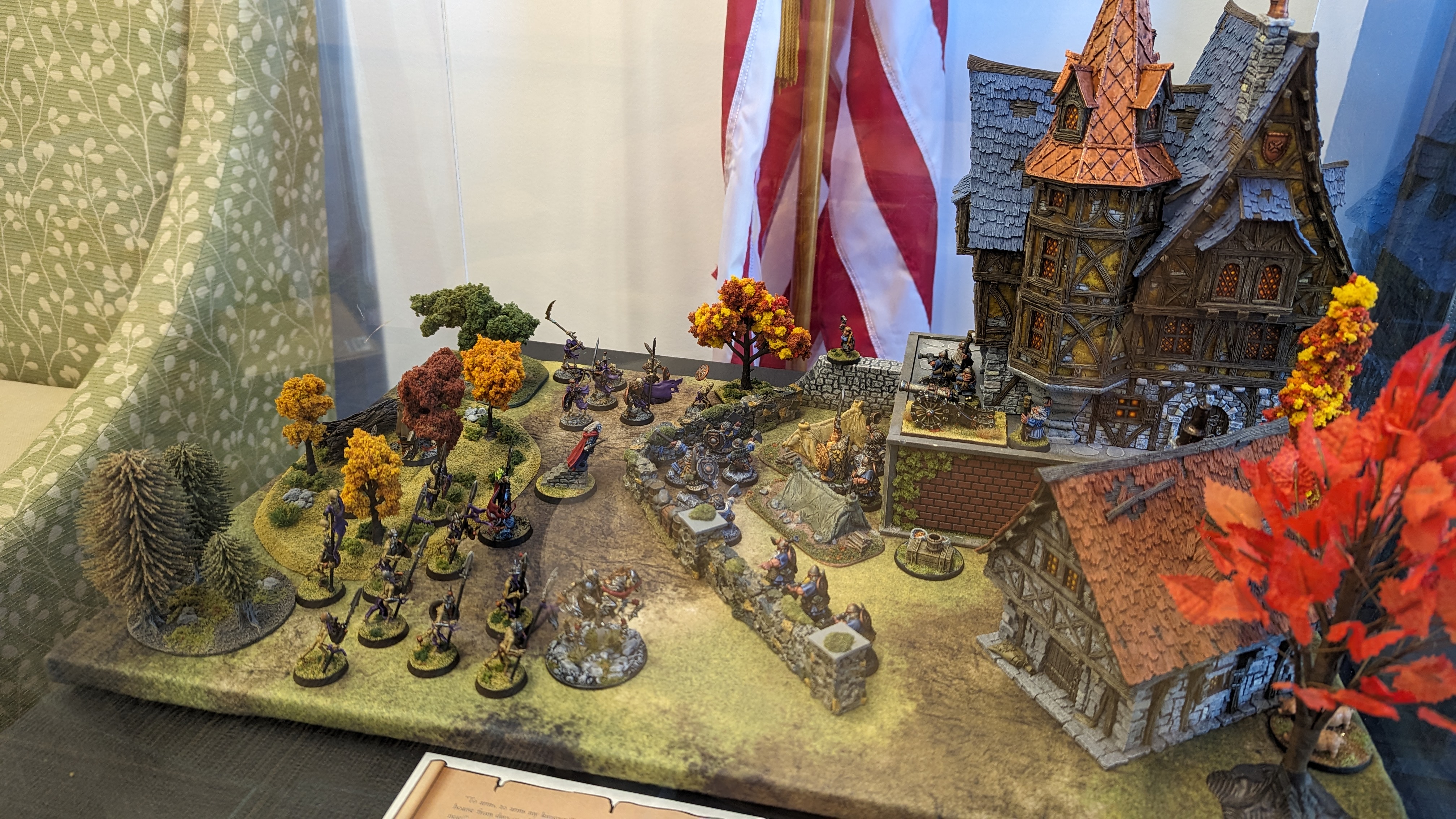
I entered a diorama showcasing a band of dwarven warriors mounting a hasty defense on the perimeter of a small settlement. An undead vanguard was emerging from a nearby forest, so the stage was set for an epic battle! A couple of my beautiful resin village buildings from Tabletop World made an appearance. I wrote a few paragraphs of free-form narrative lore to help put viewers “in situ” in the diorama.
It was a plumb location, right in the main lobby near the public entrance! All models and terrain was built and painted by me. Astute readers will notice some familiar faces in the setup!
The most challenging part of this installation was finding a suitable pedestal with a protective plexiglass cover on top! I called around to a number of local art nonprofits, community theater, library, etc. before finally striking gold at my local historical society! They had a large, well built plinth in storage, and they were happy to lend it to me for the duration of this exhibit.
Anyway, I’m properly chuffed at the somewhat silly idea of finally taking my place among the pantheon of “real artists.” Of course, I know that there are no gatekeepers on what constitutes art, and that anyone with a lick of creativity can claim that mantle. Still, it’s fun and rewarding to display my stuff in public (for 2 months, wow!) and help people expand their notions of what exactly “art” is.
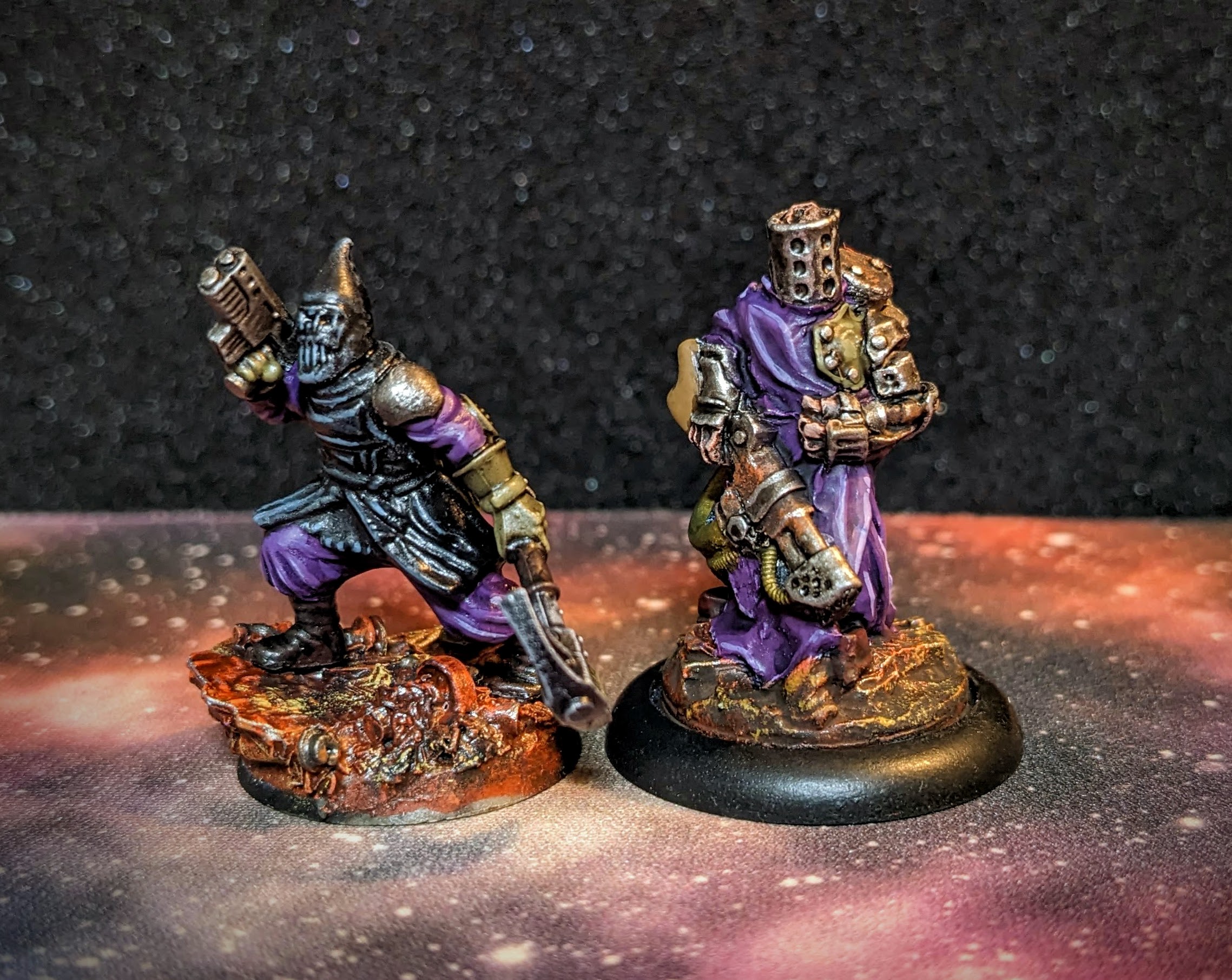
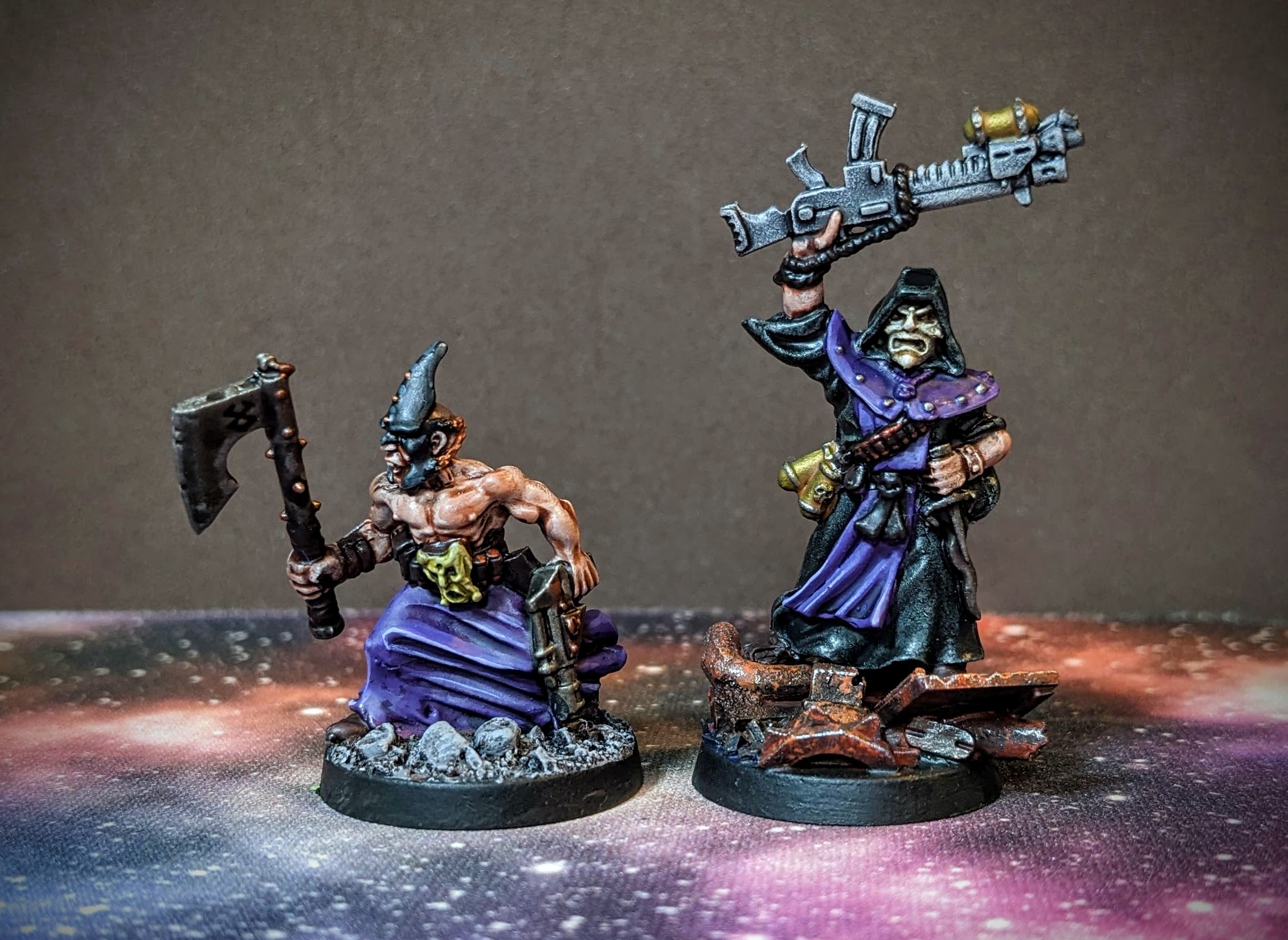
The warband (The Seekers of the Fractal Schematic) is a hodgepodge of models from many different manufacturers, all tied together by a loose theme and a simple & consistent paint scheme. For me, the warband fits the Inq28 / Blanchitsu creative aesthetic.
I’ve really enjoyed converting and painting up the basic cultist models that form the backbone of this warband. These figures come from a variety of sources — a few are from Necromunda, a few from other sources, but most are built from the various plastic Frostgrave infantry kits that were released a few years ago. They’re a fantastic starting point for all manner of sci-fi and fantasy soldier conversions.
The guys in the photo below, for example, started with Frostgrave torsos, plus various arms from Genestealer Cults and Adeptus Mechanicus kits, along with gas mask heads from Pig Iron Productions.
The vibe I’m going for includes flamethrowers, creepy cybernetics popping out of flesh, cult iconography, scavenged equipment, and rusted industrial wreckage for the bases. You know, typical Dark Mechanicum stuff.
Simple conversions, quick paint jobs using contrast paints and a bold purple color … that gets the job done.
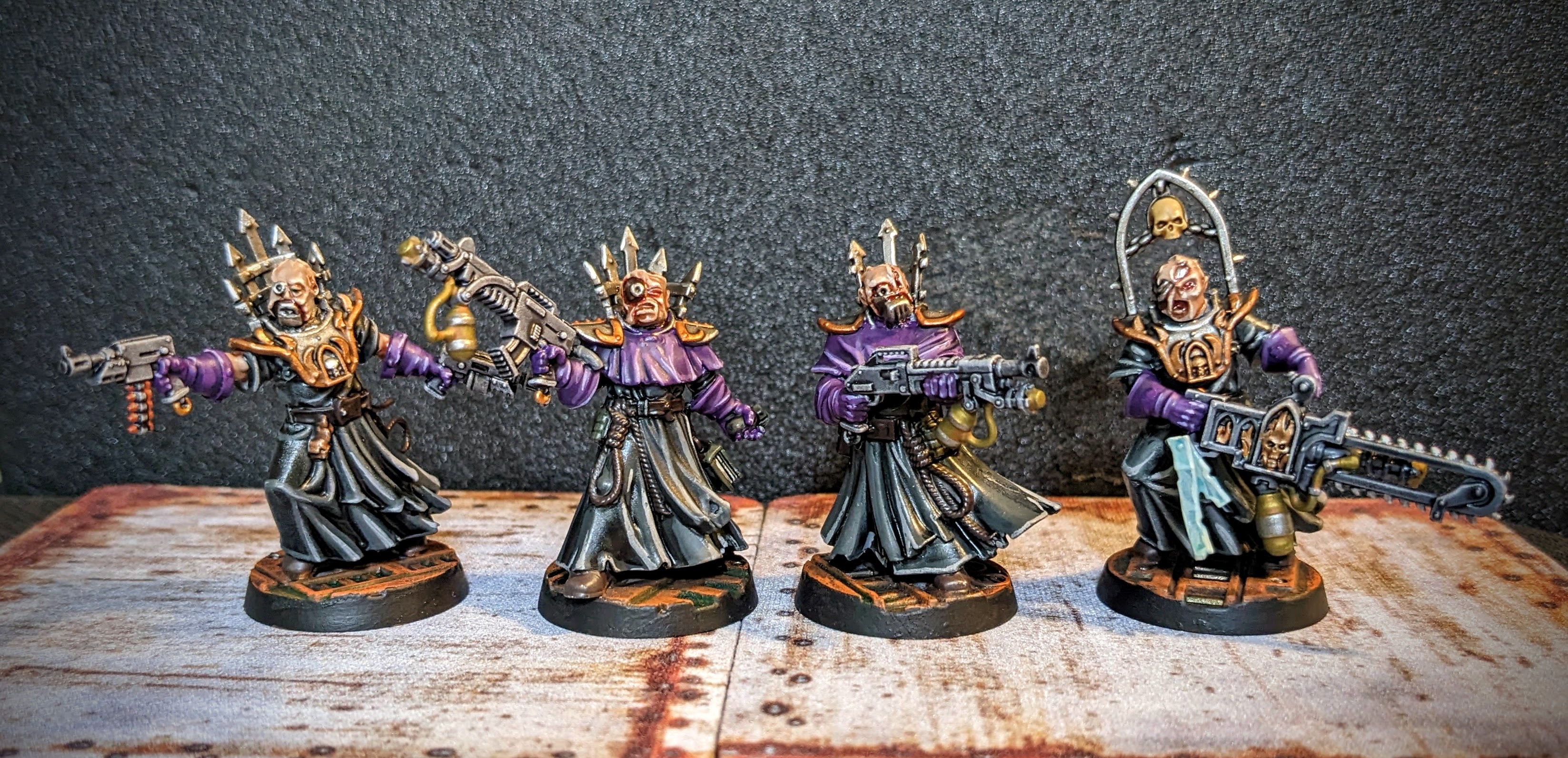
I don’t mind mixing in Games Workshop models when they suit my theme. The four guys below are from Necromunda, with some heads swaps to make them fit the “tortured cyborg zealot” motif.
I’ve got plenty more bits — I accidentally dropped a bunch of money at Mindtaker’s bulk bits bin during a visit last month. Oops! So look for plenty more heretics, scavengers, cultists, and cyborgs in the future.















 Comrade's Wargames